
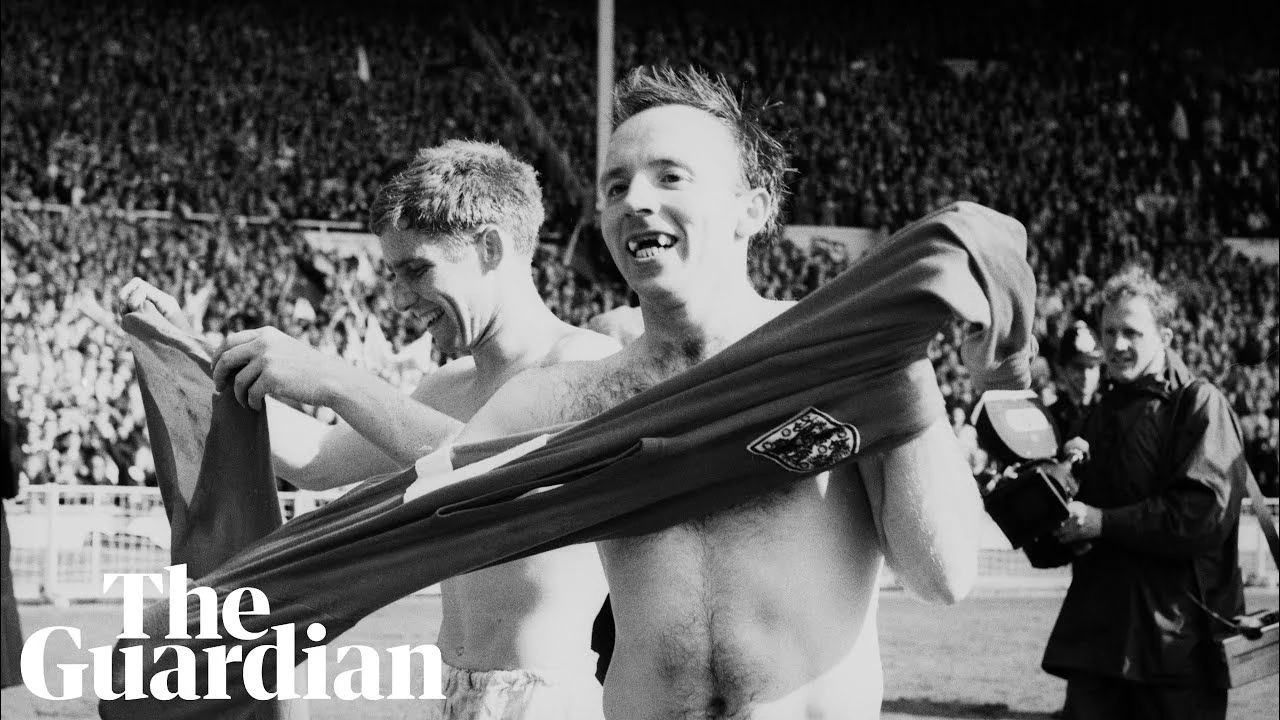
Nobby Stiles was not the most conspicuous footballer in England’s 1966 World Cup side. His task was to win the ball, protect the defence and give more attacking teammates room to play. He did it throughout the tournament, including in the semi-final against Portugal, where he marked Eusébio, and in the final, which England won 4–2 after extra time. At the final whistle, Stiles danced on the Wembley pitch with the Jules Rimet Trophy in one hand and his false teeth in the other. That unlikely image became one of the enduring memories of the victory.
Stiles’s career was larger than that celebrated moment. He spent eleven years at Manchester United, helped the club win two league titles and the European Cup, and later worked as a coach, including with United’s youth team. His playing was built on ball-winning and simple distribution: work that often enabled others to take the more visible parts.
Collyhurst and a route into Manchester United
Norbert Peter Stiles was born on 18 May 1942 in Collyhurst, a working-class district of north Manchester. His father, Charlie, managed an undertakers’ parlour in a family business; his mother, Kitty, worked as a machinist to supplement the household income. Stiles attended St Patrick’s Catholic Primary School and grew up supporting Manchester United.
His football drew attention early. At 15, he played for England Schoolboys, and in September 1959 United took him on as an apprentice. The club gave him the chance to pursue a childhood ambition, but his physical appearance did not fit the conventional image of a footballer. He was short, severely short-sighted and missing several teeth; he wore contact lenses on the pitch and dentures off it.
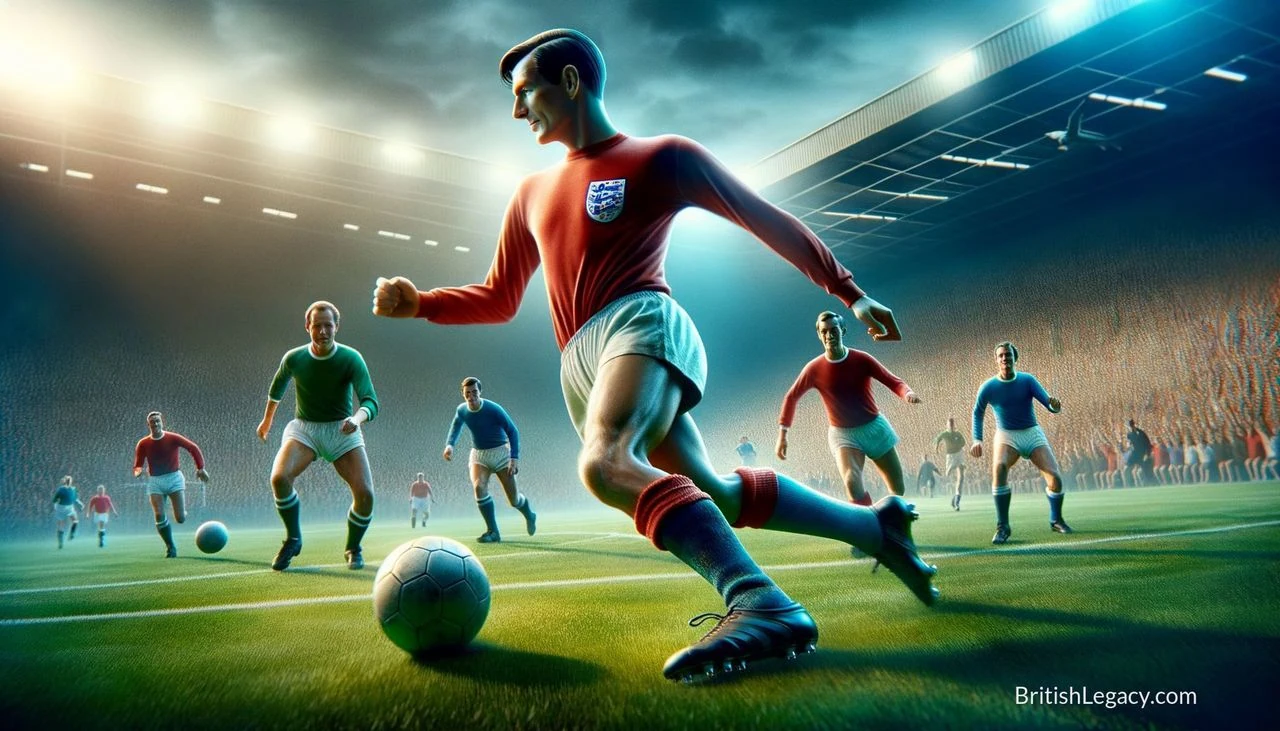
Manager Matt Busby gave Stiles his first-team debut in October 1960, against Bolton Wanderers, initially at full-back. His strength lay in winning possession and playing the ball simply. United converted him into a holding midfielder, a role that was still unusual in a period when teams commonly fielded five forwards. By recovering the ball and passing it on, he helped teammates such as Bobby Charlton—and later George Best—find space to influence the game.
Stiles was not an automatic choice from the outset. He was left out of United’s 1963 FA Cup final team, which beat Leicester City 3–1. He became a more regular presence in the seasons that followed and won his first league title in 1965. In 1967 he collected a second. The following year United won the European Cup, beating Benfica 4–1 at Wembley. Stiles played well against the Portuguese side, although he could not keep Eusébio entirely quiet: late in the match, the forward broke through and shot straight at goalkeeper Alex Stepney.
The work behind England’s 1966 triumph
England manager Alf Ramsey was assembling a midfield for a World Cup on home soil. He needed a player who could disrupt the opposition and recover the ball, and tested Stiles in that role against Scotland in April 1965. Stiles retained his place in most of the following internationals. In February 1966, he scored the only goal in a Wembley friendly against West Germany.
At the tournament, Stiles played every minute of England’s campaign. England began with a goalless draw against Uruguay, then beat Mexico and France to progress from the group. Stiles worked in front of the defence, helping create time and room for players such as Charlton. England’s quarter-final against Argentina was a bruising encounter. In the match against France, Stiles’s late tackle seriously injured midfielder Jacques Simon, and some in the media and the Football Association called for him to be dropped. Ramsey defended him, saying the tackle had been mistimed rather than malicious.
The semi-final against Portugal brought Stiles’s defensive assignment into sharp focus. He was tasked with marking Eusébio, one of the tournament’s most prolific scorers. His close attention limited the forward’s influence, although Eusébio scored a late penalty in England’s 2–1 win. Ramsey praised Stiles’s individual performance in the dressing room afterwards—a rare accolade from the manager.
In the final against West Germany, Stiles had no equivalent man-marking brief, but again supplied hard work and defensive strength in midfield. England’s 2–1 lead was levelled with the last kick of normal time; Geoff Hurst then scored twice in extra time to complete his hat-trick and secure a 4–2 win. Stiles’s dance with the trophy and his dentures was broadcast widely. Decades later, the image was recalled in the lyrics of “Three Lions”, the England football song written for Euro 96 by Frank Skinner, David Baddiel and the Lightning Seeds.
Stiles continued with England after the World Cup, but his place was not guaranteed. He was dropped after England lost to Scotland in 1967, and at the 1968 European Championship Tottenham Hotspur’s Alan Mullery had taken the holding role. Stiles returned for the third-place play-off, then played only three more times for England. He was selected for the 1970 World Cup in Mexico as Mullery’s understudy, but did not play. He finished his international career with 28 caps and one goal.
United honours, then management and coaching
Stiles made 395 appearances for Manchester United in all competitions, scoring 19 goals. In 1971 the club sold him to Middlesbrough for £20,000. He played for the club for two seasons, then joined Preston North End in 1973 as a player-coach under Bobby Charlton. His playing career continued into the 1974–75 season, after which he moved into management.
His first managerial spell at Preston was brief. In August 1975 he became caretaker manager after Charlton resigned in protest at the transfer of defender John Bird, then resigned a week later in support of his former United teammate. Stiles returned as Preston’s manager in 1977 and remained until 1981, when he was dismissed after the club’s relegation. He went on to coach the Vancouver Whitecaps for three years. In September 1985 he took charge of West Bromwich Albion, but was dismissed the following February after the team managed only three wins under him. He later spoke about struggling with depression during that period and with the commute from Manchester to the Midlands.
Between 1989 and 1993, Stiles coached Manchester United’s youth team. Among the players who developed there were David Beckham, Ryan Giggs, Paul Scholes, Nicky Butt and Gary and Phil Neville. It was a different kind of contribution from his work as a player: less visible than a World Cup performance, but part of the club’s development of young talent.
Honours, family and later years
Stiles won the First Division title with United in 1964–65 and 1966–67, shared the Charity Shield in 1965 and 1967, and was part of the side that won the European Cup in 1967–68. Alongside Bobby Charlton and Ian Callaghan, he is one of only three Englishmen to have won both the World Cup and the European Cup. His other recognitions included the Football League’s 100 Legends, the English Football Hall of Fame in 2007 and a place in the Professional Footballers’ Association Team of the Century for 1907–1976. He received an MBE in 2000, following a media campaign highlighting that five members of England’s 1966 team had not been officially decorated for their achievements.
Stiles married Kay Giles in June 1963; she was the sister of footballer Johnny Giles. They had three children and lived in Manchester. Stiles wrote two autobiographies, Soccer My Battlefield in 1968 and After the Ball in 2003. In 2010, Manchester United bought his 1966 World Cup medal and 1968 European Cup medal at auction, for more than £200,000 combined. He had sold them so that his family could benefit from the proceeds.
In 2013, Stiles was diagnosed with prostate cancer. In 2016, he was reported to have advanced dementia and was too ill to attend a dinner marking the 50th anniversary of England’s World Cup win. Stiles died in Manchester on 30 October 2020, aged 78. His brain was donated to the FIELD study investigating links between a career in professional football and dementia.
Why Nobby Stiles deserves a place in British Legacy
Stiles’s place in British sporting history rests on a distinctive combination of achievement and function. He played every minute of England’s 1966 World Cup campaign, doing the demanding defensive work that helped the team reach and win the final. His assignment against Eusébio in the semi-final is a clear example: Stiles’s job was not to outshine the Portuguese forward, but to limit his influence so England could progress. The trophy dance that followed the final made him instantly recognisable, yet the work behind it was disciplined, tactical and essential to the team.
His club career gives that achievement further weight. At Manchester United, Stiles helped win two league championships and the European Cup, and his ability to regain and distribute possession supported the attacking play of teammates. After playing, he returned to United as a youth coach and worked with players who would become prominent members of the club’s first team. His path—from a schoolboy in Collyhurst to an international and European champion, then a coach of young footballers—shows several ways a player can shape the game. For British Legacy, Stiles matters not only as one of the familiar faces of England’s greatest football triumph, but as a footballer whose less glamorous work made collective success possible and whose coaching carried his experience into a later generation.
Sources
Nobby Stiles — revision 1371594377
Adapted in part from Nobby Stiles by Wikipedia contributors, under CC BY-SA 4.0. Text has been edited and combined with the existing article; this adapted text is shared under the same licence. Contributor history.
.jpg)