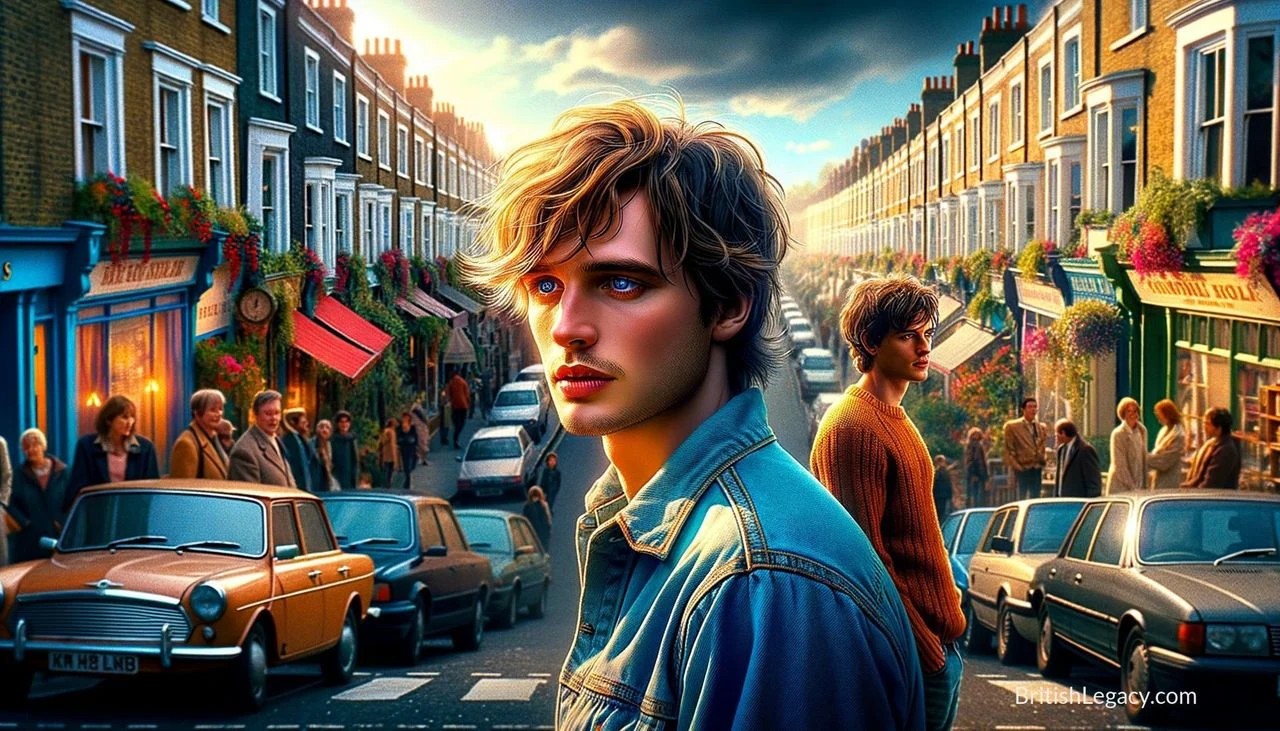
In Notting Hill, a meeting between an unassuming London bookseller and a celebrated American actress turns an ordinary west London life into a public spectacle. Roger Michell’s romantic comedy, written by Richard Curtis, sets that contrast against recognisable London streets and a close-knit circle of friends. Released in 1999, it became a major international success, while its story of celebrity and privacy gave its London setting a role well beyond the scenery.
A bookshop encounter
William Thacker, played by Hugh Grant, owns a travel bookshop in Notting Hill. He is divorced and shares a flat with Spike, a messy and unpredictable Welshman played by Rhys Ifans. One day, Hollywood actor Anna Scott, played by Julia Roberts, enters the shop. Their encounter continues outside: William spills orange juice on Anna and takes her to his nearby flat so she can change. She kisses him before leaving.
Their different circumstances shape the relationship that follows. Anna invites William to visit her at the Ritz, where he is mistaken for a journalist and finds himself at a press event. He claims to write for Horse & Hound. Later, Anna joins him at his sister Honey’s birthday party, where William’s friends and family are surprised to meet her. Their private meetings sit uneasily alongside her public life: even at a restaurant, other diners discuss Anna as if she were not present.
Their romance falters when Anna’s American boyfriend arrives unexpectedly. Six months pass before she turns up at William’s home, distressed by a tabloid scandal and seeking somewhere to hide. They reconnect, but photographers soon gather outside after Spike inadvertently alerts them to her presence. Anna blames William and leaves. Later, when she returns to London to make a film, a misunderstanding prompts another separation.
William eventually finds Anna at a press conference at the Savoy. Posing again as a reporter from Horse & Hound, he asks whether she would consider being more than a friend if he begged her forgiveness. Her reply is to ask him to repeat the question about how long she intends to stay in Britain; she then says, “Indefinitely”. The story ends with the two married and expecting a child. Spike and Honey marry as well.
Friends, performances and a familiar line
Grant’s William is surrounded by friends whose lives give the film much of its domestic comedy. The supporting cast includes Emma Chambers as Honey, Hugh Bonneville as Bernie, Tim McInnerny as Max, Gina McKee as Bella and Richard McCabe as Tony. James Dreyfus plays Martin, William’s colleague, while Ifans’s Spike brings disarray into the flat. The story’s ensemble keeps its focus on a group of people responding to an extraordinary visitor in their midst.
The film’s best-known declaration comes late in the story, when Anna tells William: “I’m just a girl, standing in front of a boy, asking him to love her.” The line makes the difference between public image and private feeling explicit. Anna is famous, but the scene asks to be understood as a personal plea rather than a performance for an audience. The ending brings that tension back into public view: William asks his question at a press conference, and Anna answers in front of the assembled reporters.
That balance of romance and social comedy rests on a particular premise: fame changes the practical conditions of an ordinary relationship. The couple’s meetings are affected by press events, tabloid attention and the presence of people who recognise Anna. William’s friends, meanwhile, provide a more private setting in which she can take part in a birthday party and meet people who treat her as a guest. The film moves between those worlds rather than presenting the relationship as separate from the pressures surrounding it.
Made on London streets
Richard Curtis chose Notting Hill as the setting in part because he lived there and knew the area. Filming began in west London in April 1998, with work on location and at Shepperton Studios. The production used streets including Portobello Road, Westbourne Park Road, Golborne Road and Lansdowne Road; the travel bookshop was located at 142 Portobello Road. Other scenes were filmed at the Ritz, the Savoy, the Nobu restaurant, the Hempel Hotel’s Zen Garden and Kenwood House.
Filming in a busy neighbourhood required coordination with residents, businesses, local authorities and police. Location manager Sue Quinn described finding locations and securing permissions as a major task; the production team wrote to thousands of people in the area and promised donations to their chosen charities. The account of filming reports that 200 charities received money. A planned large exterior set was not used: the filmmakers instead worked on actual streets, with measures intended to manage the disruption and crowds around the production.
The film also uses a reproduction of Marc Chagall’s 1950 painting La Mariée (The Bride) as a story object. Anna sees a print in William’s home and later gives him the original. A reproduction was made for filming by British artist Thomasina Smith, with permissions obtained and an agreement that the copy would be destroyed to prevent it circulating as a possible forgery. The painting’s image of a bride, including its violin-playing goat, returns as a detail on William and Anna’s wedding cake.
Success, reception and limits
Notting Hill opened in the United Kingdom on 21 May 1999 and in the United States a week later. Its worldwide box office reached about $364 million, making it the highest-grossing British film at the time of its release, a record later surpassed. It received three Golden Globe nominations and two BAFTA nominations. The film won the BAFTA Audience Award for Most Popular Film, the British Comedy Award for Best Comedy Film and the Brit Award for Best Soundtrack. It also won three Empire Awards, for Best British Film, Best British Director for Michell and Best British Actor for Grant.
The soundtrack combines Trevor Jones’s score with songs by a range of performers. Elvis Costello’s cover of Charles Aznavour’s “She” is used at the end of the film; Aznavour’s original plays over the opening credits in non-US releases alongside Costello’s version. Ronan Keating’s recording of “When You Say Nothing at All” reached number one in the British charts. The soundtrack won a Brit Award in 2000.
Critical responses were not uniformly favourable. The film received generally positive reviews, but some critics objected to its idealised view of London life and British eccentricity. One criticism was that its representation of Notting Hill failed to reflect the area’s diversity, with a review noting the absence of Black characters. That objection complicates any claim that the film offers a complete portrait of its setting: the neighbourhood provides the locations and atmosphere, but its fictional social world is selective.
Why Notting Hill deserves a place in British Legacy
Notting Hill deserves a place in British Legacy as a British-made film whose London setting is integral to its story, not simply a backdrop. Its west London locations shape the contrast between William’s neighbourhood life and Anna’s work as an international film star. The production filmed on actual streets, including Portobello Road, and the account of its location work records the practical negotiations required to make a major film in a populated area. Its British connection is also evident in its director, writer, principal British cast and recognition through the BAFTAs, British Comedy Awards and Empire Awards.
The film’s reach is part of that legacy. It became the highest-grossing British film at the time of its release, attracted international audiences and carried details of its London setting into a widely seen romantic comedy. Its awards and soundtrack success document that public impact without requiring the film to stand for every experience of the city. Indeed, the criticism that its fictional Notting Hill underrepresents the area’s diversity is an important part of its reception. Remembering both its popular achievement and the limits of its portrait offers a more useful account of British cinema: one that recognises the craft, locations and commercial success while treating representation as a question worth asking.
Sources
Notting Hill (film), revision 1374297990
Adapted in part from Notting Hill (film) by Wikipedia contributors, under CC BY-SA 4.0. Text has been edited and combined with the existing article; this adapted text is shared under the same licence. Contributor history.