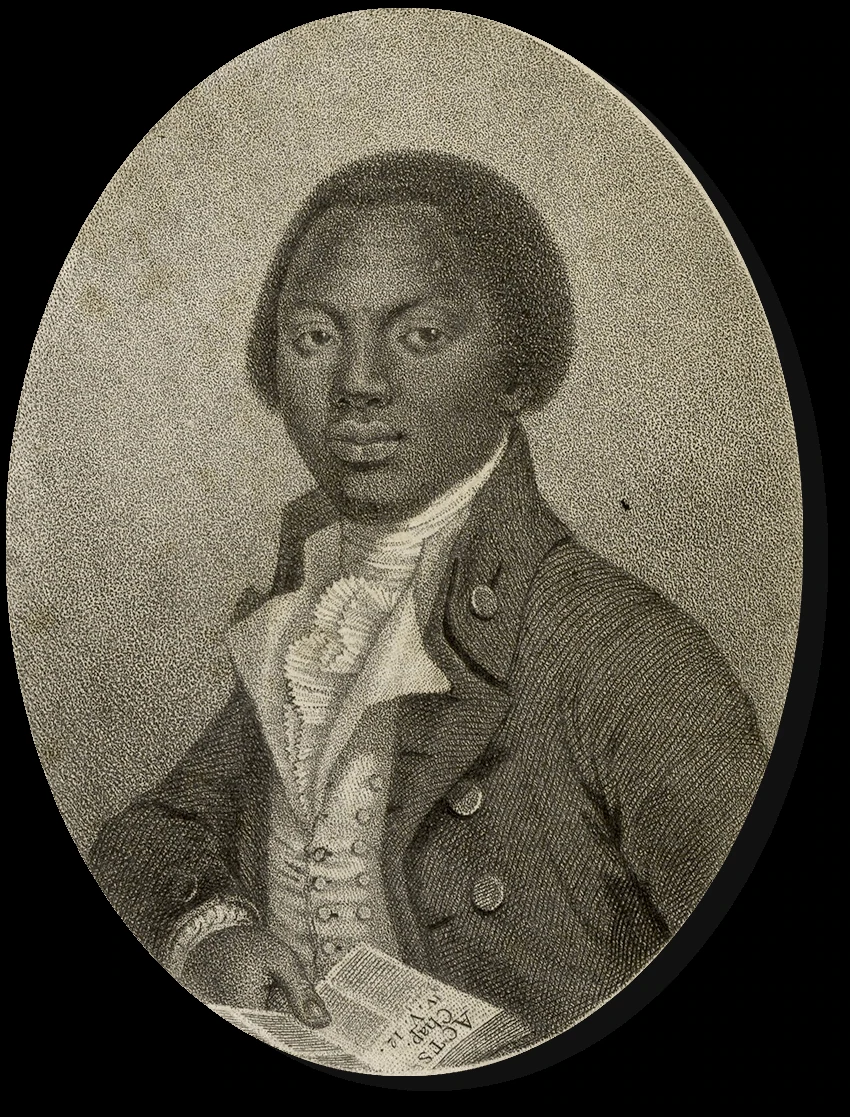
When Olaudah Equiano published The Interesting Narrative of the Life of Olaudah Equiano, or Gustavus Vassa, the African in London in 1789, he turned a life marked by enslavement into an argument against the system that had claimed him. His book recounted kidnapping, forced passage across the Atlantic, sale and self-purchase. It also presented its author as a sailor, trader, Christian, traveller and political witness: a person whose experience gave him grounds to challenge the assumptions and interests of slaveholding society.
Equiano's exact birthplace remains contested. In his autobiography, he said he was born in Essaka, in Igboland, in what is now southern Nigeria. Later scholars have pointed to records interpreted as evidence for South Carolina, while other scholars dispute that conclusion. The uncertainty should be acknowledged rather than settled by assertion. His connection to Britain, by contrast, is clear: he was baptised in Westminster, made a public life in Britain, campaigned and published there, travelled to promote his book, married in Cambridgeshire and died in Westminster in 1797.
A childhood seized by the slave trade
Equiano’s account says he and his sister were kidnapped when he was about eleven. They were separated, and he was passed between owners before being taken to the coast and put aboard a European slave ship. The crossing brought him to the Caribbean; he was then sent on to Virginia. In his narrative, he describes the fear of the voyage and the violent disruption of family and home. Those recollections became central to the book’s force: the Atlantic slave trade appears not as a distant commercial system but as a sequence of acts imposed on individual lives.
In Virginia, Equiano was bought by Michael Pascal, a Royal Navy officer, who renamed him Gustavus Vassa. The name followed earlier changes of name during his captivity. Equiano later used Vassa in most of his public and official life, while using his African name in his autobiography. Naming was part of the power owners exercised over enslaved people; his decision to title his book with both names placed that history in view while asserting his right to author his own story.
Pascal took Equiano to England and had him accompany him during the Seven Years’ War. Equiano was baptised at St Margaret’s, Westminster, in 1759, and learned to read and write. He served at sea, gaining maritime experience that would remain important to his later life and writing. The records around this period also lie at the heart of the birthplace debate: a parish entry describes him as born in Carolina, while his autobiography locates his childhood in Africa. Scholars have interpreted those materials differently, and the evidence supplied here does not resolve the disagreement.
In 1762 Pascal sold him to James Doran, captain of the merchant ship Charming Sally. Doran took him to Montserrat, where he was sold to Robert King, a Quaker merchant who traded in the Caribbean. Equiano worked on King’s shipping routes and in his stores. King allowed him to trade on his own account as well as on his owner’s behalf, selling goods between Georgia and the Caribbean islands. By saving the proceeds, Equiano purchased his freedom in 1766 for £40.
Self-purchase changed his legal status, but it did not remove the dangers of the slave economy. In his narrative, Equiano describes the vulnerability of free Black people in the colonies and the risk of being kidnapped and enslaved again. His own account includes a near-abduction while he was loading a ship in Georgia. Freedom, in this world, was not a secure condition equally protected everywhere; it depended on circumstances and remained exposed to the power of those who profited from enslavement.
A sailor, traveller and witness
By about 1768 Equiano had gone to Britain and continued to work at sea. His voyages included a 1773 Arctic expedition aboard the Royal Navy ship Racehorse. On that voyage he worked with Charles Irving, who later recruited him for a project on the Mosquito Coast in Central America. Equiano was expected to help select enslaved people and manage them as labourers on sugar-cane plantations. The venture failed, and Equiano returned to England in 1777.
These experiences complicate any account that treats Equiano only as the subject of other people’s actions. He travelled widely, worked in maritime and commercial settings, and had to find ways to earn a living after emancipation. His autobiography draws authority from that range of experience, but it does not present freedom as a simple passage from hardship to security. Equiano knew the operations of trade from inside an empire whose commerce depended on slavery, and his own position could be precarious even when he was legally free.
That precariousness is apparent in the case of John Annis, a Black cook who had served aboard a British ship with Equiano. Annis’s former enslaver seized him and took him from the vessel, despite the legal argument that a person could not be removed from England into slavery. Equiano and the abolitionist Granville Sharp tried to secure Annis’s release but failed. The episode sharpened the human stakes of the law: principles against slavery could be argued in Britain, yet they did not guarantee safety to every Black person in practice.
Equiano became one of the prominent Black participants in the British abolitionist movement. He was associated with the Sons of Africa, a group of free Africans in Britain who campaigned against the slave trade, and worked with a wider network that included Sharp. In 1783 he alerted Sharp to the Zong case. More than a hundred enslaved Africans had been thrown overboard, and the resulting dispute was pursued as an insurance claim. The case drew abolitionist attention to the treatment of human beings as property and cargo. Equiano’s part in bringing it to Sharp’s notice linked campaigners to knowledge held by people who had encountered the slave system directly.
His political work was not confined to that case. Equiano wrote letters to newspapers, spoke in public and travelled to make his views known. In November 1786 he was appointed commissary of provisions and stores for a scheme to resettle London’s Black poor in Sierra Leone. He left after protesting about financial mismanagement. The episode shows both his involvement in a project presented as a means of resettlement and his unwillingness to accept its conduct without scrutiny.
Writing a life into public debate
Published in 1789, The Interesting Narrative works across several forms: autobiography, travel writing, religious reflection and political intervention. Its closing words, “Written by Himself”, made authorship part of its claim. In a society that treated Africans as commodities and often denied their intellectual equality, Equiano insisted on the right to speak and to shape how his experience would be understood. He did not merely provide material for an abolitionist argument; he composed and presented that argument in his own voice.
The book appeared as British debate about the slave trade was intensifying. It became a bestseller, and nine editions were published during Equiano’s lifetime. He promoted it through speaking and travel, including journeys around Britain and Ireland. In 1792–93 he spent eight months in Ireland. The book’s circulation carried his testimony beyond a small circle of organised reformers and into the commercial print culture of Georgian Britain. Its success also gave Equiano a degree of independence from the people who had supported its production.
The narrative describes African customs and family life, the separation of children from their relatives, the Middle Passage and the conditions of slavery in the colonies. It also records his work at sea, religious life, travel and attempts to trade. That breadth resists the reduction of a person to a single episode of suffering. Readers encounter someone who observes, remembers, evaluates and makes choices, as well as someone subjected to a violent system. The result was testimony, but also a portrait of a complex human life.
Equiano’s book and campaigning contributed to a collective movement. They did not alone bring about a particular Act of Parliament. The British slave trade was abolished in 1807, ten years after Equiano’s death. That distinction does not diminish his role; it locates it accurately. He was an influential writer and campaigner in a broader struggle involving Black activists, religious groups, reformers and political pressure.
Family, death and British remembrance
On 7 April 1792 Equiano married Susannah Cullen at Soham in Cambridgeshire. They had two daughters, Anna Maria and Joanna. Susannah died in 1796, and Equiano died in Westminster on 31 March 1797. His will directed that, if his daughters died before adulthood, half his wealth should support a school in Sierra Leone and half the London Missionary Society. The provision connected his private estate to education and religious work beyond his immediate household.
Equiano’s life crossed the Atlantic and involved places far beyond Britain, but Britain was where he built much of his public and family life. Westminster was the site of his baptism and death; London was central to his campaigning and publication; and his marriage joined his story to a Cambridgeshire community. His burial place has been lost. These details resist a neat national biography: his British significance emerged from movement between regions and from a life shaped by the wider Atlantic world.
His remembrance is visible in British institutions and places. Westminster Abbey records his baptism and commemoration at St Margaret’s. A Westminster site associated with the publication of his autobiography is marked by Historic England, and the Church of England remembers him in its calendar on 30 July alongside Thomas Clarkson. These commemorations recognise a writer and campaigner whose life bears on Britain’s history of slavery and abolition, and on the Black political and literary work carried out within Britain.
Why Olaudah Equiano deserves a place in British Legacy
Equiano deserves a place in British Legacy because his writing made the slave trade answerable to the people it brutalised. His autobiography connected the large workings of Atlantic commerce to the human consequences of kidnapping, family separation, forced passage, sale and the struggle to obtain freedom. Its reach was substantial: nine editions appeared during his lifetime, and he travelled to promote it. The achievement was literary as well as political. Equiano shaped his experience into a carefully sustained public account, challenging readers to recognise an author and moral witness where slaveholding society had tried to define a person as property.
His contribution to Britain is specific, not a general claim about national character. He was baptised in Westminster, worked and campaigned in Britain, brought the Zong case to Granville Sharp’s attention, wrote and spoke publicly, and challenged the management of a resettlement scheme in which he had served. His life also makes clear that abolition was a collective campaign: Equiano’s influence should be recognised without claiming that he alone produced later legislation. Remembering him brings Black intellectual and political labour into the history of British public life, alongside the country’s entanglement in slavery and the reform movements that confronted it.
That legacy remains useful because it joins testimony to agency. Equiano did not leave only a record of what was done to him; he wrote, travelled, organised, negotiated and made public demands. His book offers historical evidence and a work of literature, while his activism shows how a person excluded from power could intervene in British debate. To place him in British Legacy is therefore to remember both the violence his work exposed and the force of his response: a life and a text that enlarged the terms on which Britain could discuss freedom, identity and responsibility.
Sources
Olaudah Equiano — Wikipedia, revision 1375419672
Adapted in part from Olaudah Equiano by Wikipedia contributors, under CC BY-SA 4.0. Text has been edited and combined with the existing article; this adapted text is shared under the same licence. Contributor history.