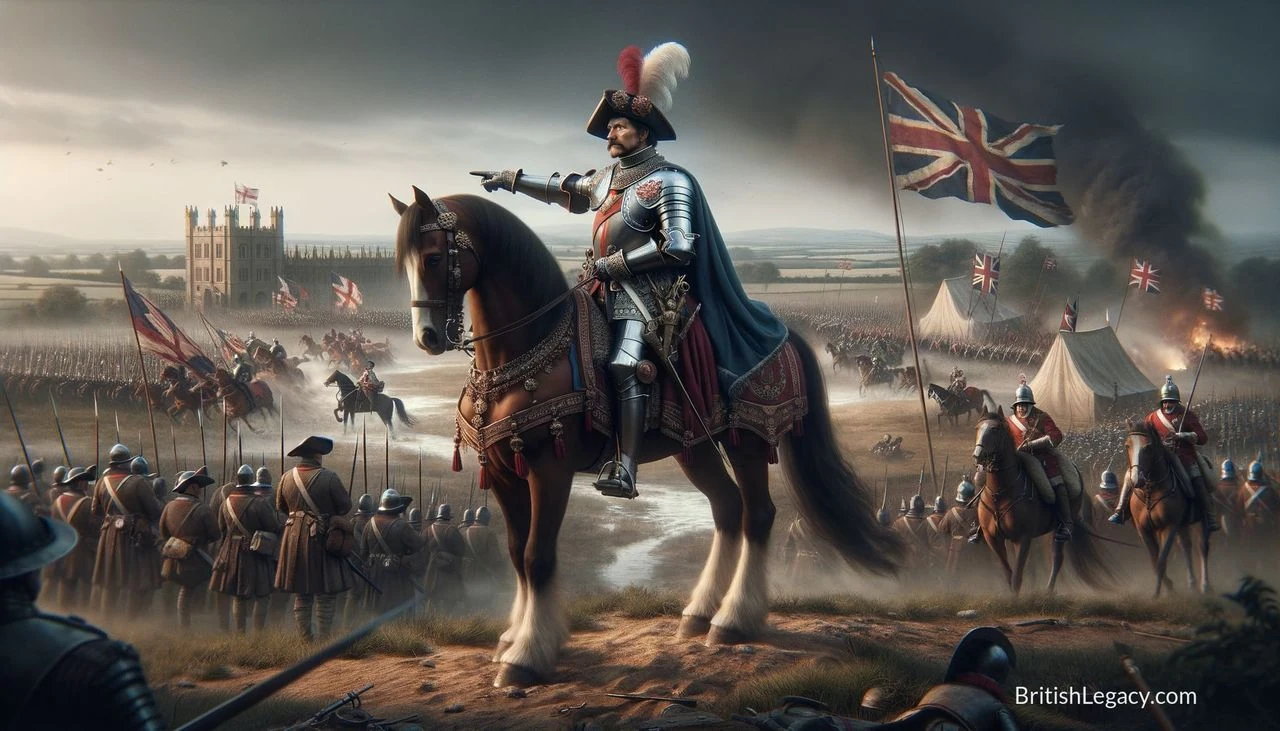
Oliver Cromwell helped bring down a king, commanded armies across three kingdoms and governed England as Lord Protector. His career joined military success to political upheaval: he fought for Parliament, supported the execution of Charles I and later used force to dissolve Parliament himself. The Commonwealth he helped establish did not survive long after his death. His campaigns in Ireland, especially at Drogheda and Wexford, remain central to the fierce argument over what his rule meant.
A country gentleman enters Parliament
Cromwell was born in Huntingdon on 25 April 1599, the son of Robert Cromwell and Elizabeth Steward. He attended Huntingdon Grammar School and entered Sidney Sussex College, Cambridge, in 1616. His father died the following year, and Cromwell left Cambridge without taking a degree. In 1620 he married Elizabeth Bourchier, the daughter of a London merchant; they had nine children.
His early adult life brought financial and personal difficulty. Elected MP for Huntingdon in 1628, he made little impression in that Parliament, which Charles I dissolved the next year. A dispute in Huntingdon was followed by the sale of most of his property there and a move to a farmstead in nearby St Ives. He later inherited property in Ely from his maternal uncle, and by the end of the 1630s had returned to the ranks of the gentry.
Cromwell's religious convictions deepened during this period. A surviving letter from 1638 describes a spiritual awakening and expresses Independent Puritan beliefs. In 1640 he was elected MP for Cambridge, first to the Short Parliament and then to the Long Parliament. Before the war, his parliamentary work included support for annual parliaments and a bill aimed at abolishing episcopacy. These details give a more complex picture than a sudden rise from obscurity: political connections, property and religious conviction all shaped his route into public life.
From Parliamentarian officer to leading commander
When armed conflict began in 1642, Cromwell recruited a cavalry troop in Cambridgeshire and served with the Eastern Association. His experience and authority grew through the campaigns of 1643 and 1644. At Marston Moor in July 1644, his cavalry helped break the Royalist horse and attack the infantry. He was wounded, briefly left the field for treatment, then returned. The victory secured northern England for Parliament, though it did not end the war.
In 1645, the New Model Army took the field under the command of Thomas Fairfax, with Cromwell as lieutenant-general of cavalry and second-in-command. Cromwell had a significant role in the army's development and was an effective battlefield commander, but describing him as its sole founder overstates his part. At Naseby in June, he led one of the victorious cavalry wings; at Langport the following month, Parliamentarian forces defeated the last sizeable Royalist field army. The First English Civil War ended after Charles I surrendered to the Scots in 1646.
The king's future divided the victors. Cromwell initially considered terms under which Charles might return to power, but negotiations failed and a second civil war followed in 1648. Cromwell defeated a Royalist rising in Wales and then won a decisive victory over a Scottish army at Preston. After soldiers purged Parliament of members opposed to the army leadership, the remaining Rump Parliament agreed to put Charles on trial. Cromwell became a determined supporter of the trial and signed the king's death warrant. Charles I was executed on 30 January 1649, and England became a republic known as the Commonwealth.
Conquest in Ireland and Scotland
In 1649, the Commonwealth sent Cromwell to Ireland, where an alliance of Irish Confederate Catholics and Royalists posed a military threat. His forces landed at Dublin and took Drogheda and Wexford, both fortified ports. At Drogheda, after the town was captured, his troops killed thousands. Cromwell's own account defended the killing as a judgement against those he considered responsible for bloodshed. At Wexford, negotiations were under way when some of his soldiers entered the town; killings and looting followed. The circumstances differed between the sieges, but the massacres and Cromwell's justification for Drogheda form an unavoidable part of his record.
Cromwell left Ireland in 1650 while the conquest continued under other commanders. The conflict lasted almost three years after his departure. In its aftermath, Catholic-owned land was confiscated, Catholic priests were persecuted and public practice of Roman Catholicism was banned. The broader consequences included dispossession and forced relocation. Cromwell did not direct every later action, but his campaign and the Commonwealth's settlement are inseparable from the violence and loss suffered in Ireland.
In 1650, Cromwell invaded Scotland after the Scots recognised Charles II as king. He defeated the Scottish army at Dunbar in September. The following year, he followed Charles II into England and won the decisive battle at Worcester, ending the immediate Royalist military challenge. Scotland was then ruled within the Commonwealth and kept under military occupation, although Presbyterian worship continued.
Lord Protector and the limits of the republic
Back in England, Cromwell pressed Parliament to set elections and establish a lasting settlement. Frustrated by the Rump Parliament's failure to do so, he dissolved it by force in April 1653. A nominated assembly also failed to produce a stable settlement. Under a new constitution, the Instrument of Government, Cromwell became Lord Protector on 16 December 1653. He held the office until his death.
The Protectorate combined republican institutions with concentrated authority. Cromwell was neither a king nor simply a parliamentary leader: he governed as a single chief magistrate alongside a council and Parliament. His religious aims included reforming parish ministry and promoting godly conduct. His government also faced persistent political opposition. After a Royalist rising in 1655, the country was divided into military districts overseen by major-generals. The scheme strengthened military oversight and deepened concern that the regime was becoming a permanent military state.
Cromwell dissolved the first Protectorate Parliament in 1655 and a second in 1658. In 1657, Parliament offered him the crown as part of a proposed constitutional settlement. He refused it, but accepted a renewed Protectorate under a revised constitution that adopted some forms associated with monarchy. He died at Whitehall on 3 September 1658, aged 59, and was succeeded by his son Richard. Richard lacked a firm base in Parliament and the army; he resigned in 1659. In 1660, the monarchy was restored under Charles II.
A reputation argued over in public
Cromwell's reputation has never settled into a single verdict. Supporters have presented him as a defender of parliamentary government and liberty of conscience; critics have pointed to regicide, religious coercion and rule sustained by military power. Those judgements need to be considered alongside the concrete record: an army commander who helped defeat the Royalists, a politician who backed the execution of the king, and a ruler who twice dissolved Parliament.
His place in public memory has itself been contested. A statue outside the Houses of Parliament was first proposed in 1856 and erected in 1895, with most of the money supplied privately by Prime Minister Archibald Primrose. It followed controversy over public funding and opposition from Irish nationalists. The statue makes visible a continuing tension: Cromwell can be commemorated as a central figure in English political history while remaining a symbol of conquest and suffering for many people in Ireland.
After the Restoration, Cromwell's body was removed from Westminster Abbey and subjected to a posthumous execution in 1661. His head was displayed at Westminster Hall and later passed through private collections before being buried at Sidney Sussex College, Cambridge, in 1960. This grim afterlife is a reminder that the political settlement he helped create was violently reversed, even as his deeds remained embedded in national and Irish histories.
Why Oliver Cromwell deserves a place in British Legacy
Cromwell deserves a place in British Legacy not as an uncomplicated hero, but because his actions expose a defining conflict in the history of government: who holds power when a ruler and Parliament can no longer agree? As a Parliamentarian commander, he helped defeat Charles I; as a signatory to the king's death warrant, he helped make regicide a political reality; and as Lord Protector, he governed through institutions that combined republican language with the authority of one man and the army. The Commonwealth's eventual collapse and the Restoration show the limits of that experiment. His story offers a specific way to examine how military force, parliamentary authority and religious conviction shaped the political order of the three kingdoms.
That legacy must also include the human consequences of his campaigns. In Ireland, the killings at Drogheda and Wexford and the confiscations and religious restrictions that followed cannot be reduced to a footnote to his English career. They explain why his memory carries radically different meanings on either side of the Irish Sea. Including both his role in Parliament's victory and the violence committed in its name makes for a more honest account of British history. Cromwell's contested reputation is not a reason to exclude him; it is precisely why his career belongs in a British legacy that examines power, its consequences and the lasting disagreements it leaves behind.
Sources
Oliver Cromwell — Wikipedia revision · Oliver Cromwell — Wikipedia
Adapted in part from Oliver Cromwell by Wikipedia contributors, under CC BY-SA 4.0. Text has been edited and combined with the existing article; this adapted text is shared under the same licence. Contributor history.