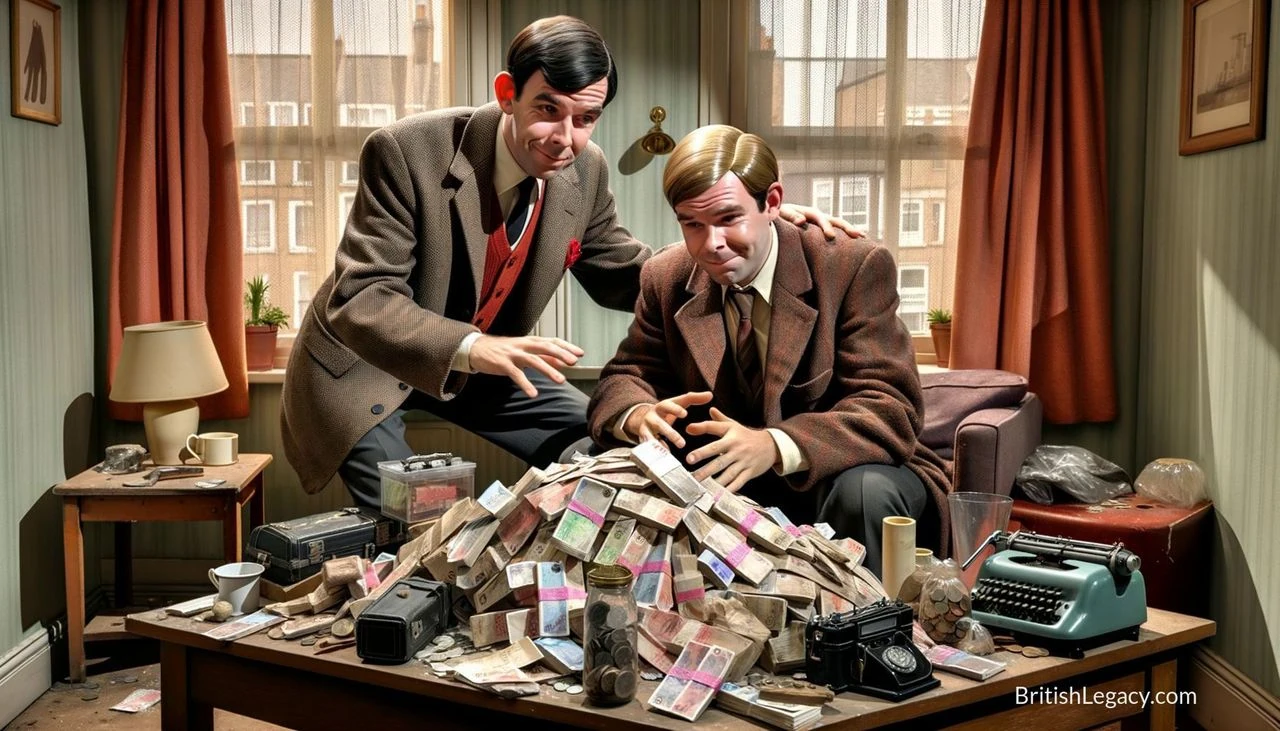
For Del Boy Trotter, the next deal was always the one that would make him a millionaire. In John Sullivan’s Only Fools and Horses, those schemes rarely went to plan, but the optimism endured. Set among the streets, pub and council flat of working-class Peckham, the BBC sitcom made the bond between Del Boy and his younger half-brother Rodney its emotional centre. It began in 1981, built its audience over time and reached a record-setting high with its 1996 Christmas finale.
A market trader’s big plans
Sullivan created and wrote the series, which first aired on BBC One on 8 September 1981. David Jason played Derek “Del Boy” Trotter, a fast-talking South London market trader, and Nicholas Lyndhurst played Rodney, his younger half-brother. They lived in Nelson Mandela House, a fictional tower block in Peckham, with their grandfather, Grandad, played by Lennard Pearce. The family’s attempts to improve their fortunes through buying and selling goods gave the show its comic engine; Del Boy’s repeated promise that they would be millionaires “this time next year” supplied its most persistent hope.
The brothers’ circumstances give that ambition its edge. Rodney is more idealistic and socially awkward, while Del Boy is confident, resourceful and prepared to bend the rules. Orphaned young, Rodney was raised by his much older brother, and their arguments sit alongside a durable family loyalty. The show’s comedy often comes from the distance between Del Boy’s grand claims and what the Trotters can actually manage. Their three-wheeled van and their trading name, Trotters Independent Traders, became part of the series’ visual identity.
Grandad’s death in 1984 was written into the story after Pearce died during the filming of the fourth series. Sullivan introduced Grandad’s estranged younger brother, Uncle Albert, played by Buster Merryfield, who moved in with the brothers. Albert’s stories beginning “During the war…” became a recurring joke. The changing household gave the series a way to carry its family dynamic forward without losing its focus on Del and Rodney.
From modest beginnings to a national audience
The programme did not become a ratings success immediately. Its first series drew a lukewarm critical response and averaged about seven million viewers. A repeat run of the first two series in 1983 performed well enough to bring a third series, after which the audience grew. The show’s format also developed: early episodes were largely self-contained, while later series gave more room to continuing relationships and changes in the Trotters’ lives.
Its eventual run comprised seven series and sixteen Christmas specials. The seven series aired between 1981 and 1991; further specials followed, including a three-part Christmas sequence in 1996 and three final specials broadcast from 2001 to 2003. This distinction matters: the programme did not run continuously for 22 years, but returned periodically after its regular series had ended.
“Time on Our Hands”, the 1996 episode originally billed as the series finale, brought the Trotters’ long pursuit of wealth to a decisive turn. They finally became millionaires, and 24.3 million people watched the episode, then a record audience for a British sitcom. The achievement rested on more than the surprise of their success. The story had spent years making the brothers’ hopes, failures and arguments familiar to viewers, so their change in fortune carried the weight of a shared journey.
Peckham’s wider cast and comic language
The Trotters’ world expanded through regular characters connected to the Nag’s Head pub and their dealings. Roger Lloyd-Pack’s Trigger, a road sweeper and Del Boy’s friend, and John Challis’s Boycie, a boastful used-car salesman, became particularly familiar figures. Other recurring characters included lorry driver Denzil, played by Paul Barber; Mickey Pearce, played by Patrick Murray; and pub landlord Mike, played by Kenneth MacDonald. Tessa Peake-Jones joined as Raquel, Del Boy’s partner, while Gwyneth Strong played Cassandra, who married Rodney.
That larger circle helped the series balance schemes with the daily business of friendship, courtship and family. Raquel and Cassandra’s relationships with the brothers brought new strands to the story, while the regulars at the pub gave the Trotters a community beyond their flat. The series’ comedy often depended on recognition: the audience knew who would boast, who would be taken in and who would have to deal with the consequences.
Del Boy’s phrases travelled beyond the episodes. “Lovely jubbly” and “plonker” became closely associated with the character; the latter was popularised by the show, and “lovely jubbly” entered the Oxford English Dictionary in 2003. The series also left a strong visual memory. Del Boy’s fall through a bar flap in “Yuppy Love” and the brothers’ Batman-and-Robin costumes in “Heroes and Villains” are among its best-known comic scenes. Its portrayal of working-class ambition does not require the Trotters to succeed at every turn: the jokes arise from their ingenuity, their misjudgements and their refusal to give up.
Beyond the original episodes
The series’ success produced more than repeat broadcasts. It received BAFTA awards for best comedy series in 1985, 1988 and 1996, and a BAFTA audience award in 2004. In the same year, a BBC poll voted it Britain’s best sitcom. It also ranked 45th in the British Film Institute’s list of the 100 Greatest British Television Programmes. These honours sit alongside its exceptional audience for “Time on Our Hands” and the continuing recognition of its characters and scenes.
Sullivan’s Peckham world continued in other forms. The spin-off The Green Green Grass, centred on Boycie and Marlene, ran from 2005 to 2009. The prequel Rock & Chips, about the younger Del Boy and his family, began in 2010. In 2019, a stage musical written by Jim Sullivan and Paul Whitehouse opened at the Theatre Royal Haymarket in London. The series also became an enduring home-video title, with complete collections and special releases bringing episodes to new viewers as well as long-standing fans.
Its influence reached into public life as well as entertainment. A yellow Reliant van and Batman-and-Robin lookalikes appeared in the 2012 London Olympic Games closing ceremony, drawing on one of the show’s recognisable comic images. The programme has also been sold internationally, with versions and remakes made in several countries. Those afterlives reflect the portability of its central idea: a family’s hopes can be both funny and heartfelt, even when the plans meant to secure a better life keep going awry.
Why Only Fools and Horses deserves a place in British Legacy
Only Fools and Horses deserves a place in British Legacy because its achievements are specific and lasting. John Sullivan built a comedy around the lives of working-class Londoners without making ambition an abstract slogan: it was expressed through a market stall, dubious deals, a familiar pub and two brothers sharing a cramped home. The relationship between Del Boy and Rodney gave the schemes emotional stakes. Their different temperaments generated conflict, but their history as family kept the comedy connected to care and responsibility. That combination helped the series grow from a modest first run into a programme watched by 24.3 million people for its 1996 finale.
Its legacy can be seen in the details that remain in circulation: phrases associated with Del Boy, the bar-fall gag, the Reliant van and the Batman-and-Robin costumes. Its awards and BBC poll result record recognition from the television industry and viewers; its spin-offs, prequel, stage musical and international adaptations show how Sullivan’s characters could support stories beyond the original broadcast. The series also gave successive audiences an unusually clear portrait of a particular London setting and a family’s tenacious hopes. Remembering it in British Legacy means recognising not only a popular sitcom, but a work whose humour, characters and cultural references became part of the country’s shared television vocabulary.
Sources
Only Fools and Horses — Wikipedia revision · Only Fools and Horses — Wikipedia
Adapted in part from Only Fools and Horses by Wikipedia contributors, under CC BY-SA 4.0. Text has been edited and combined with the existing article; this adapted text is shared under the same licence. Contributor history.