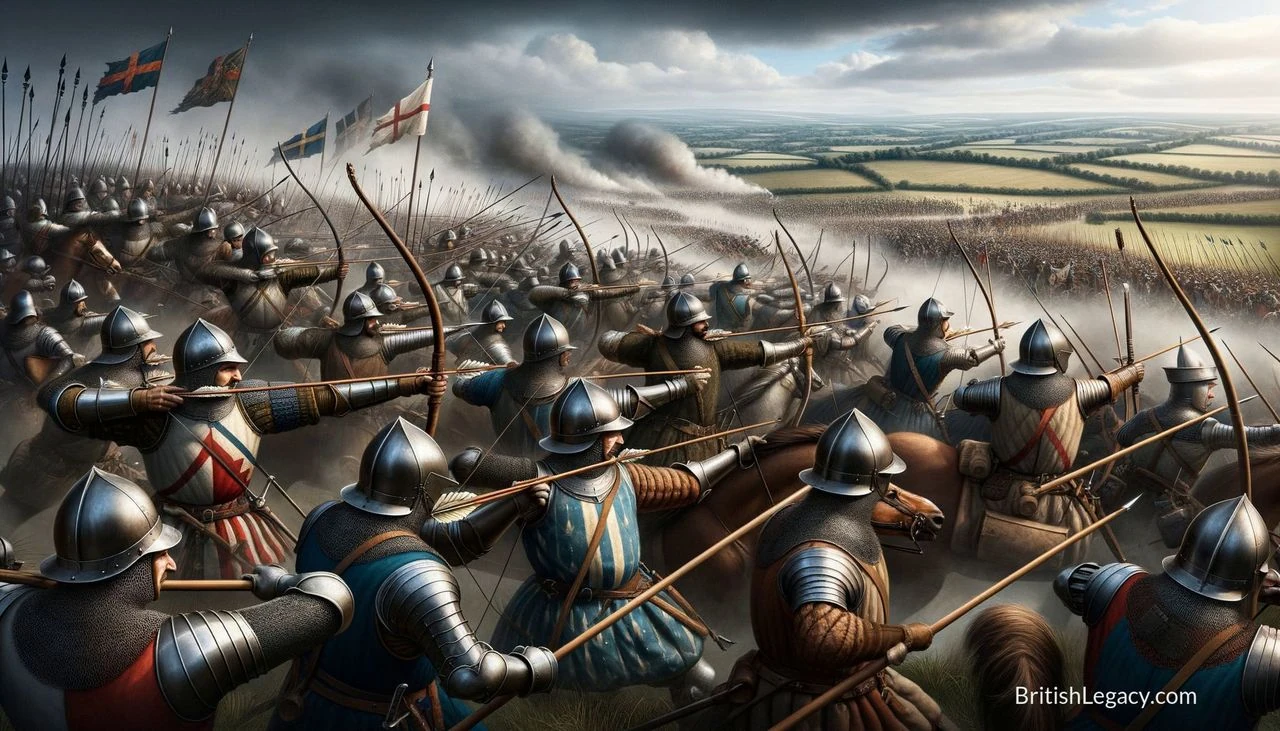
On 25 October 1415, an English army retreating towards Calais after the siege of Harfleur met a larger French force near Agincourt. The English victory became one of the best-known episodes of the Hundred Years’ War. Longbowmen, defensive positioning and the muddy, confined battlefield all feature in accounts of how Henry V’s soldiers overcame their numerical disadvantage.
From Harfleur to Agincourt
Henry V had begun his campaign in France in 1415, seeking to press his claims and recover territory. The siege of Harfleur cost the English army men and left others ill. By October, Henry was leading his diminished force towards Calais when it encountered the French near the village of Agincourt.
The force estimates in the existing account are approximately 6,000 English soldiers against nearly 15,000 French. Such figures should be read as estimates rather than an exact count. Whatever the precise numbers, the English were outnumbered. Henry arranged his troops in a defensive formation, with archers protected by stakes and positioned to make use of the terrain.
Archers, armour and mud
The English longbowmen were central to the battle’s later reputation. The account describes them as capable of shooting rapidly in volleys, while French knights advanced in heavy armour across a narrow, muddy field. The ground and congestion hampered the French advance; arrows added to the pressure on their front ranks. The English then fought at close quarters when the opposing lines met.
The battle was not simply a contest between a new weapon and an old one. The English defence depended on the placement of their archers and the conditions on the field as well as on the bows themselves. The French force’s numbers did not translate straightforwardly into an advantage in the confined, mud-soaked approach. The combination of terrain, formation and archery helps explain why the encounter is remembered as a striking English victory.
Casualty totals are also estimates. The existing account puts French losses at around 7,000, including nobles and knights, and English losses at fewer than 500. These figures convey the scale of the reported disparity, but should not be mistaken for precise returns. The battle’s outcome was decisive in the encounter; the available account does not provide enough detail to quantify its wider military consequences.
Memory and representation
Agincourt became a lasting story of victory against the odds, and of the effectiveness of disciplined troops and tactical preparation. Henry V’s leadership and the English soldiers’ achievement entered popular memory. William Shakespeare later dramatised the battle in Henry V, including the St Crispin’s Day speech. That literary treatment helped give the event a voice that extends beyond the battlefield itself.
The longbow, too, became closely associated with the English account of the victory. It is tempting to make Agincourt a simple turning point in the history of warfare or a universal lesson about technology defeating numbers. The details here support a more specific conclusion: English archery mattered in circumstances shaped by the defensive position and difficult ground. The battle’s fame has endured, but broad claims about its influence around the world are harder to establish from the evidence available for this feature.
Why the Battle of Agincourt deserves a place in British Legacy
Agincourt belongs in British Legacy as a major episode in England’s medieval history and in the long conflict between the English and French crowns. Its place in the record rests on a concrete achievement: in 1415, an English force weakened by the Harfleur campaign defeated a larger French army. The account points to a combination of archery, defensive organisation and terrain rather than to numbers alone. That combination makes the battle useful for understanding how battlefield conditions and the deployment of soldiers could shape an outcome.
Its legacy also lies in how the victory was remembered. The association with Henry V, the English archers and Shakespeare’s Henry V carried the story from military history into literature and popular memory. Remembering Agincourt need not turn it into a claim about an unchanging British character or a universal military formula. It is more valuable as a specific, consequential English victory whose reputation was renewed through later cultural representation. That distinction preserves both the historical event and the history of the story told about it.