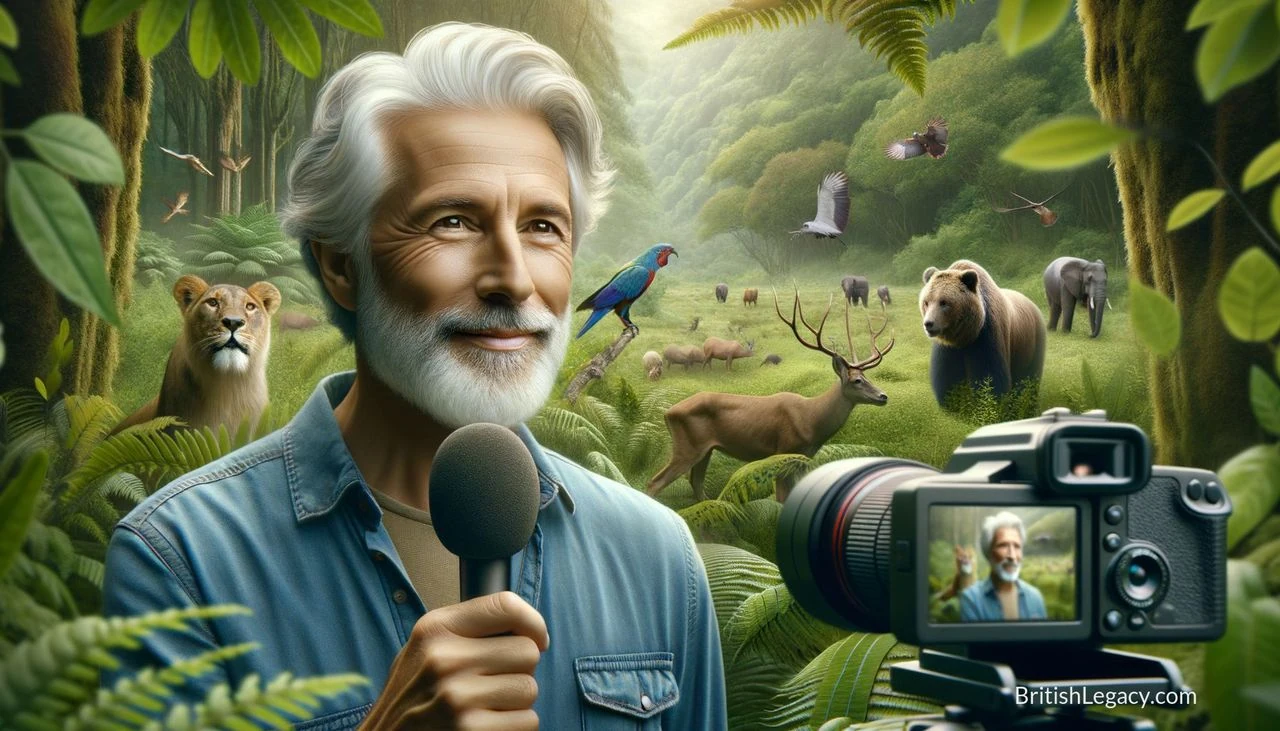
David Attenborough’s career has joined natural history to the possibilities of television. As presenter, writer, narrator and BBC executive, he helped shape how wildlife documentaries are made and how audiences encounter the natural world. From the expeditions of Zoo Quest to the global reach of Life on Earth, The Blue Planet and Planet Earth, his work has made scientific subjects part of shared public culture. In later programmes, he has also addressed the pressures human activity places on the planet.
A naturalist finds his way into broadcasting
David Frederick Attenborough was born in Isleworth, Middlesex, on 8 May 1926. He grew up in Leicester, where his father, Frederick, was principal of University College, Leicester. As a child he collected fossils, stones and other natural specimens. A lecture by the conservationist Grey Owl, attended with his brother Richard in 1936, helped shape his interest in the relationship between people and the natural world.
Attenborough attended Wyggeston Grammar School for Boys and studied geology and zoology at Clare College, Cambridge, graduating in natural sciences. After two years of National Service in the Royal Navy, he worked editing science textbooks. He applied to the BBC in 1950 for a radio production job and was turned down, but his application attracted the attention of Mary Adams, who offered him training with the television service. He joined the BBC full-time in 1952.
His first work was behind the camera, producing factual programmes. Natural history entered his broadcasting life through Animal Patterns, a studio series featuring animals from London Zoo. After meeting the zoo’s reptile-house curator, Jack Lester, Attenborough helped develop Zoo Quest. When Lester fell ill, Attenborough took over as presenter shortly before the first programme was broadcast in 1954. The series brought animal-collecting expeditions to television and established his on-screen role.
Building a broader BBC and a lasting body of work
Attenborough’s contribution to broadcasting was not limited to presenting. In 1965 he became Controller of BBC Two, taking responsibility for a channel that was still establishing its identity. He commissioned a varied schedule spanning the arts, science, travel, comedy and other subjects. Programmes launched or commissioned during his tenure included Monty Python’s Flying Circus, The Old Grey Whistle Test and The Money Programme. He also backed Civilisation, Kenneth Clark’s series on Western art, which helped establish the model for ambitious, presenter-led documentary series.
In 1969 Attenborough became director of programmes for BBC Television. The senior post put him further from programme-making, and in 1973 he left it to return to full-time broadcasting. That decision cleared the way for a project he had long wanted to present: a sweeping account of the history of life. The resulting Life on Earth, first broadcast in 1979, travelled across continents and drew on new filming techniques to capture behaviour that earlier wildlife programmes had rarely shown.
The Living Planet followed in 1984, exploring how living things adapt to their environments. With The Trials of Life in 1990, the two series became the first part of an extended collection of documentaries about life on Earth. Attenborough continued it with films on subjects including plants, birds, mammals, invertebrates, reptiles and amphibians. Time-lapse photography in The Private Life of Plants made the growth and movement of plants visible at a pace audiences could follow; low-light and infrared cameras later revealed the behaviour of nocturnal mammals.
He also narrated and presented programmes beyond that collection. He narrated every episode of the long-running BBC series Wildlife on One and worked with the BBC Natural History Unit on The Blue Planet (2001) and Planet Earth (2006). The latter was the BBC’s first wildlife series shot in high definition. He returned for later productions, including Blue Planet II in 2017, which brought renewed attention to plastic pollution, and narrated the Netflix series Our Planet in 2019.
From wonder to environmental urgency
Attenborough’s programmes have long included the effects of human activity on nature. Over time, some of his work made those concerns its central subject. In State of the Planet (2000), he considered the impact of human activities using scientific evidence and interviews with scientists and conservationists. Later programmes addressed climate change, population growth and the loss of species.
Climate Change – The Facts and Extinction: The Facts, both broadcast in 2019, adopted a more urgent tone about climate change and biodiversity loss. In David Attenborough: A Life on Our Planet (2020), he reflected on environmental change during his lifetime and set out his hopes for the future. He also spoke at the opening ceremony of the 2021 United Nations Climate Change Conference, COP26, urging action on emissions.
His conservation activity has extended beyond broadcasting. He has supported campaigns to protect albatrosses from longline fishing and to safeguard rainforest in Borneo. He helped launch ARKive, a project to create a digital library of natural-history media, and supported the World Land Trust’s appeal to establish a rainforest reserve in Ecuador. In 2022, the United Nations Environment Programme named him a Champion of the Earth for his work in documenting and advocating for the protection and restoration of nature.
Recognition and a British broadcasting legacy
Attenborough’s honours reflect his work in television, science communication and conservation. He was appointed a Commander of the Order of the British Empire in 1974, knighted in 1985 and made a Member of the Order of Merit in 2005. In 2020, he was appointed a Knight Grand Cross of the Order of St Michael and St George for services to television broadcasting and conservation. The Stephen Hawking Medal for Science Communication followed in 2024.
The distinction between these honours matters: the Order of Merit is not a second knighthood. His achievements also include election as a Fellow of the Royal Society, the BAFTA Fellowship, the Kalinga Prize for the Popularization of Science and the Michael Faraday Prize. A research ship, RRS Sir David Attenborough, bears his name. A number of species have also been named in his honour, including the fossil fish Materpiscis attenboroughi, whose scientific importance he highlighted in Life on Earth.
Attenborough’s place in British public life is closely tied to the BBC: he joined its television service when it was still young, helped define BBC Two as a controller and went on to make natural-history programmes with the corporation across many decades. His broadcasting career has helped make British television production a prominent vehicle for wildlife filmmaking and science communication, while the subjects of his films have reached audiences around the world.
Why David Attenborough deserves a place in British Legacy
David Attenborough deserves a place in British Legacy for a body of work that changed both the scale and the accessibility of natural-history broadcasting. Life on Earth and its successors brought viewers into varied habitats and presented the history, behaviour and adaptations of living things as connected stories. The films depended on more than a recognisable voice: they combined research, long-term observation and evolving camera techniques to show audiences creatures and processes that had seldom been filmed. His work helped establish the landmark authored documentary as a defining form of British television.
His legacy also includes institutional and public contributions. At BBC Two, he supported a diverse schedule that included influential work in the arts, comedy and factual broadcasting; as a programme-maker, he helped make wildlife filmmaking a sustained part of the BBC’s output. His later documentaries have used that established public trust to explain climate change, biodiversity loss and conservation, while projects such as ARKive and his support for conservation organisations have extended his work beyond the screen. These achievements connect his British broadcasting career to a wider benefit: bringing knowledge of the natural world to broad audiences and giving environmental questions a lasting place in public discussion.
Sources
David Attenborough (revision 1377734588) · David Attenborough
Adapted in part from David Attenborough by Wikipedia contributors, under CC BY-SA 4.0. Text has been edited and combined with the existing article; this adapted text is shared under the same licence. Contributor history.