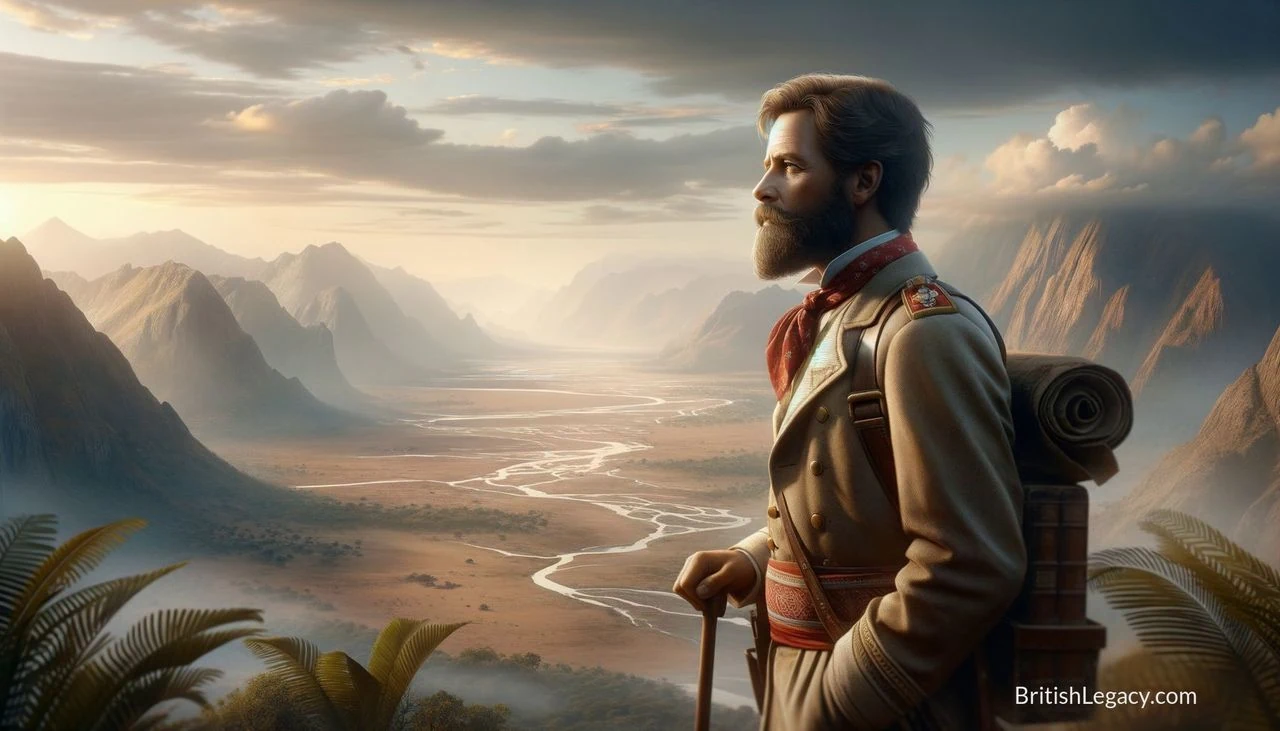
David Livingstone became one of Victorian Britain’s most celebrated explorers, but the story is more complicated than the legend of a lone humanitarian opening up Africa. A Scottish mill worker who trained as a doctor and missionary, he mapped important features of central and southern Africa and wrote forcefully against the slave trade. He also believed that Christian missions and European commerce could transform the continent, and his explorations formed part of the era of European expansion. His achievements, failures and contradictions belong together.
From a Blantyre mill to medical training
Livingstone was born on 19 March 1813 in Blantyre, Scotland, the second of seven children. At ten, he began working in a cotton mill, where he and his brother John spent long days tying broken threads on spinning machines. The family’s limited means did not end his education: he attended the village school around his shifts and continued reading, with a particular interest in science and the natural world. His father, Neil, was a Sunday-school teacher and teetotaller; Livingstone’s early engagement with Christian faith developed alongside, rather than instead of, his curiosity about nature.
In 1836 he began studying medicine and chemistry at Anderson’s University in Glasgow, supporting himself with mill work outside term time. He applied to the London Missionary Society (LMS) in 1837 and was accepted as a probationary candidate the following year. Further theological training in Essex and clinical study at Charing Cross Hospital prepared him for work that joined medical practice to missionary service. He qualified in Glasgow in November 1840 and was ordained later that month.
Livingstone had hoped to serve in China, but the LMS sent him to southern Africa. He sailed in November 1840 and reached the Cape of Good Hope in March 1841, travelling onwards to the Kuruman mission. There he learned Tswana and began work among communities north of established mission stations. In 1845 he married Mary Moffat, daughter of missionary Robert Moffat. The couple had six children, and Livingstone’s long absences meant that family life was often separated by distance.
Routes across southern and central Africa
Missionary work and exploration were intertwined. Livingstone moved between mission stations, but he was drawn towards regions where Europeans had little mapped knowledge. In 1849, travelling with William Cotton Oswell, he crossed the Kalahari and reached Lake Ngami. He later followed the Zambezi and saw the waterfall known as Mosi-oa-Tunya, naming it Victoria Falls after Queen Victoria. Between 1852 and 1856 he travelled from the interior to the Atlantic coast at Luanda and then east to the Indian Ocean at Quelimane, recording much of the Zambezi’s course. He became the first European to cross south-central Africa at that latitude, though trade routes across the region already existed.
These journeys brought him fame in Britain and recognition from the Royal Geographical Society. His 1857 book, Missionary Travels and Researches in South Africa, presented his observations and argued that Christian missions and what he called “legitimate commerce” could displace slave trading. His programme is not well described as separate from empire: Livingstone sought British commercial and missionary access to the interior, and his geographical work contributed to European knowledge and expansion. He nevertheless framed trade and education as alternatives to the slave trade, a conviction that shaped both his writing and his later expeditions.
His government-backed Zambezi expedition, undertaken from 1858 to 1864, proved a serious failure. The river could not be navigated as he had hoped, progress was hampered by rapids and logistical problems, and disputes arose within the expedition. Mary Livingstone died of malaria in 1862 while in Africa. The expedition’s scientific officers did collect botanical, geological and other material, but the undertaking damaged Livingstone’s reputation and made it harder for him to raise funds. Its difficulties complicate the image of an invariably successful explorer and leader.
Anti-slavery campaigning and its limits
From the 1850s onwards, Livingstone made opposition to the African slave trade a central purpose of his public work. His books, letters and journals described the violence and suffering he encountered, helping to stir British support for abolition. He hoped that Christian missions and commercial routes would provide alternatives to slave trading. That aim did not mean his expeditions were independent of the trade: during his later journeys he accepted assistance from traders who kept and sold enslaved people, and he relied on porters and servants whose circumstances could be difficult to establish.
His record was not one of having ended the East African slave trade. His testimony contributed to public campaigning and to efforts to suppress it, but it did not by itself bring about its abolition. Nor was his account of the trade free from problems: his estimates of the numbers involved have been criticised as exaggerated. The mismatch between his stated purpose and the compromises of travel in the region is part of the historical record, not a reason to dismiss either his opposition to slavery or the limits of his conduct.
His views on Christianity also require more than a heroic shorthand. Livingstone’s work at Kolobeng included the baptism of Chief Sechele, the one African convert identified in the account. Sechele later remained Christian and helped spread Christianity among the Kwena, while retaining beliefs and practices Livingstone opposed. Their relationship shows that African leaders were participants in, and interpreters of, religious change—not merely recipients of a European mission.
The last journeys and the making of a legend
In 1866 Livingstone returned to Africa to search for the source of the Nile. The geographical work of this final expedition was substantial, even though his theory about the Nile’s source was wrong. He identified features including Lakes Malawi and Bangweulu and added detail to knowledge of the Zambezi and other waterways. Illness, lost supplies and the desertion of members of his party made the journey increasingly difficult. In 1871, at Nyangwe, he witnessed a massacre associated with slave traders. His surviving notes and later account do not give precisely the same context for the event, and the episode has been subject to continuing scrutiny.
After losing contact with the outside world, Livingstone met the journalist Henry Morton Stanley at Ujiji on 10 November 1871. Stanley’s reported greeting, “Dr Livingstone, I presume?”, became famous, although the surviving accounts do not settle the exact wording beyond doubt. Livingstone declined to leave Africa with Stanley and continued his investigations despite increasingly poor health.
He died on 1 May 1873 at Chief Chitambo’s village in present-day Zambia, from malaria and internal bleeding caused by dysentery. His African attendants Chuma and Susi arranged for his heart to be buried near the place of death and led the long journey carrying the rest of his remains to the coast. His body was returned to Britain and buried in Westminster Abbey. The loyalty and effort involved in that journey helped shape the public image of Livingstone as a figure of perseverance.
Why David Livingstone deserves a place in British Legacy
Livingstone belongs in British Legacy because his life connects British work, belief and public debate to consequential events in Africa. His geographical records helped fill in European maps of central and southern Africa: his journeys reached Lake Ngami, traced much of the Zambezi, and brought Victoria Falls to wider European attention. Those achievements were real, but they were not a discovery of an empty continent. Existing African communities and trade routes shaped the journeys, supplied guides and knowledge, and continued to act on their own priorities. Remembering that context gives a more accurate account of what his explorations did and for whom they mattered.
His anti-slavery campaigning also deserves careful recognition. Livingstone’s published descriptions helped stir British opposition to the East African trade, but neither his efforts nor his record should be turned into a claim that he ended it. He accepted assistance from slave traders, and his vision of “Christianity, Commerce and Civilization” carried both a challenge to slavery and a programme of European influence. The failures of the Zambezi expedition, his distance from his family, and the disputed aspects of his later travels further resist a simple heroic portrait. Taken together, these details make his legacy more useful, not less: they show how moral purpose, geographical knowledge and imperial ambition could coexist, and why the effects of British activity overseas must be examined as well as celebrated.
Sources
David Livingstone — revision 1379268759
Adapted in part from David Livingstone by Wikipedia contributors, under CC BY-SA 4.0. Text has been edited and combined with the existing article; this adapted text is shared under the same licence. Contributor history.