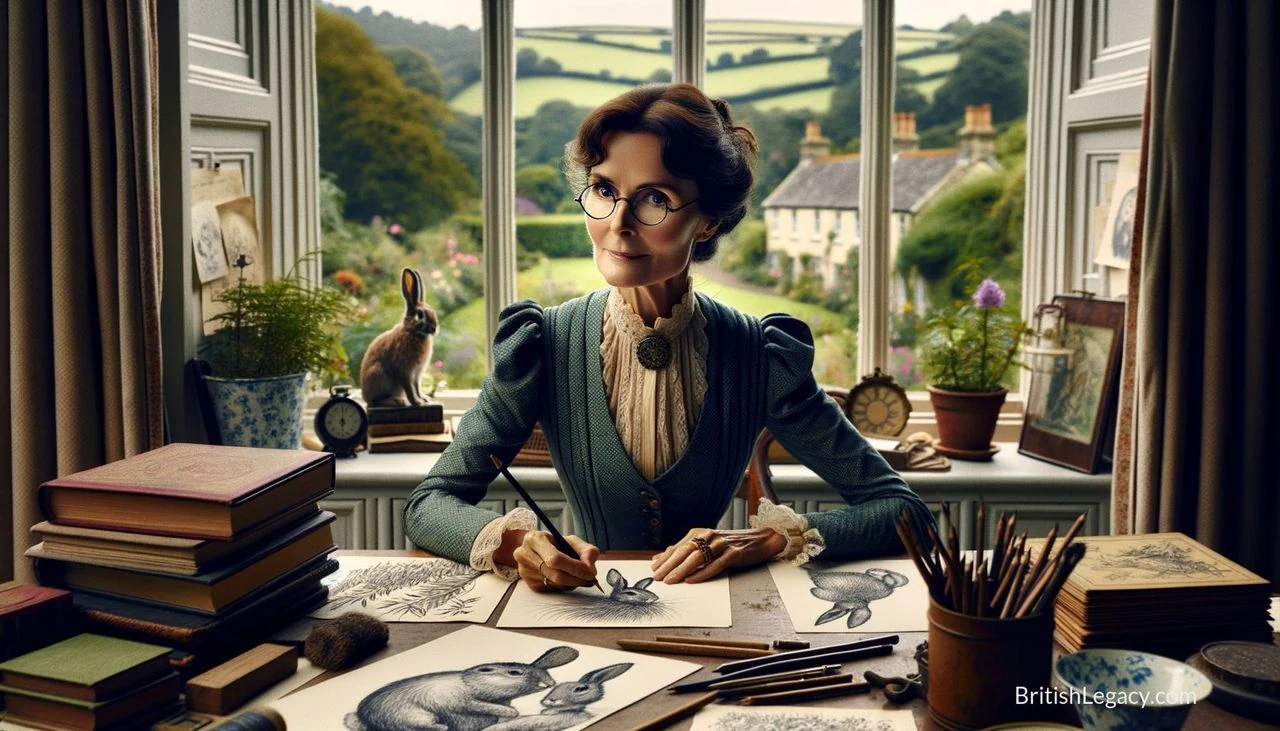
Beatrix Potter’s stories gave rabbits, ducks and kittens distinct lives, but their appeal rests on more than charming characters. Her keen observation shaped both her illustrations and her work as a naturalist; the success of her books gave her the means to become a farmer and an influential protector of the Lake District. From an illustrated letter to Noel Moore to the land she left to the National Trust, her career joined artistic invention to practical stewardship.
A childhood spent observing
Helen Beatrix Potter was born in West Brompton, London, on 28 July 1866. Her parents, Rupert and Helen, were artistically inclined, and Beatrix and her younger brother, Walter Bertram, grew up with few friends outside their extended family. They kept small animals and drew them closely. Family holidays in Scotland and, later, the Lake District gave Potter further opportunities to sketch and study the countryside.
She was educated at home by governesses rather than attending university. In the 1890s her interest in natural history focused increasingly on fungi. She painted specimens and studied their reproduction under the microscope, developing ideas about the germination of fungal spores. In 1897 she submitted a paper to the Linnean Society, but, as a woman, could not attend or read it herself; a botanist presented it on her behalf. She later withdrew the paper after recognising that some specimens had been contaminated. Her scientific work was not a brief prelude to the books: it reflected the same disciplined attention to detail that made her pictures so persuasive.
From picture letters to Peter Rabbit
Potter had already earned money from illustrations, including drawings for printed verses and designs for Christmas and other greeting cards. In September 1893, while on holiday in Perthshire, she wrote to Noel Moore, the son of her former governess Annie Moore. The letter told a story about four rabbits—Flopsy, Mopsy, Cottontail and Peter—and became the starting point for The Tale of Peter Rabbit.
Potter revised the story and, after failing to find a publisher, paid to print an edition for family and friends in 1901. Frederick Warne & Co, which had earlier declined it, later accepted the book. Potter coloured the illustrations for the commercial edition, published on 2 October 1902. It was an immediate success. She went on to make books with characters including Squirrel Nutkin, Jemima Puddle-Duck, Mrs. Tiggy-Winkle and Tom Kitten. Warne published 23 of her small-format tales, and Potter continued to write and illustrate while also taking an active role in the books’ design and presentation.
The stories’ rural settings and animal characters grew out of careful looking, not simply a taste for fantasy. Potter’s watercolours give the animals vivid expressions and gestures, while their world remains tied to the everyday details of gardens, farms and village life. Their humour and brisk narrative pace helped the books find readers well beyond the places that inspired them.
An author who understood her characters’ value
Potter was closely involved in the commercial life of her work. In 1903 she made and patented a Peter Rabbit soft toy, an early example of a fictional character moving beyond the page into licensed merchandise. Other products followed, including painting books, board games, figurines and china. The licensing brought her an independent income and helped establish a model for extending a children’s book’s life through products as well as stories.
In 1905 she used some of her book income, together with an inheritance from an aunt, to buy Hill Top Farm at Near Sawrey. She learned about livestock and farm management, acquired additional land and remained closely involved with her properties. In 1913 she married William Heelis, a solicitor whose firm had advised her on land purchases, and settled in Near Sawrey. Her life there increasingly centred on farming and the countryside. She became a prize-winning breeder of Herdwick sheep and later acquired Troutbeck Park Farm, where she worked to restore the land and raise the local breed.
Science, farming and conservation
Potter’s interest in nature took several forms: scientific drawing, the stories’ observed animal life and the management of working farms. She cared about preserving not only attractive scenery but also the traditional farming practices and grazing land that shaped the Lake District. Her friendship with Hardwicke Rawnsley, a founder of the National Trust, strengthened her commitment to conservation.
In 1930 Potter and Heelis joined the National Trust in buying and managing land within the Monk Coniston estate. Potter acted as estate manager for seven years, helping protect farms and landscape from development. She continued to write and draw, though farm work and diminishing eyesight made it harder to sustain her earlier output. Her later responsibilities did not displace her creative work so much as redirect her energies towards the place that had long nourished it.
Potter died at Castle Cottage, Near Sawrey, on 22 December 1943. She left nearly all her property to the National Trust: more than 4,000 acres, sixteen farms, cottages and livestock. The bequest helped preserve land that now forms part of the Lake District National Park and supported the continuation of fell farming. Hill Top opened to the public in 1946, allowing visitors to encounter the setting behind many of her books.
Why Beatrix Potter deserves a place in British Legacy
Potter’s place in British Legacy rests on the range of her achievement. She was a children’s author and illustrator whose books have continued to travel across languages and generations, but her work also reached beyond publication. She developed the Peter Rabbit character as a commercial property, making and patenting a soft toy in 1903 and licensing further products. That early understanding of how a character could live beyond a book helped shape a lasting connection between storytelling and merchandising.
Her contribution to the Lake District was equally concrete. Potter bought farms, learned their practical management and became a successful breeder of Herdwick sheep. Through land purchases and her work with the National Trust, she helped preserve farms, grazing land and the character of the countryside. Her bequest of more than 4,000 acres, sixteen farms, cottages and livestock gave that commitment lasting force. The stories and the conservation work belong together: the same close attention to animals and rural life that animated her illustrations informed her care for the landscape. Potter’s British legacy is therefore not only a shelf of much-loved books, but also a substantial act of stewardship that safeguarded a living countryside.
Sources
Adapted in part from Beatrix Potter by Wikipedia contributors, under CC BY-SA 4.0. Text has been edited and combined with the existing article; this adapted text is shared under the same licence. Contributor history.