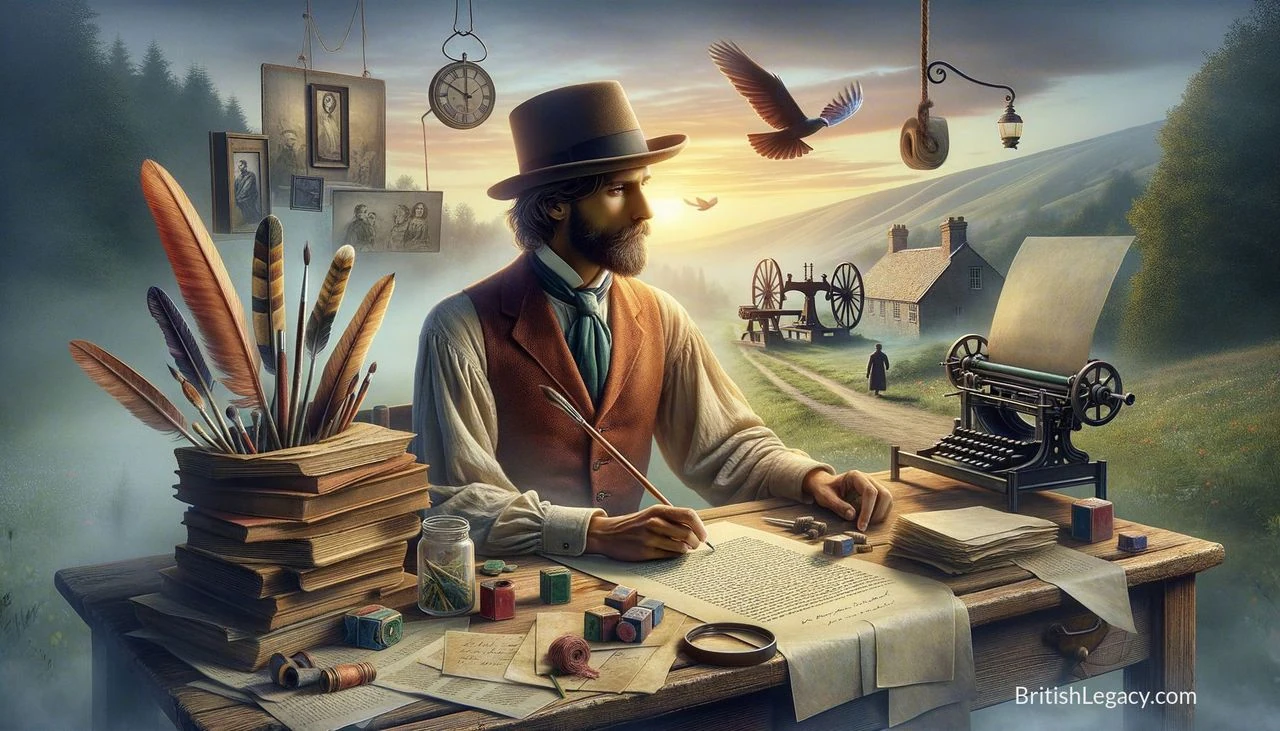
William Blake made books in which words and images were not separate contributions but parts of one design. Poet, painter and printmaker, he developed a way to print text and illustration together, then coloured many pages by hand. The work drew on a private mythology and a restless engagement with religion, politics and human experience. Though little recognised in his lifetime, Blake became a seminal figure in the poetry and visual art of the Romantic Age.
London beginnings and an engraver’s training
Blake was born in Soho, London, on 28 November 1757, the third of seven children of James Blake, a hosier, and Catherine Blake, née Wright. He attended school long enough to learn reading and writing, leaving at about ten, and was otherwise educated at home. His parents enrolled him in Henry Pars’s drawing school in the Strand. He also copied engravings of classical art, and the Bible became an enduring source for his writing and imagery.
In 1772, aged 14, he began a seven-year apprenticeship to the engraver James Basire. Basire sent him to draw in London’s Gothic churches, including Westminster Abbey. The buildings’ forms and decoration helped shape Blake’s artistic ideas. At the end of his apprenticeship he became a professional engraver; in 1779 he enrolled at the Royal Academy of Arts. There he resisted the fashionable approach associated with its first president, Joshua Reynolds, favouring particular, sharply defined forms over generalised ideals of beauty.
Blake married Catherine Boucher in 1782. She became a close collaborator as well as his life partner, helping to print and colour his work. In 1784, after his father’s death, Blake and fellow former apprentice James Parker opened a print shop. He also moved within the circle of radical publisher Joseph Johnson, whose associates included Mary Wollstonecraft and Thomas Paine. The political upheavals of the era informed his work, although his response to revolution was not a fixed political programme.
Poems made visible
Blake’s illuminated books bring together poetry, lettering and imagery on the same page. In 1788 he developed relief etching, a method that let him create text and design on a copper plate for printing together. He wrote and drew backwards on the plate in an acid-resistant medium; the acid removed the exposed areas, leaving the protected design raised for printing. He then inked the plate and often coloured the printed pages by hand. The method gave him close control over the relationship between poem and image.
Among the works made through this approach are Songs of Innocence and Songs of Experience, brought together as Songs of Innocence and of Experience in 1794. Their paired perspectives explore childhood, suffering and social life without treating either innocence or experience as a complete account of human nature. In The Marriage of Heaven and Hell, Blake challenged conventional divisions between good and evil, declaring that “Without Contraries is no progression”. His larger prophetic books, including Jerusalem, developed an intricate symbolic world that resists simple classification.
Relief etching was not his only work as a printmaker. Much of his commercial activity involved intaglio engraving, a slower process in which an image was cut into a copper plate. Blake also illustrated other writers, including Wollstonecraft and Robert Blair. His images for the Book of Job became a major late project. In 1825 he began a series of illustrations for Dante’s Divine Comedy; his death two years later left the undertaking unfinished.
Work, belief and recognition
Blake lived in London for most of his life, with a period in Felpham, Sussex, from 1800. There he worked on illustrations for the poet William Hayley, but came to resent what he saw as the demands of commercial work at the expense of art. In 1803, after an altercation with a soldier, he faced charges including sedition and treasonable expressions against the King. He was acquitted at the Chichester assizes.
Back in London, Blake continued to write, engrave and exhibit. His independent exhibition in 1809, held at his brother’s shop, attracted little attention, and its sole review was hostile. During his lifetime he had only a small audience for much of his work. His artistic and religious outlook also set him apart: he placed imagination at the centre of human existence and criticised institutions and forms of authority he believed constrained it. The visions he said he experienced were part of his own account of his artistic life; they should not be mistaken for evidence that his work can be reduced to biography or diagnosis.
Blake died in London on 12 August 1827. Catherine had worked alongside him for decades, and continued to sell his illuminated works after his death. His reputation grew later, particularly after the publication of a biography in the 1860s and the attention of Pre-Raphaelite artists and writers. In the twentieth century, scholars and artists helped bring his poetry and images to a wider public. His work has since found readers and interpreters across literature, visual art and music.
Why William Blake deserves a place in British Legacy
Blake’s place in British cultural history rests on a distinctive achievement: he made the physical form of a book part of its meaning. By developing relief etching for his illuminated works, he could bring poem, lettering and image together on a page, then apply colour by hand. That practice makes works such as Songs of Innocence and of Experience more than poems accompanied by pictures; their visual and verbal elements work in concert. His books also show an artist taking unusual control over how ideas were made and presented.
His importance is not limited to technique. Blake used poetry and visual art to examine childhood, suffering, power, religion and the limits imposed on human life. His thinking can be difficult and his symbolic system resists easy summaries, but that complexity has given later artists, writers and readers room to argue with his work and find new meanings in it. Recognition came slowly: he was little known in his lifetime, and the wider appreciation of his work grew after his death. Remembering Blake in British Legacy connects London’s artistic and printmaking traditions with a body of work that continues to invite close attention, across both page and picture.
Sources
William Blake — Wikipedia revision 1379569469
Adapted in part from William Blake by Wikipedia contributors, under CC BY-SA 4.0. Text has been edited and combined with the existing article; this adapted text is shared under the same licence. Contributor history.