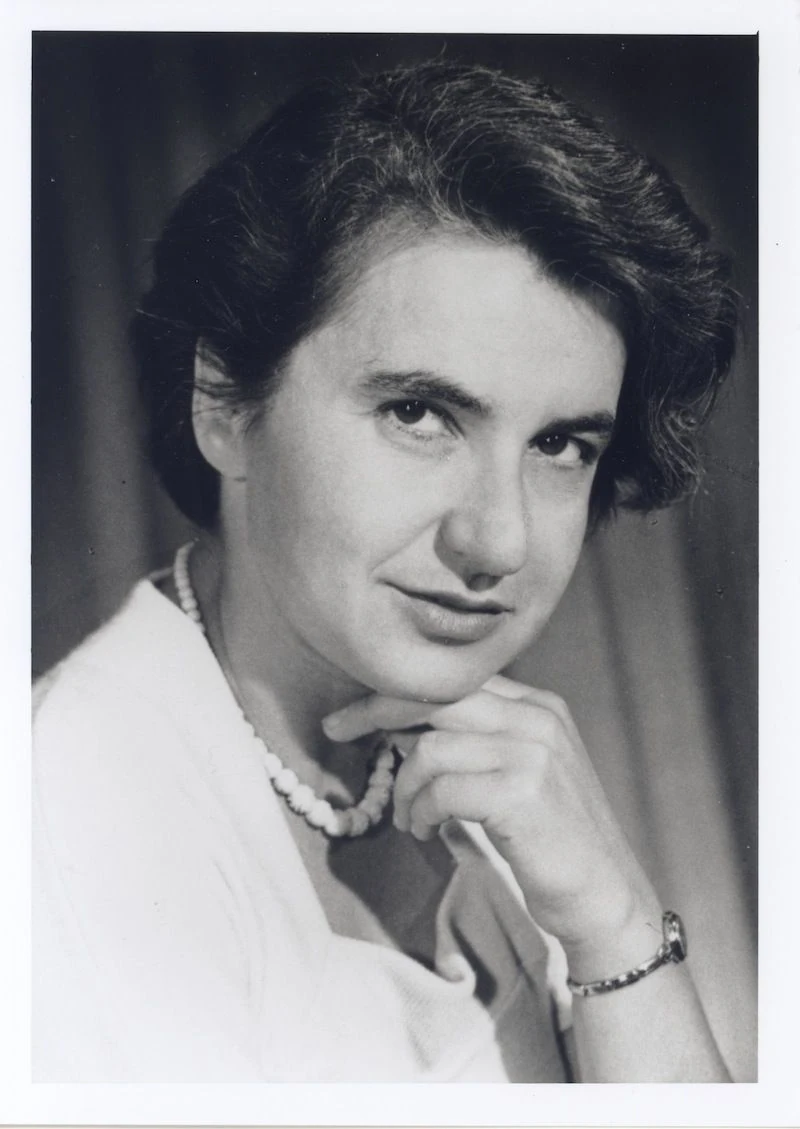
Rosalind Franklin’s scientific achievement was not simply to produce a celebrated X-ray image. It was to make diffraction patterns yield reliable evidence about the structure of matter. That ability helped clarify DNA’s helical form, but Franklin had already established her standing through research on coal and carbon. At Birkbeck, she later applied structural methods to viruses. Her career, conducted largely in British institutions and shaped by training in Paris, joined exacting experimental work to a range of questions extending from industrial materials to the biology of life.
Coal, carbon and a new method
Born in London on 25 July 1920, Franklin studied natural sciences at Newnham College, Cambridge. She graduated in 1941 and began research in physical chemistry. In 1942 she joined the British Coal Utilisation Research Association, investigating the structure and porosity of coal. By studying how gases moved through its pores, she examined the relationship between a material’s internal structure and its properties. This work formed the basis of her Cambridge PhD thesis, completed in 1945, on the physical chemistry of solid organic colloids with particular reference to coal.
Her coal research was not a brief prelude to the better-known DNA work. Franklin examined how carbon-rich materials changed when heated and why some could become graphite while others did not. She developed distinctions between graphitising and non-graphitising carbon, and published a series of studies on coal and carbon. The work gave her an established research field and addressed materials whose internal structure affected their behaviour and use.
In 1947 Franklin moved to Paris to work with Jacques Mering at the Laboratoire Central des Services Chimiques de l’État. There she became an accomplished X-ray crystallographer. X-ray diffraction does not photograph atoms directly: researchers infer structure from the patterns produced when X-rays interact with a material. Franklin learned to apply the method to substances that did not form simple, regular crystals, then used it in research on carbon. This experience became central to her later work on biological molecules.
DNA at King’s College London
Franklin joined the Medical Research Council’s Biophysics Unit at King’s College London in 1951. She was assigned to investigate DNA fibres and worked with Raymond Gosling, a doctoral student. Maurice Wilkins had also been studying DNA, but the allocation of responsibilities was not clearly communicated. The resulting confusion contributed to tension between Franklin and Wilkins. The scientific challenge was to obtain dependable evidence from fibres whose structure and behaviour varied with their conditions.
Franklin improved the quality of the X-ray diffraction work and devised a way to control the humidity around DNA fibres. This mattered because their form changed with water content. Franklin and Gosling distinguished two forms, known as A and B, and investigated the conditions in which each appeared. Careful control allowed them to compare like with like and to interpret the patterns more reliably.
In May 1952, Gosling took the image later known as Photograph 51 during his joint work with Franklin. It showed the B form of DNA. Its distinctive pattern strongly supported a helical structure, but the photograph was only one part of the scientific case. Franklin’s contribution also involved controlling experimental conditions, analysing diffraction patterns and assessing what the evidence could establish. Her measurements and interpretation helped make the data usable in testing a model of DNA.
Photograph 51 and the record of discovery
The history of how Franklin’s results reached other researchers is complicated, and a simple account of either solitary discovery or outright theft can obscure the evidence. Gosling later recalled that, as Franklin was preparing to leave King’s, he handed Photograph 51 to Wilkins. King’s account states that Wilkins showed the image to James Watson without Franklin’s agreement or knowledge. Franklin’s unpublished results also circulated through institutional channels, including a Medical Research Council report seen by Watson and Francis Crick. The supplied accounts do not settle every question about access and intention, so the episode should not be reduced to a single uncontested explanation.
Watson and Crick used evidence from the King’s work, alongside other information, in developing their model. On 25 April 1953, Franklin and Gosling published their own DNA paper in Nature, in the same issue as Watson and Crick’s model. Their publication presented experimental findings relevant to the proposed structure. The sequence of papers makes clear that the celebrated model and the experimental work at King’s belong to the same history, while also showing why Franklin’s contribution was not adequately conveyed by the public story that followed.
In 1962 the Nobel Prize in Physiology or Medicine was awarded to Francis Crick, James Watson and Maurice Wilkins. Franklin had died in 1958. She was therefore not among the recipients, and her role in the experimental case had not received equal recognition during her lifetime. Her importance, however, does not rest on speculation about an award she might have received. It rests on her research, the evidence she produced and published, and the independent scientific work she led afterwards.
From Birkbeck to viruses
In 1953 Franklin moved to Birkbeck College, University of London, where she worked under crystallographer John Desmond Bernal and led her own research group. She continued her investigations of carbon and turned to RNA and viruses, again using structural methods to answer biological questions.
Her group studied tobacco mosaic virus, an RNA virus. Franklin established that its particles were of consistent length, challenging an existing view. The team went on to examine the arrangement of the virus’s protein components and RNA. Franklin also contributed to work on other plant viruses, including turnip yellow mosaic virus. This research helped develop structural virology: the study of viruses through their organised physical and molecular structures.
In 1957 Franklin began research on polio virus, but her deteriorating health prevented her from completing the project. Her colleagues continued the work after her death. The Birkbeck years were therefore not an epilogue to the DNA research. They were a substantial new phase, in which Franklin built a group and extended structural analysis to questions about viruses and other nucleic acids.
Death and recognition
Franklin died in Chelsea on 16 April 1958, aged 37. She had been working on virus structures; the inscription on her tomb at Willesden Jewish Cemetery records that her research and discoveries on viruses remain of lasting benefit. The emphasis reflects the breadth of her work beyond DNA.
Her British recognition includes the Royal Society Rosalind Franklin Award and Lecture, established for outstanding contributions to natural science, engineering or technology and efforts to promote women in STEM. The Royal Society of Chemistry’s Chemical Landmark recognition at King’s commemorates the college’s DNA research. Franklin’s name thus appears not only in accounts of a famous discovery but in institutions that recognise scientific achievement and encourage later researchers.
Why Rosalind Franklin deserves a place in British Legacy
Franklin deserves a place in British Legacy because her research changed what scientists could know about the structure of matter and of life. At King’s College London, her work with Raymond Gosling produced and interpreted crucial X-ray evidence about DNA. Photograph 51 became an emblem, but it was not a self-explanatory revelation: its value depended on experimental control, careful measurement and scientific interpretation. Franklin’s work helped make a convincing structural model possible, and her findings appeared in the same issue of Nature as the Watson and Crick model. A fair account recognises both the importance of her evidence and the complicated history of how it was shared and acknowledged.
Her legacy is also unusually broad. Franklin’s British research began with coal, developed into influential work on carbon and graphite, and later encompassed RNA and viruses. At Birkbeck she led a research group and applied structural methods to biological problems beyond DNA, contributing to the study of viruses as organised molecular structures. This range matters: it shows a scientist who did not merely contribute to one celebrated moment, but repeatedly made difficult material evidence useful. Her work at Cambridge, King’s and Birkbeck, together with the British awards and commemorations that bear her name, makes her part of the country’s scientific history. Remembering Franklin accurately means valuing the rigour, breadth and lasting usefulness of that work.
Sources
Rosalind Franklin — Wikipedia, revision 1373331518
Adapted in part from Rosalind Franklin by Wikipedia contributors, under CC BY-SA 4.0. Text has been edited and combined with the existing article; this adapted text is shared under the same licence. Contributor history.