Mo Farah’s greatest races were often decided in the final lap. After staying with the leaders over thousands of metres, he could produce a sharp finishing sprint that few rivals could match. The tactic brought him four Olympic gold medals, six World Championship titles and a place among the most successful British track athletes in history. His career also began with a childhood marked by separation and exploitation, a story he did not make public until 2022.
A childhood reshaped by a new identity
Farah was born Hussein Abdi Kahin on 23 March 1983 in Gabiley, in what was then the Somali Democratic Republic. His father died when he was four, and he later became separated from his mother. At nine, he was brought to the United Kingdom from Djibouti by a woman he had not met before. He was made to use the name Mohamed Farah, belonging to another child, and was forced to work as a domestic servant.
For his first years in Britain, he was not allowed to attend school. At 11 or 12, he began Year 7 at Feltham Community College. His physical education teacher, Alan Watkinson, recognised his running ability and helped him get support from social services; Farah was subsequently fostered by another family. Watkinson also helped him apply for British citizenship, which he received in July 2000 under the name Mohamed Farah. Farah did not publicly disclose his birth identity and childhood experience until 2022.
He joined Hounslow Athletics Club and competed in the London Youth Games in 1994. A year later, he entered the English schools cross-country championships, finishing ninth. He won the first of five English school titles in 1997. In 2001, Farah began training at St Mary's University, Twickenham, and won his first major title: the 5,000 metres at the European Athletics Junior Championships. Athletics philanthropist Eddie Kulukundis paid legal fees connected with his naturalisation, helping him travel to competitions.
Building towards the world’s best
Farah’s progress through the 2000s brought national records and European medals, but the 2008 Beijing Olympics exposed the gap between promise and the very top level: he failed to reach the 5,000-metre final. He responded with a sequence of increasingly significant results. In 2009, he won the 3,000 metres at the European Indoor Championships. The following year, he took European gold in both the 5,000 and 10,000 metres in Barcelona, becoming the first Briton to win the European 10,000-metre title.
In 2011, Farah moved to Portland, Oregon, to train with Alberto Salazar and the Nike Oregon Project. At the World Championships in Daegu, he won silver in the 10,000 metres and gold in the 5,000, becoming the first British man to win a World Championships medal over either distance. His breakthrough reflected more than a fast finish: he developed the strength to remain in contention through the race and the tactical judgement to choose when to attack.
That year he also set British records in the 5,000 and 10,000 metres. In 2013, he broke the European 1,500-metre record, demonstrating a range that extended beyond his two best-known events. His career included competition from 1,500 metres to the marathon, though the 5,000 and 10,000 metres became the stage for his defining track achievements.
Olympic doubles and a defining celebration
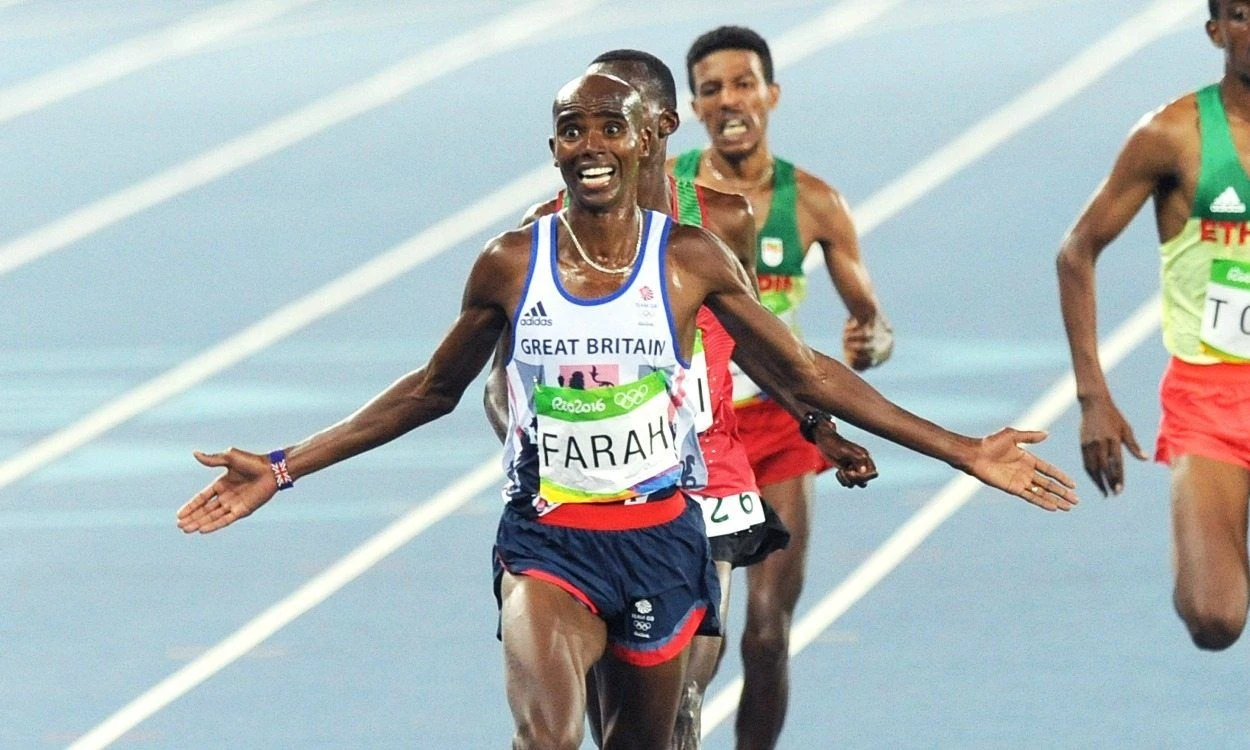
At the London 2012 Olympics, Farah won the 10,000 metres in 27 minutes 30.42 seconds, then took the 5,000 metres in 13:41.66. The second victory completed a long-distance double before a home crowd. He repeated it at Rio in 2016, winning both events again. He became only the second athlete, after Finland’s Lasse Virén, to take both Olympic titles at consecutive Games.
Farah extended the same command to the World Championships. He won both distances in Moscow in 2013 and Beijing in 2015. In London in 2017, his final World Championships appearance on the track, he won the 10,000 metres and finished second in the 5,000. He had announced that he would move from track racing to the marathon after the championships. His record across the Olympics and World Championships stood at four Olympic and six world titles.
The celebration associated with those victories became known as the “Mobot”: Farah curved his arms above his head to make an M. The gesture began after a 2012 television appearance, when presenter Clare Balding suggested the shape. It was an instantly recognisable way to mark a win, but the results behind it were the harder achievement: repeated success against the world’s leading distance runners over several seasons.
From the track to the road
Farah continued to win after turning to road racing. He won the Chicago Marathon in 2018 in 2:05:11, setting a European record. He also won the Great North Run six times in succession, from 2014 to 2019. The change of distance did not erase his track identity; rather, it showed the range of an athlete whose competitive career had moved between events from the 1,500 metres to the marathon.
In 2020, Farah set a world record for the one-hour run, covering 21,330 metres in Brussels. He returned to the track with the aim of qualifying for the Tokyo Olympics, but in 2021 finished eighth in the European 10,000-metre Cup and did not meet the Olympic qualifying standard. He began retirement after his final competitive race, the Great North Run, on 10 September 2023.
His honours included appointment as Commander of the Order of the British Empire in 2013 and a knighthood in the 2017 New Year Honours for services to athletics. In 2017, he was named BBC Sports Personality of the Year. Farah also established the Mo Farah Foundation after visiting Somalia in 2011; in 2012, he won £250,000 for the foundation on the television game show The Cube.
Why Mo Farah deserves a place in British Legacy
Farah’s place in British sporting history rests on results of unusual scale and consistency. He won the 5,000 and 10,000 metres at two successive Olympic Games, then added world titles in both events in 2013 and 2015. His four Olympic golds and six World Championship golds mark him out as one of the most successful male track distance runners in the sport’s history. Those victories were not confined to a single championship or a home Games: they came across years of competition, on different tracks and against successive generations of rivals.
His British connection is also part of the substance of his story. Farah developed as an athlete in west London, ran for Great Britain, trained at St Mary’s in Twickenham and became a leading representative of the country at international championships. His life story includes the difficult truth that he was trafficked to Britain as a child and forced to work under another child’s name, before a teacher helped secure support and a route into education. His later public account brought that experience into view without defining him solely by it. Alongside his competitive achievements, the Mo Farah Foundation and his fundraising on The Cube show a further connection between public sporting success and charitable work. His legacy combines extraordinary performance with a story rooted in British athletics and a life whose full history became known only much later.
Sources
Adapted in part from Mo Farah by Wikipedia contributors, under CC BY-SA 4.0. Text has been edited and combined with the existing article; this adapted text is shared under the same licence. Contributor history.