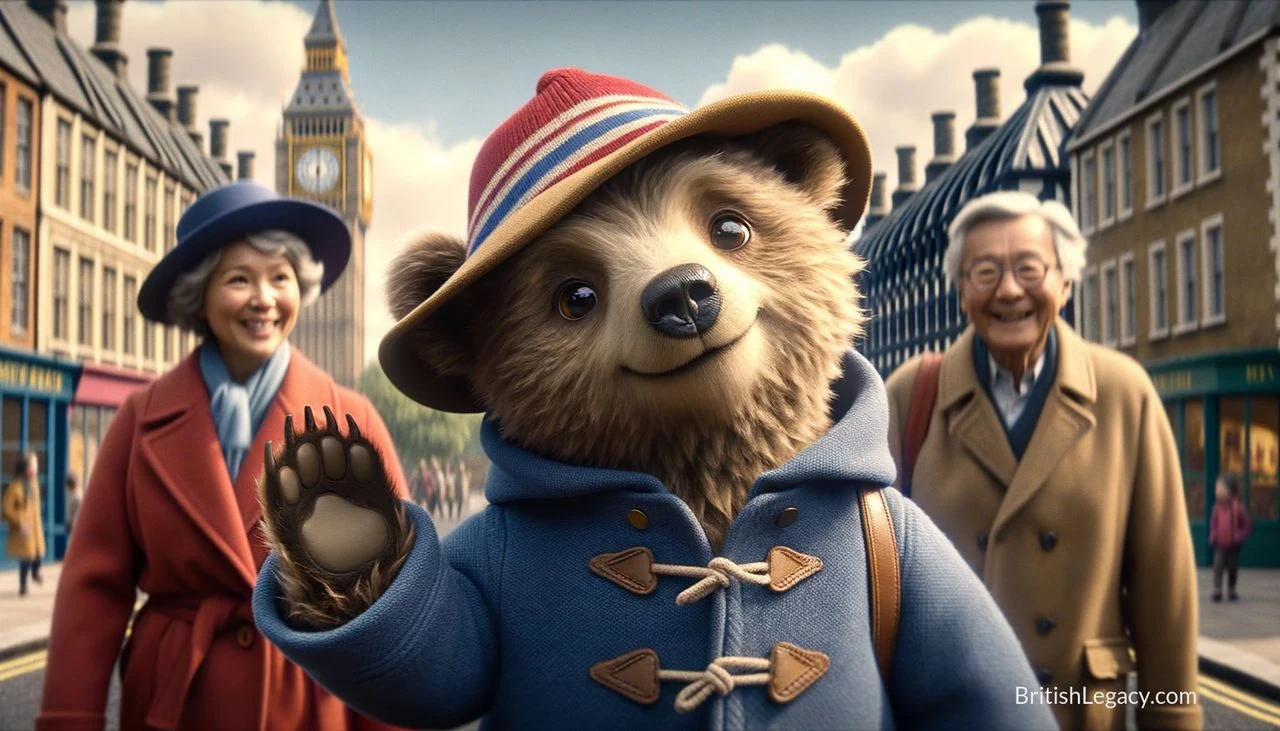
When Paddington arrives at the station that gives him his name, he is a stranger in a city that does not yet know what to make of him. Paul King’s 2014 film turns that meeting into a brisk live-action and animated adventure: a bear from Peru, a London family learning to make room, and a taxidermist determined to capture him. Its comedy sits alongside a more serious question about who gets welcomed into a home. Adapted from Michael Bond’s books, the film made a familiar British literary character the centre of an international cinema production.
A journey from Peru to the Browns’ doorstep
The film begins in Peru, where a British explorer encounters two members of a rare bear species, Lucy and Pastuzo. He discovers that they can speak and are especially fond of marmalade, and leaves them with his hat and an invitation to visit London. About 40 years later, an earthquake kills Pastuzo. Lucy sends their orphaned nephew to London while she goes to the Home for Retired Bears.
The young bear reaches Paddington station after stowing away on a cargo ship. Henry and Mary Brown and their children, Jonathan and Judy, take him in; their housekeeper, Mrs Bird, also comes to care for him. The family name him after the station. Henry is initially reluctant, but Paddington’s search for a permanent home gradually becomes a story about the Browns changing as much as their unexpected guest does.
That search leads towards the explorer, Montgomery Clyde, and the Geographers’ Guild, whose records of his expedition have been erased. It also brings Paddington to the attention of Millicent Clyde, a taxidermist at the Natural History Museum who wants to add him to her collection. When Millicent’s plan puts him in danger, the Browns come to his rescue. She is sentenced to community service in her father’s petting zoo, and the family let Paddington stay permanently.
Bond’s character, reworked for the screen
Michael Bond introduced Paddington in A Bear Called Paddington in 1958. The film draws on the character’s established fondness for marmalade and places his familiar journey to London within a new feature-length plot. King wrote and directed the adaptation from a story developed with Hamish McColl. David Heyman produced it, and Ben Whishaw voices Paddington. Hugh Bonneville and Sally Hawkins play Henry and Mary Brown; the cast also includes Julie Walters, Jim Broadbent, Peter Capaldi and Nicole Kidman.
The production combined live action with computer-generated animation. Framestore, a British visual-effects company, created Paddington using CGI and motion capture. The film’s London locations make the city more than a backdrop: scenes were filmed at Paddington station, around Portobello Road and in Primrose Hill, among other West London locations. The station’s exterior establishing shot, however, used nearby Marylebone station. The Geographers’ Guild sequences brought together Pall Mall’s Reform Club and interiors at Hatfield House in Hertfordshire.
The production itself crossed national lines. Paddington was a British-French venture involving StudioCanal UK, Heyday Films, TF1 Films Production and Anton Capital Entertainment. Principal photography began in September 2013 and wrapped in June 2014. Colin Firth was initially cast as Paddington’s voice but left the project after filming; Whishaw took over the role. The finished film opened in the United Kingdom on 28 November 2014 and in France the following week.
Kindness, comedy and a place in the city
King described his central interest as a question of family: whether it should be a closed, self-protective unit or one prepared to accept outsiders. He drew on London’s history of immigration, including calypso music associated with the Windrush generation. The film also gives Mr Gruber a refugee background, depicting him as having arrived in Britain in 1938. These choices locate Paddington’s personal search for safety within a broader story of migration and welcome, without making the film’s comedy dependent on its themes being stated aloud.
The film received two BAFTA nominations, for Best British Film and Best Adapted Screenplay, and won the Empire Award for Best Comedy Film. It also won the British Academy Children’s Award for Feature Film. Its commercial reach extended beyond Britain: it grossed $326.1 million worldwide. The first film began a series that continued with Paddington 2 in 2017 and Paddington in Peru in 2024. An animated television series, The Adventures of Paddington, launched in 2020, with Whishaw returning as the bear’s voice.
The film’s later life has also reached the stage. Paddington: The Musical, based on Bond’s characters and with a story inspired by the 2014 film, opened in London’s West End in 2025. The musical won seven Laurence Olivier Awards in 2026, including Best New Musical. Across these different forms, the character’s screen story has continued to introduce Paddington to audiences beyond the books’ established readership.
Why Paddington deserves a place in British Legacy
Paddington deserves a place in British Legacy not simply because it adapts a well-known children’s character, but because it makes the character’s arrival in London the engine of a distinctly place-based film. Paddington station, Portobello Road, Primrose Hill and other recognisable settings connect an imagined bear’s journey to the real city. The production also draws on British creative work, from Paul King’s writing and direction to Framestore’s visual effects, while its French partners show how a British film can be made through international collaboration.
The film gives that craft a clear human subject. Paddington is an outsider in need of safety, and the Browns must decide whether their household will make room for him. King’s interest in welcome and family informs a story that treats kindness not as a slogan but as a series of choices, culminating in the Browns’ decision to let him stay. The film’s success in cinemas, its sequels and television continuation, and its later adaptation for the West End show how Bond’s creation has travelled between books, screen and stage. That sustained life, grounded in London yet reaching international audiences, is a specific and enduring contribution to British popular culture.
Sources
Paddington (film), revision 1379017532
Adapted in part from Paddington (film) by Wikipedia contributors, under CC BY-SA 4.0. Text has been edited and combined with the existing article; this adapted text is shared under the same licence. Contributor history.