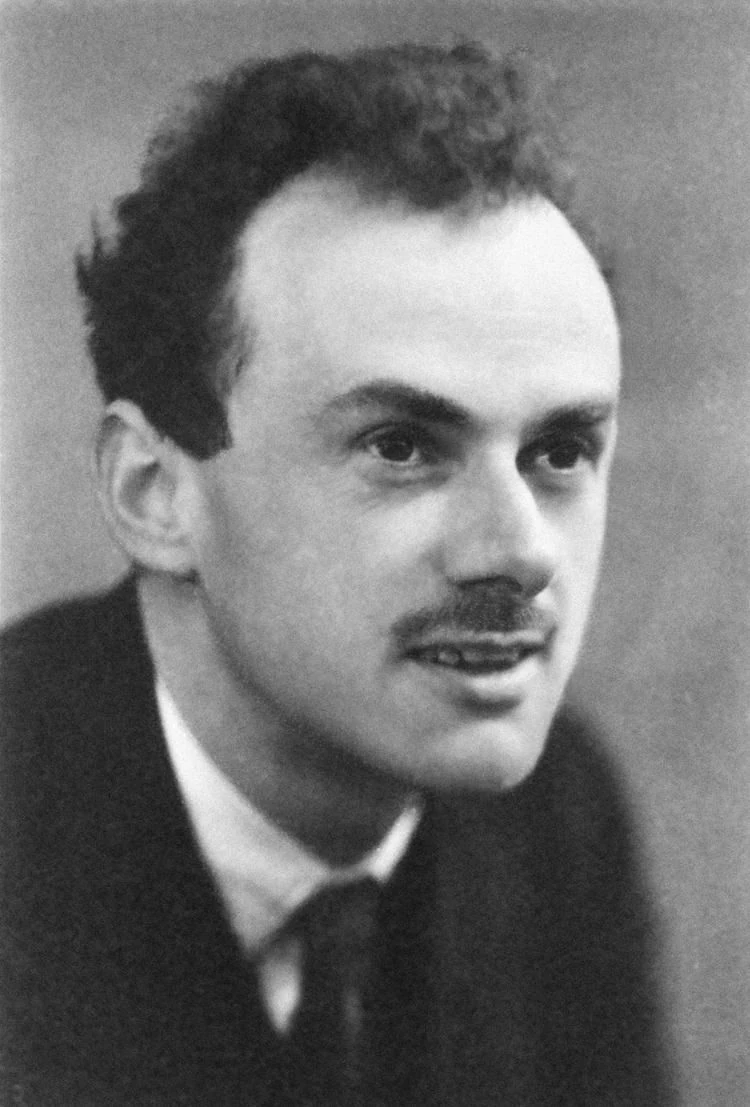
In 1928, Paul Dirac brought quantum mechanics and special relativity together in an equation describing the electron. Its mathematics pointed to a particle with the electron’s mass but opposite charge: the positron, later observed by Carl Anderson in 1932. The result made Dirac one of the central figures in modern theoretical physics. It also grew from a career formed in Bristol and Cambridge, where he helped establish ideas that would underpin quantum theory and quantum electrodynamics.
From Bristol engineering to Cambridge mathematics
Paul Adrien Maurice Dirac was born in Bristol on 8 August 1902. He attended Bishop Road Primary School and the Merchant Venturers’ Technical College, an institution attached to the University of Bristol. Its practical teaching included technical subjects alongside modern languages. Dirac later expressed gratitude for that education.
At the University of Bristol, he studied electrical engineering on a scholarship and graduated with first-class honours in 1921. The post-war economic climate made engineering work difficult to find. He therefore continued at Bristol, switching to mathematics and completing a second degree in 1923, again with first-class honours. The mathematical training became crucial to his physics: Dirac was drawn to the relationship between mathematical structures and the laws of nature.
Scholarships enabled him to move to Cambridge, where he studied at St John’s College under the physicist Ralph Fowler. He completed his PhD in 1926, submitting what the supplied Wikipedia article describes as the first thesis on quantum mechanics. His early research helped turn the new theory into a coherent mathematical framework. By connecting Heisenberg’s matrix mechanics with classical mathematical ideas, Dirac developed a general formulation of quantum mechanics using non-commuting variables.
Quantum mechanics and the Dirac equation
Dirac’s 1928 equation addressed a problem in the theory of the electron: how to describe it in a way consistent with both quantum mechanics and special relativity. The equation did more than provide a relativistic account of the electron. Its implications included the existence of an antiparticle, which Dirac interpreted through the positron. Anderson observed the positron in 1932, four years after Dirac formulated the equation.
The equation’s significance reached beyond that prediction. It helped explain the origin of quantum spin as a relativistic phenomenon and became a central part of theoretical physics. Dirac’s work also contributed to quantum field theory, the framework used to describe elementary particles and their interactions. He was the first to use the term “quantum electrodynamics” for the theory of interactions involving charged particles and light.
His contributions were not confined to the equation that bears his name. Dirac and Enrico Fermi independently developed the statistical description of systems of identical particles with half-integer spin, now known as Fermi–Dirac statistics. Dirac introduced the terms “fermion” and “boson” for particles with half-integer and integer spin respectively. His work on quantum mechanics also gave physics the Dirac delta function and bra–ket notation, a compact way to express states and operators that remains widely used.
In 1930, Dirac published The Principles of Quantum Mechanics. The book brought earlier approaches, including matrix mechanics and wave mechanics, into a unified mathematical formalism. It became a standard text and helped communicate the structure of the subject to generations of physicists. Dirac also investigated magnetic monopoles, hypothetical particles that would carry a single magnetic pole. He showed that the existence of even one such monopole could account for the quantisation of electrical charge; none has been detected.
Cambridge, wartime work and international physics
Dirac became Lucasian Professor of Mathematics at the University of Cambridge in 1932, a post he held until 1969. In 1933, he shared the Nobel Prize in Physics with Erwin Schrödinger. The award citation recognised their discovery of “new productive forms of atomic theory”. Dirac was elected a Fellow of the Royal Society in 1930 and later received its Royal Medal and Copley Medal.
During the Second World War, Dirac contributed to Tube Alloys, Britain’s programme of research into atomic weapons. His theoretical work on uranium enrichment included contributions to gas-centrifuge technology. He also continued to investigate foundational problems in physics, including the relationship between quantum mechanics and gravity. Later, his Hamiltonian methods for constrained systems would provide a framework used in approaches to quantum gravity.
Dirac’s influence travelled through both his writing and his teaching. Among his students were Homi J. Bhabha, Fred Hoyle, John Polkinghorne and Freeman Dyson. His work on quantum electrodynamics informed the next generation of physicists, including Richard Feynman, Julian Schwinger and Sin-Itiro Tomonaga. They developed the theory further, using renormalisation to address infinities in its calculations. Dirac remained dissatisfied with that procedure, an example of his insistence that mathematical consistency mattered as well as agreement with experiment.
In 1969, Dirac left his Cambridge chair on reaching the retirement age. He moved to Florida and joined Florida State University, where he became a professor in 1972. He continued publishing and working on theoretical physics. His final paper, published in 1984, returned to his reservations about quantum field theory and ended with a statement of his intention to keep searching for a Hamiltonian formulation.
Recognition, remembrance and a distinctive approach
Dirac was known among colleagues for being precise and taciturn. More securely documented than the imported article’s “silent genius” label is his commitment to mathematical beauty as a guide in physics. He argued that physical laws should have mathematical beauty, treating it as both a quality of nature and a practical principle for developing theory.
He died in Tallahassee, Florida, on 20 October 1984, aged 82. His honours included the 1933 Nobel Prize, the Royal Medal in 1939 and the Copley Medal in 1952. In 1995, a marker inscribed with the Dirac equation was unveiled in Westminster Abbey. His Bristol childhood home is commemorated with a blue plaque, and a road nearby bears his name.
Institutions have also kept his work in view. The Institute of Physics awards the Paul Dirac Medal for outstanding contributions to theoretical physics, while the International Centre for Theoretical Physics presents an annual Dirac Medal. At Florida State University, the Paul A. M. Dirac Science Library and a statue commemorate his later career there. These tributes reflect a scientific legacy that belongs to more than one country, but began with his education and early intellectual formation in Britain.
Why Paul Dirac deserves a place in British Legacy
Dirac’s place in British Legacy rests first on the reach of his scientific work. Educated in Bristol and Cambridge, he helped give quantum mechanics a rigorous mathematical form and produced an equation that joined it to special relativity. That equation predicted the positron before it was observed, while his wider work helped establish quantum field theory and quantum electrodynamics. His contributions to Fermi–Dirac statistics, particle terminology and the mathematical language of quantum physics remain part of the discipline’s foundations.
His British story is not simply one of birthplace or honours. Bristol’s engineering education preceded the mathematical studies that took him to Cambridge; there, he held the Lucasian chair for nearly four decades, taught influential students and wrote a book that became a standard text. His wartime work also connected theoretical physics with a major British research programme. The enduring value of this record lies in the tools and ideas other scientists could use: a way to describe particles, a framework for understanding their interactions and a disciplined example of mathematical reasoning. Bristol’s commemorations, the Westminster Abbey marker and the Institute of Physics medal make that continuing influence visible in British public and scientific life.
Sources
Adapted in part from Paul Dirac by Wikipedia contributors, under CC BY-SA 4.0. Text has been edited and combined with the existing article; this adapted text is shared under the same licence. Contributor history.