When Paula Radcliffe crossed the London Marathon finish line in April 2003, her time of 2:15:25 set a women’s marathon world record that stood for 16 years. The performance was the defining mark of a career that ranged from junior cross-country victories to Olympic finals, world titles and repeated wins on the roads. Radcliffe’s story is not one of a single record alone: it is also a record of sustained competition, interrupted by injuries and difficult setbacks, and of her outspoken concern about doping in athletics.
Learning to run in Cheshire and Bedfordshire
Radcliffe was born in Davenham, Cheshire, on 17 December 1973. She began running at seven, joining Frodsham Athletic Club, and later became a member of Bedford & County Athletics Club after her family moved to Oakley, Bedfordshire. There, coach Alex Stanton guided her development from the age of 12. Her first national-level race came at the 1986 English Schools Cross Country Championships, where she finished 299th in a field of around 600; the following year she placed fourth. In 1991 she won the English Schools 1,500 metres title.
Her early progress came alongside health challenges. Radcliffe experienced asthma and was diagnosed with exercise-induced asthma at 14; she discovered she had anaemia in 1992. In that year, she won the junior race at the World Cross Country Championships in Boston. At 19, she finished seventh in the 3,000 metres at the 1993 World Championships, the first of several appearances at the highest level. She studied French, German and economics at Loughborough University, graduating in Modern European Studies.
The years before her marathon career established her as a versatile distance runner. She won silver in the 1997 and 1998 World Cross Country Championships, then took the European cross-country long-course title in 1998. At the 1999 World Championships in Seville she won silver in the 10,000 metres. In 2000, she claimed her first senior world title at the World Half Marathon Championships. She went on to win the half-marathon title in 2001 and 2003 as well.
From the track to the marathon
Radcliffe represented Great Britain at four consecutive Olympic Games, from Atlanta in 1996 to Beijing in 2008. Her fifth place in the 5,000 metres at Atlanta was followed by fourth in the 10,000 metres at Sydney in 2000, where she set a British record. She did not win an Olympic medal, but the results show how often she competed among the world’s leading distance runners across different events.
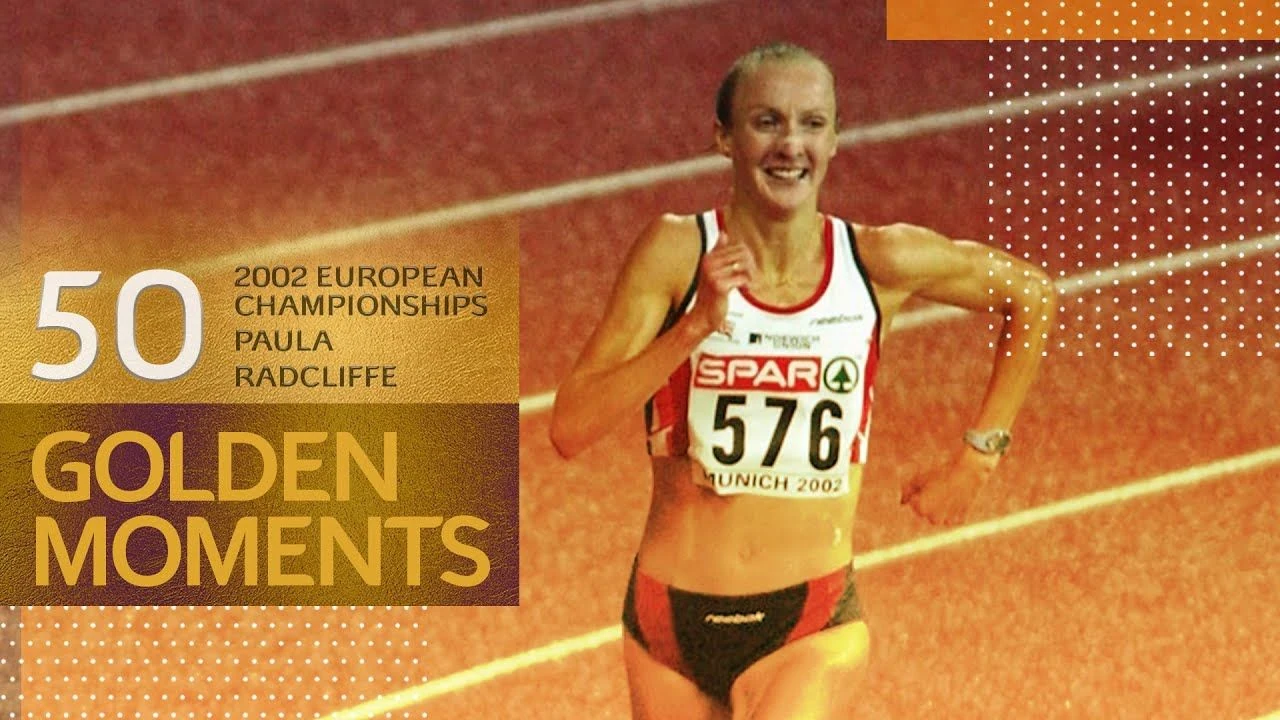
In 2002, she moved up to the marathon and won on her London debut in 2:18:55, then the fastest time in a women-only race. Later that year she set a world record of 2:17:18 at the Chicago Marathon. She also won the European 10,000 metres title in Munich and the 5,000 metres at the Commonwealth Games in Manchester. At the end of the year, she received the BBC Sports Personality of the Year award and was appointed an MBE for services to athletics.
Her next London appearance brought the 2:15:25 world record on 13 April 2003. It remained the women’s marathon world record until Brigid Kosgei broke it in 2019. Radcliffe also won the London Marathon in 2005, making her a three-time winner of the race, and took the New York City Marathon title in 2004, 2007 and 2008. In 2005 she became world marathon champion in Helsinki, winning in a championship-record 2:20:57. She also won the 2002 Chicago Marathon. These achievements place the record within a wider body of success across major road races and championship competition.
Setbacks, comebacks and the end of competition
Radcliffe’s career also included stretches when injury and illness kept her from competing. In 1994, a foot injury, initially misdiagnosed, forced her to miss the season and left her considering whether to quit. Later, knee and calf problems disrupted her 2000 campaign. Her most public disappointment came at the 2004 Athens Olympics. After a leg injury shortly before the marathon, she withdrew after 36 kilometres; five days later, still affected by the preceding problems, she retired from the 10,000 metres. The two departures came after extensive preparation and intense public attention.
In 2005 she won the London Marathon and then the world title in Helsinki. After taking a break in 2006 and giving birth to her first child, her return was delayed by a stress fracture in her lower back. She resumed racing in 2007, finished second at the Great North Run, then won the New York City Marathon. A foot injury and a femoral stress fracture disrupted her preparation for Beijing in 2008. She completed the Olympic marathon in 23rd place, having struggled with cramp, and later won the New York race for a third time.
Further injuries affected her seasons in 2009 and 2011. She finished third in the 2011 Berlin Marathon, but a foot injury ruled her out of the London 2012 Olympic Games. In January 2015, she announced that the London Marathon that April would mark the end of her marathon career. She finished in 2:36:55. Radcliffe later worked as a BBC athletics pundit and commentator. In 2025, she returned to marathon competition, finishing the Tokyo Marathon in 2:57:22 and the Boston Marathon in 2:53:44, where she won her category.
Speaking out about fairness in athletics
Radcliffe became a prominent opponent of performance-enhancing drugs. In 2001, she and fellow British runner Hayley Tullett protested against the reinstatement of Russian athlete Olga Yegorova after a positive test for EPO. Radcliffe continued to call for robust testing and sanctions for doping offences, and wore a red ribbon while competing to show support for blood testing. Her stance made anti-doping a visible part of her public role as well as a question for governing bodies and competitors.
Her contribution to British sport has also been recognised through awards and appointments. In addition to her MBE, she received the Laureus World Comeback of the Year award in 2008 and was inducted into the England Athletics Hall of Fame in 2010. She was inducted into Loughborough University’s Hall of Fame in 2015, after graduating from the university and receiving an honorary Doctor of Technology degree in 2002. Her career joined elite competition to a continuing presence in athletics as a broadcaster.
Why Paula Radcliffe deserves a place in British Legacy
Paula Radcliffe deserves a place in British Legacy because her achievements give a clear measure of how far British distance running could reach across track, cross-country and road events. Her 2:15:25 London Marathon world record lasted from 2003 until 2019, but the record was not an isolated result. She won the London Marathon three times, the New York City Marathon three times, the 2005 world marathon title, the European 10,000 metres championship and three World Half Marathon Championships. She also represented Great Britain at four Olympic Games, taking on the world’s strongest fields even though an Olympic medal eluded her.
Her legacy includes both performance and public responsibility. Radcliffe’s repeated protests against doping helped make fair competition a visible issue in athletics, and her later work as a BBC pundit and commentator extended her connection with the sport beyond her own racing career. Her international victories were achieved while representing Great Britain and England, bringing British athletics into prominent contests around the world. The account of her career also matters because it does not conceal its disappointments: Olympic withdrawals, recurring injuries and delayed comebacks sit alongside the titles and records. That combination gives her place in British sporting history substance. She showed the reach of a British runner at the highest level, and the breadth of her career remains a significant example of endurance across disciplines and generations of competition.
Sources
Paula Radcliffe — revision 1376829645 · Paula Radcliffe
Adapted in part from Paula Radcliffe by Wikipedia contributors, under CC BY-SA 4.0. Text has been edited and combined with the existing article; this adapted text is shared under the same licence. Contributor history.