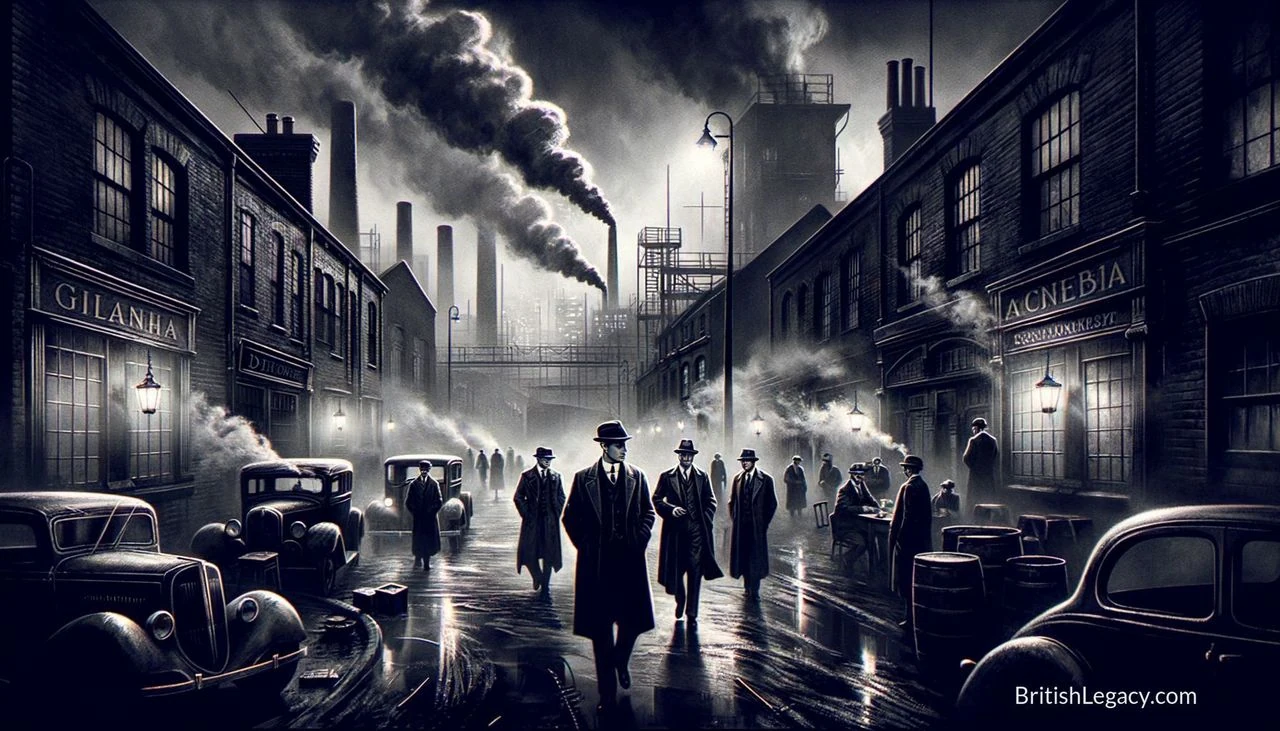
When Peaky Blinders arrived on television in September 2013, it brought a fictional Birmingham crime family into a setting shaped by the city’s real street-gang history. Cillian Murphy stars as Thomas Shelby, whose family operates in the underworld of post-First World War Small Heath. The drama takes its name from a gang that existed in Birmingham from the late nineteenth century into the 1920s, but its Shelbys are fictional: the series uses the past as a foundation for its own story rather than as a documentary account.
A fictional family in a real city
The series follows the Shelby family’s growing power in Birmingham. Thomas is its central figure, with Paul Anderson playing Arthur Shelby and Helen McCrory playing Aunt Polly. The story places the family among competing interests in the city’s criminal underworld, including the Birmingham Boys and the Sabini gang. That fictional conflict draws on a real history of gangs and territorial violence, while the Shelby family and the drama’s particular events belong to the series.
The historical Peaky Blinders were a street gang based in Birmingham, associated especially with Small Heath and Cheapside. They were among groups formed in a city where poverty, gambling dens and rough street sports helped foster youth violence. In the 1890s, gangs consisted of boys and men between the ages of 12 and 30. The Peaky Blinders’ activities included robbery, violence, racketeering, illegal bookmaking and control of gambling. Their reputation was built not only on battles with rival groups but on assaults against members of the public and police officers.
The gang name appears in a Birmingham newspaper report about an assault in March 1890. Its origin is less certain than the television story’s familiar image suggests. One explanation links “peaky” to the shaped peak of a flat cap and “blinder” to a Birmingham slang term for someone smartly dressed. The claim that gang members sewed razor blades into their caps is described as a folk etymology, not an established historical fact. The series’ striking name therefore carries a piece of local history, but its best-known explanation should not be mistaken for confirmed evidence.
Territory, rivalry and decline
The real gang’s influence grew through fights over territory in Birmingham and nearby districts. Its rivals included the Cheapside Sloggers, whose name reflects the rough fighting culture of the period. Over time, the Blinders expanded beyond street fighting and robbery into activities such as protection rackets, fraud, smuggling, hijacking and bookmaking. Historian Heather Shor is cited as distinguishing their emphasis on street violence and protection rackets from more organised criminal activity.
Accounts of the gang describe violent confrontations with police as well as rival groups. Constable George Snipe was killed in 1897 and Charles Philip Gunter in 1901. The group also used weapons including knives, belt buckles, metal-tipped boots and firearms. This history gives the drama a harsher context than its celebrated dress and visual style alone might suggest: the real gang’s influence involved serious violence against both rivals and people who were not involved in gang life.
Among the historical figures associated with the gang were Thomas Gilbert, who used the name Kevin Mooney, and members David Taylor, Earnest Haynes, Harry Fowles and Stephen McNickle. Billy Kimber, later a prominent rival in the Birmingham underworld, was a former Peaky Blinder. Some members served in the First World War; Henry Lightfoot, identified as the first person named as a Peaky Blinder, fought at the Battle of the Somme in 1916.
The gang’s position weakened as the larger Birmingham Boys, led by Kimber, challenged its influence, particularly after the Blinders extended their reach into racecourses. The Peaky Blinders had largely disappeared by the 1920s. The gang’s name nevertheless lived on as a general term for violent young street criminals in Birmingham. The television series turns that history into family drama, but the real group’s changing fortunes were shaped by rivalry, policing, education, discipline and harsher sentencing.
Style, sound and screen world
Steven Knight created the television drama, which stars Murphy, Anderson, McCrory, Sophie Rundle and Joe Cole. Its fictional account places a family in a Birmingham underworld that the historical gang once inhabited. Several exteriors were filmed at the Black Country Living Museum, connecting the production’s visual landscape to the industrial Black Country near Birmingham.
The real gang’s clothing offered a distinctive visual reference. Members wore flat caps and overcoats, with tailored suits, buttoned waistcoats, bell-bottom trousers and, among wealthier men, silk scarves and starched collars. Such dress was sufficiently recognisable to city residents, police and rival gang members. The television series’ carefully composed period look draws attention to this sartorial history, though the real gang’s clothes were not simply costume: they helped mark identity and status in the city.
The programme also sets modern rock and indie music against its historical setting. The article describes music by Arctic Monkeys and Nick Cave and the Bad Seeds; that deliberate contrast gives the drama a sound distinct from a strictly period-based soundtrack. Alongside the costumes and locations, it makes the series’ past feel staged for a contemporary audience rather than presented as a neutral reconstruction.
The story later extended to film. Peaky Blinders: The Immortal Man, directed by Tom Harper and written by Knight, premiered on 2 March 2026 and aired on Netflix on 20 March 2026. The move from television to a feature film continues the screen life of a title that draws its force from the meeting of a real Birmingham gang’s name and a fictional family’s fortunes.
Why Peaky Blinders deserves a place in British Legacy
Peaky Blinders deserves a place in British Legacy because it makes a specific part of Birmingham’s history newly visible while keeping the distinction between history and invention in view. The real gang emerged from the city’s street life, fought for territory and became associated with violence, robbery and control of gambling. The series centres a fictional family in that setting, using the Shelby story to bring the name and atmosphere of Birmingham’s gangland past to television audiences. Its local grounding is reinforced by filming at the Black Country Living Museum, rather than relying on an unspecified, interchangeable image of Britain.
The series’ legacy also rests on the way it combines period clothing and places with modern music and a continuing screen story. Its flat caps and tailored suits recall real gang fashion, while its soundtrack makes clear that the programme is a contemporary interpretation, not a claim to reproduce the past exactly. That distinction matters: the razor-blade story is a popular explanation for the gang’s name, but the historical account identifies it as apocryphal. By bringing Birmingham’s history into popular drama—and by prompting viewers to distinguish documented history from television invention—the series contributes to how the city and its past are represented in British popular culture.
Sources
Adapted in part from Peaky Blinders by Wikipedia contributors, under CC BY-SA 4.0. Text has been edited and combined with the existing article; this adapted text is shared under the same licence. Contributor history.