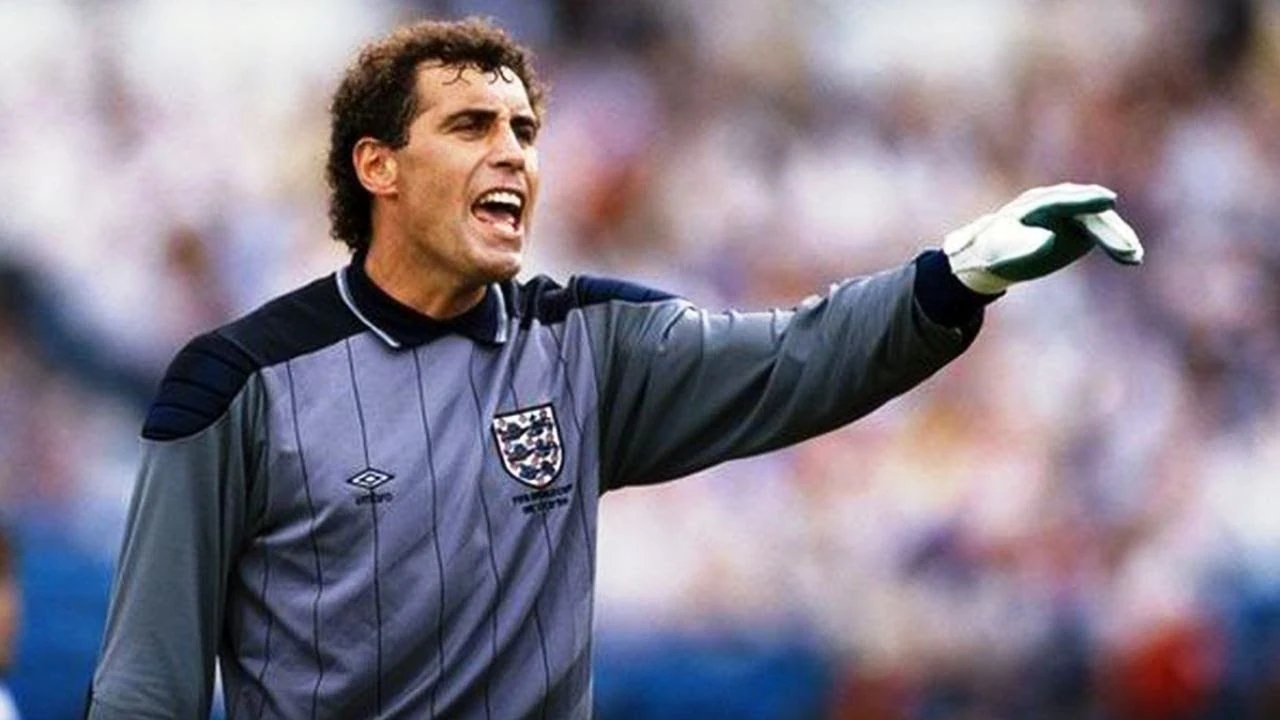
Peter Shilton’s career took him from a teenage debut for Leicester City to 1,005 English league appearances, two European Cups with Nottingham Forest and 125 games for England. The goalkeeper’s longevity is striking, but so is the range of his career: he played in three World Cups, moved between leading English clubs and remained in the professional game until he was 47.
A Leicester teenager steps into the first team
Born in Leicester on 18 September 1949, Shilton joined Leicester City’s schoolboy set-up in 1963, aged 13. First-team goalkeeper Gordon Banks noticed his promise. In May 1966, at 16, Shilton made his senior debut against Everton. Leicester soon made him their first-choice goalkeeper, selling Banks to Stoke City.
Shilton established himself through a difficult period for the club. Leicester were relegated from the First Division in 1969, reached that season’s FA Cup final, and returned to the top division as Second Division champions in 1971. Shilton was still only 19 when Leicester faced Manchester City at Wembley; a Neil Young goal decided the final. In 1967 he had scored an unusual goal of his own, a long clearance that bounced over Southampton goalkeeper Campbell Forsyth and into the net.
In November 1974, Stoke City signed Shilton for £325,000, then a world-record fee for a goalkeeper. He played every one of Stoke’s 48 fixtures in 1975–76. The club’s finances came under pressure after a storm damaged the Victoria Ground, and Stoke sold players to fund repairs. Shilton remained through relegation in 1977 before joining Nottingham Forest that September.
Forest’s European Cup years
Under manager Brian Clough, Forest had just been promoted when Shilton arrived. They won the First Division title in their first season back, with Shilton conceding only 18 goals in 37 league appearances. A decisive save against Coventry City was widely praised, and his fellow professionals voted him PFA Players’ Player of the Year for 1977–78.
Forest’s success continued in Europe. Shilton played in the 1979 League Cup final as Forest beat Southampton, then helped the club win its first European Cup, defeating Malmö 1–0 in Munich. Forest retained the trophy in 1980, beating Hamburg by the same score in Madrid. The run also included a League Cup final defeat to Wolverhampton Wanderers in 1980. Shilton’s years at Forest ended in 1982, when he moved to Southampton.
He later joined Derby County, helping the side finish fifth in the league. English clubs were then barred from European competition following the Heysel disaster, so Derby could not take a UEFA Cup place. After Derby were relegated in 1991, Shilton considered a move into management. In 1992 he became player-manager of Plymouth Argyle. The club was relegated during his first season; it reached the Division Two play-offs in 1994 but lost in the semi-finals.
England across three World Cups
Shilton made his England debut against East Germany in November 1970. He initially competed with Ray Clemence for the goalkeeper’s place, and England managers alternated between the two before Shilton became the established first choice. He helped England qualify for the 1980 European Championship, their first appearance at the tournament for a decade, and played at the finals in Italy.
His first World Cup finals came in Spain in 1982, when he was 32. England won all three group matches and advanced to the second phase. Under Bobby Robson, Shilton’s international role grew: he sometimes captained the side and became its regular goalkeeper. England missed out on the 1984 European Championship, but qualified for the 1986 World Cup in Mexico.
That tournament brought the quarter-final against Argentina. Diego Maradona scored twice: first with the handball he later called the “Hand of God”, which the referee allowed, and then with a solo run that became known as the “Goal of the Century”. Gary Lineker pulled one goal back, but England were eliminated. Shilton and his team-mates protested the handball; the two goals became inseparable from accounts of the match.
At the 1990 World Cup in Italy, Shilton played in England’s run to the semi-finals. A deflected Andreas Brehme free kick put West Germany ahead; Lineker equalised, but England lost the penalty shoot-out. Shilton then played in the third-place match against Italy. It was his 125th and final England appearance, nearly 20 years after his debut. He and Harry Kane share the record for most appearances by an England men’s player. Shilton also played in 17 World Cup finals matches and shares the record of ten clean sheets in those matches with Fabien Barthez.
A thousand league games and a long farewell
After Plymouth, Shilton returned to playing. He joined Wimbledon as injury cover but did not make a first-team appearance, then had spells with Bolton Wanderers, Coventry City and West Ham United. At Bolton he made appearances, including in a play-off semi-final; he did not play in the second leg. He also did not make first-team appearances for Coventry or West Ham.
Shilton was closing in on 1,000 Football League matches when he joined Leyton Orient in November 1996. His thousandth came against Brighton & Hove Albion on 22 December, in a match shown live on Sky Sports. He retired at the end of the 1996–97 season with 1,005 Football League appearances, aged 47. His record of 1,387 competitive appearances in world football stood until 2025.
Across his career he played for 11 clubs and made more than 100 appearances for five of them. He collected major honours with Forest, including two European Cups, the First Division title, the European Super Cup and two League Cups. Individual recognition included ten selections for the PFA First Division Team of the Year, the 1977–78 PFA Players’ Player of the Year award and induction into the English Football Hall of Fame in 2002.
Life and recognition beyond the pitch
Shilton married Sue Flitcroft in 1970; they had two sons. He later married jazz singer Stephanie Hayward in 2016. He has spoken publicly about overcoming a gambling addiction and has worked with the UK government to raise awareness of related harms, including mental health problems. That work gives context to the advocacy mentioned in accounts of his life after football, without reducing a long playing career to its difficulties.
His honours reflect both his football and his work to prevent gambling harm. Shilton was appointed MBE in 1986 and OBE in 1991, then made a CBE in the 2024 New Year Honours for services to association football and the prevention of gambling harm. After retiring, he also became a regular after-dinner speaker.
Why Peter Shilton deserves a place in British Legacy
Shilton’s place in British sporting history rests on achievement as well as endurance. His 125 England caps, spanning 1970 to 1990, link successive generations of the national side. He played at three World Cups and helped England reach the 1990 semi-final. At club level, his role in Nottingham Forest’s consecutive European Cup victories in 1979 and 1980 places him at the centre of one of English football’s most notable achievements on the continental stage. His 1,005 Football League appearances make the scale of that career tangible: he kept playing across four decades and reached the thousand-match mark at Leyton Orient at 47.
His story also preserves the complications of a long sporting life. Shilton’s England career contained both remarkable tournaments and the difficult, highly visible defeat to Argentina in 1986; the 1990 semi-final ended in a penalty shoot-out loss. His work to raise awareness of gambling harm adds a further dimension to his public contribution. Together, these details make his legacy more than a list of records: they connect club football, the England team, European competition and later advocacy. For British Legacy, Shilton represents a career whose scale and reach can be traced through specific matches, teams and milestones, rather than through generic claims of sporting greatness.
Sources
Peter Shilton — revision 1378996612 · Peter Shilton
Adapted in part from Peter Shilton by Wikipedia contributors, under CC BY-SA 4.0. Text has been edited and combined with the existing article; this adapted text is shared under the same licence. Contributor history.