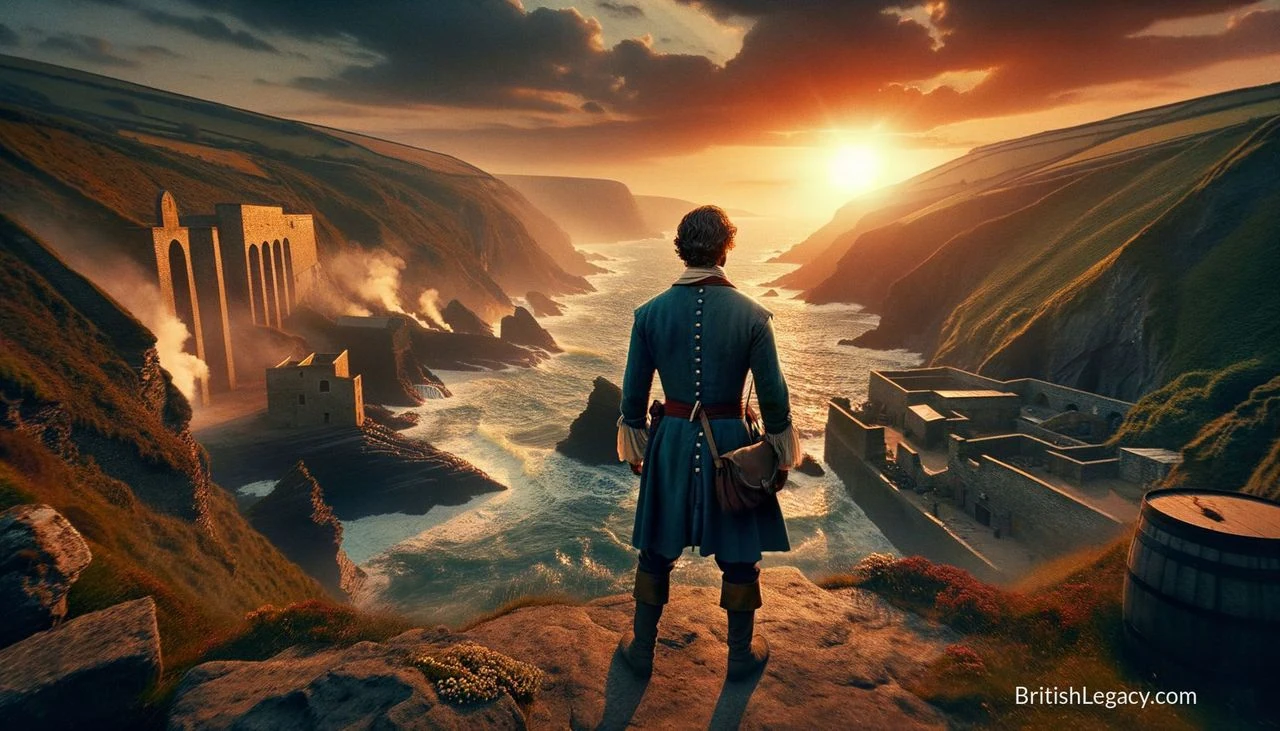
When Ross Poldark returns to Cornwall from the American War of Independence, he finds his father dead, the family estate in decline and Elizabeth Chynoweth, the woman he hoped to marry, betrothed to his cousin Francis. That turbulent homecoming begins Winston Graham’s Poldark novels, a twelve-book story whose fortunes, romances and rivalries unfold across Cornwall and into the early nineteenth century. The books have twice been adapted for television by the BBC, bringing Graham’s imagined world to successive generations of viewers.
A Cornish story in twelve novels
Graham published the first four novels between 1945 and 1953, then returned to the series after a long pause with The Black Moon in 1973. The first seven books follow events from 1783 to Christmas 1799; the remaining five move into the early nineteenth century and follow the lives of the main characters’ descendants. Each book carries the subtitle A Novel of Cornwall, making its regional setting part of the series’ identity from the outset.
Ross tries to rebuild his fortunes by reopening one of his family’s derelict copper mines. His life does not settle into a simple recovery: his relationships with Elizabeth and Francis are strained by her marriage to Francis, while Demelza Carne, a miner’s daughter taken into his household as a servant, becomes his wife. Graham’s plot follows personal attachments alongside work, money and social position. The novels’ Cornwall is not merely a scenic background; it is the place where the Poldarks’ household and livelihood are tested.
The series’ reach extends beyond Ross and Demelza. Their circle includes the physician Dwight Enys and his eventual wife, Caroline Penvenen; Ross’s cousin Verity; and George Warleggan, an industrialist and banker whose growing power makes him Ross’s antagonist. Across the later books, the next generation takes up the story. That shift lets Graham carry family ties and conflicts beyond the original homecoming rather than ending the saga with one couple.
Fiction and Cornish history
Graham drew on Cornish people, places and events for parts of the novels, although, as the account of his autobiography describes it, he adapted names and sometimes dates. The historical material is therefore woven into fiction rather than presented as a literal record. Among the examples are the story of a physician called to attend Caroline Penvenen’s dog and the fishbone incident in which Caroline fears she has a serious illness before Dr Enys removes the bone.
Some place names were altered, too: Graham used “Hendrawna” for Perranporth. For The Black Moon, set in 1794–95, he drew on the lunar eclipse of 14 February 1794; the date also connects with Valentine Warleggan’s birth in the novel. The series thus uses history as a resource for atmosphere and plot while reshaping its material to fit a fictional family saga.
The first two books also have a publication history of their own. The American editions of Ross Poldark and Demelza, issued in 1951 and 1953 respectively, were shortened; later editions have used the revised texts. The first novel, originally published in the United Kingdom in 1945, appeared in the United States under the title The Renegade. These changes form part of the books’ publishing story, distinct from the chronology of the fictional events.
From Robin Ellis to Aidan Turner
The BBC first adapted the novels in 1975. Robin Ellis played Ross Poldark and Angharad Rees was Demelza in a production that ran across two series: sixteen episodes in 1975 and thirteen in 1976–77. The adaptation covered the first seven novels, giving the original television version a story that reached the end of the eighteenth century.
In 2015, the BBC began a new adaptation, again called Poldark, with Aidan Turner as Ross and Eleanor Tomlinson as Demelza. It too adapted the first seven books and ran for five series; its final episode was broadcast on 26 August 2019. The two productions gave different casts and audiences access to Graham’s account of the same fictional world, while keeping Cornwall central to the drama.
There was also an unsuccessful attempt to continue the story on television in 1996. HTV made a pilot based on The Stranger from the Sea, with John Bowe and Mel Martin in the lead roles. No further episodes followed. The contrast between that pilot and the two BBC adaptations underlines how uneven the passage from a long-running book series to television can be: the novels offered a substantial story, but not every screen version became a continuing series.
Why Poldark deserves a place in British Legacy
Poldark deserves a place in British Legacy because it joins a distinctively Cornish setting to a story that crosses generations. Graham’s twelve novels begin with Ross’s return from war and follow his efforts to restore a family mine, his marriage to Demelza and the lives of their circle and descendants. The series’ span, from 1783 to 1820, gives its family drama room to develop alongside changing fortunes and social positions. Its subtitle, A Novel of Cornwall, signals that the region is integral to the project, not an interchangeable backdrop.
The books also show how historical fiction can engage with real places and events without pretending that its characters are documentary evidence. Graham adapted Cornish material for a fictional narrative, and two BBC adaptations made that narrative part of British television history: first with Robin Ellis and Angharad Rees, then with Aidan Turner and Eleanor Tomlinson. Together, the novels and their screen versions preserve a recognisable Cornish imaginative world across different periods of publishing and broadcasting. That sustained relationship between regional setting, popular storytelling and television is the series’ strongest claim on British cultural memory.
Sources
Adapted in part from Poldark by Wikipedia contributors, under CC BY-SA 4.0. Text has been edited and combined with the existing article; this adapted text is shared under the same licence. Contributor history.