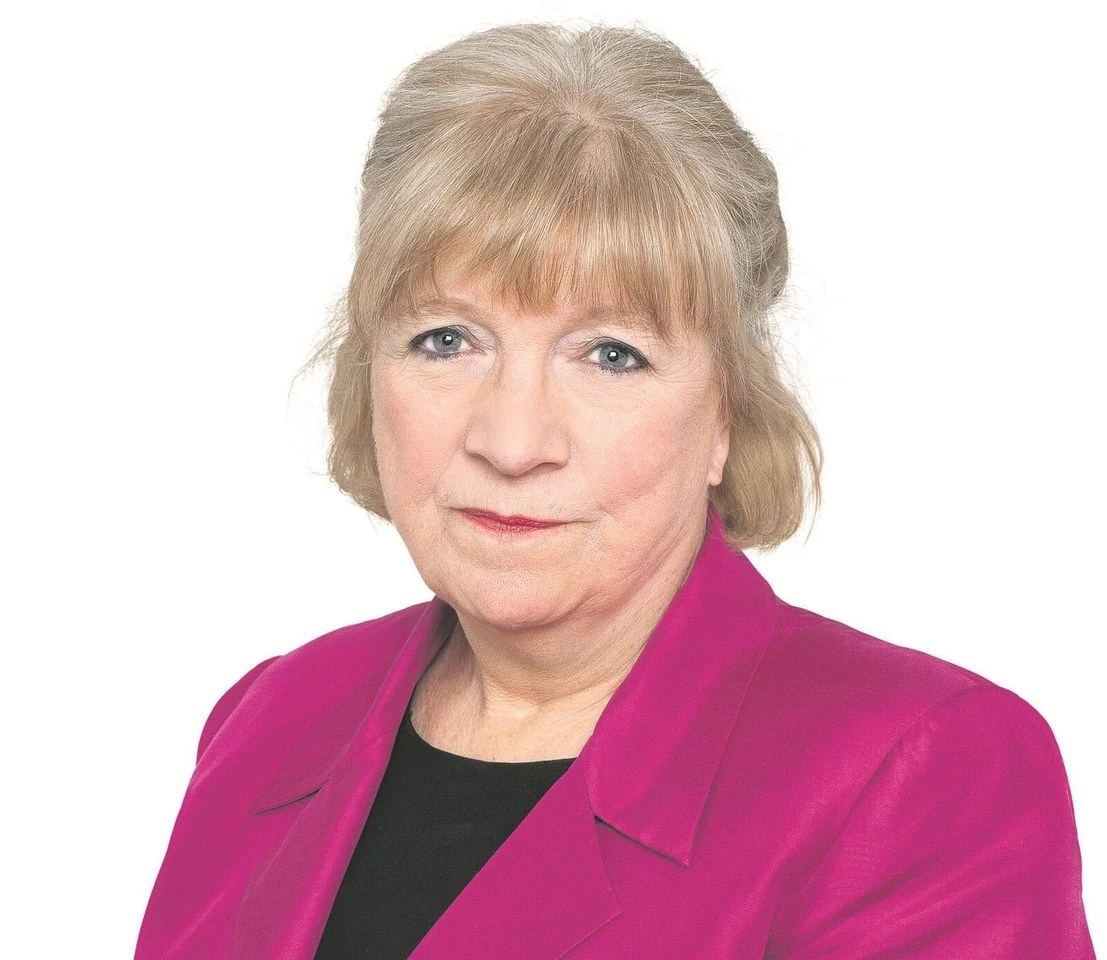
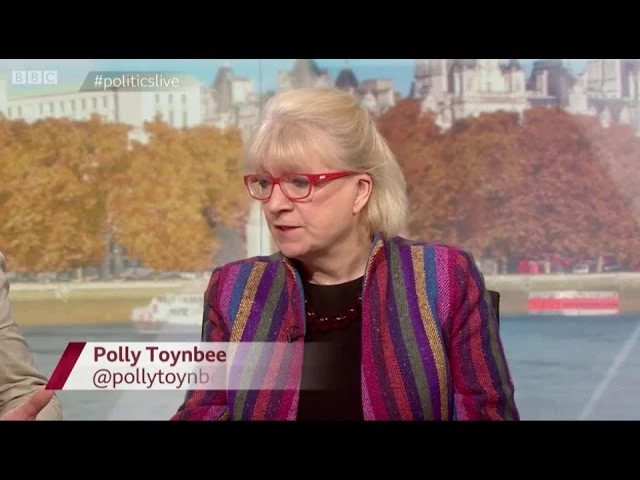
Polly Toynbee’s journalism has repeatedly returned to a practical question: what do political choices mean for people living with their consequences? A spell working in low-paid jobs became the basis of a book about life on the minimum wage; later, her columns and reporting examined poverty, public services and the welfare state. Her career has taken her from newspaper reporting to the BBC and back to The Guardian, where she has been a columnist since 1998.
A route into journalism
Born Mary Louisa Toynbee on 27 December 1946, she grew up in a family with literary and intellectual connections. Her father was the writer and critic Philip Toynbee; her grandfather was the historian Arnold J. Toynbee. Her parents separated when she was four, and she moved to London with her mother, who later married the philosopher Richard Wollheim.
Toynbee attended Badminton School in Bristol and then Holland Park School in London. She won a scholarship to St Anne’s College, Oxford, to read history, but left after eighteen months. In 1966, during a gap year, she worked for Amnesty International in Rhodesia and was expelled by the government. That same year, she published her first novel, Leftovers.
After Oxford, she took jobs in a factory and a burger bar while hoping to write. The experience helped shape A Working Life, published in 1971, which drew on her manual work and included accounts of undercover stints as a nurse and an Army recruit. She then entered journalism, working on the diary at The Observer. Her early career also included work for the Radio Times and, for a time, the US magazine Washington Monthly.
Reporting and the social-affairs brief
Toynbee worked at The Guardian before joining the BBC, where she was social affairs editor from 1988 to 1995. She moved to The Independent, serving as a columnist and associate editor, then returned to The Guardian. The sequence matters: her work has not been confined to opinion writing. Reporting, editorial responsibilities and a sustained interest in social conditions have informed the public voice for which she is best known.
In 2003, she published Hard Work: Life in Low-Pay Britain, an account of a period spent living voluntarily on the minimum wage, then £4.10 an hour. She worked as a hospital porter in an NHS hospital, a dinner lady in a primary school, a nursery assistant, a call-centre employee, a cake-factory worker and a care-home assistant. During the experiment she contracted salmonella. The book examined the conditions and pressures of low-paid work in Britain; it was reviewed in the Journal of the Royal Society of Medicine as its book of the month.
That immersion gave her a concrete subject for writing about the gap between policy and daily life. Her wider commentary has addressed inequality, welfare, health and education. She has criticised the underfunding of the National Health Service and the effects on patient care, and argued for measures including increased Working Tax Credit to reduce child poverty. The existing profile describes her as an advocate for people facing disadvantage; the more specific record is a body of reporting and argument about the systems shaping work, income and public services.
Politics, argument and public writing
Toynbee’s political affiliations have changed over time. She and her first husband, journalist Peter Jenkins, supported the Social Democratic Party breakaway from Labour in 1981 and signed the Limehouse Declaration. She stood for the SDP in Lewisham East at the 1983 general election, receiving 9,351 votes, or 22 per cent, and finishing third. After the continuing SDP collapsed in 1990, she rejoined Labour. She has since broadly supported the party while remaining willing to criticise its leaders and policies.
Her columns have taken positions on elections, public spending, inequality and Britain’s place in Europe. She opposed Brexit and criticised austerity policies and reductions in public services. Her writing has also attracted criticism. In 2010, after an article about benefit changes used the phrase “final solution”, the Press Complaints Commission described the comments as insensitive; Toynbee said the phrase was not intended as a reference to the Nazis and later apologised for using it. That episode illustrates the risks of forceful political language as well as the scrutiny that accompanies a prominent columnist.
Alongside her journalism, Toynbee has written books with David Walker, her partner and a former social-affairs editor at The Guardian. In Unjust Rewards: Exposing Greed and Inequality in Britain Today (2008), they argued that excess at the top harms others. Their later collaboration, Cameron’s Coup: How the Tories Took Britain to the Brink, appeared in 2015. Her 2023 book, An Uneasy Inheritance: My Family and Other Radicals, turned to family history and its political context.
Recognition and continuing work
In 2007, Toynbee was named Columnist of the Year at the British Press Awards. She has also received honorary degrees from the University of Essex, London South Bank University, Loughborough University, the Open University, the University of Kent and the University of Leeds. She declined a CBE in 2000.
Her work has extended beyond newspapers. She served as president of the British Humanist Association from 2007 to 2012 and is its vice-president. She has been involved with the Fabian Society, served as president of the Social Policy Association and chaired the Brighton Festival. These roles sit alongside her writing rather than replacing it: her public profile has been built principally through journalism and books that engage with political choices and social conditions.
Toynbee’s career is not a record of unbroken institutional progression. She left university early, moved among newspapers and broadcasting, and repeatedly shifted between reporting, commentary and book-length work. That variety has allowed her to approach social questions through different forms: direct experience of low-paid employment, newsroom responsibilities, political columns and collaborations focused on inequality and government.
Why Polly Toynbee deserves a place in British Legacy
Polly Toynbee merits a place in British Legacy because she has made the consequences of public policy a persistent subject of British journalism. In Hard Work, she did not write about low pay only as an abstract economic category: she worked a range of minimum-wage jobs and described the conditions she encountered. Her years as the BBC’s social affairs editor, her newspaper reporting and her subsequent columns have kept questions of welfare, poverty and public services in view. The value of that work lies not in claiming that one journalist can settle political arguments, but in showing how those arguments connect to the organisation of work and the experience of people using public services.
Her career also records how British journalism has moved between newspapers, broadcasting and campaigning debate. Toynbee’s reporting and commentary have appeared alongside books with David Walker that scrutinise inequality and political power, while her work on social policy has extended into roles with the Social Policy Association and the Fabian Society. Her election as Columnist of the Year in 2007 and the honorary degrees awarded by several British universities mark recognition of a long public career; they do not remove the disagreement her writing can provoke. That combination—close attention to social conditions, sustained argument and a willingness to enter contested debates—is the specific contribution her legacy represents.
Sources
Adapted in part from Polly Toynbee by Wikipedia contributors, under CC BY-SA 4.0. Text has been edited and combined with the existing article; this adapted text is shared under the same licence. Contributor history.