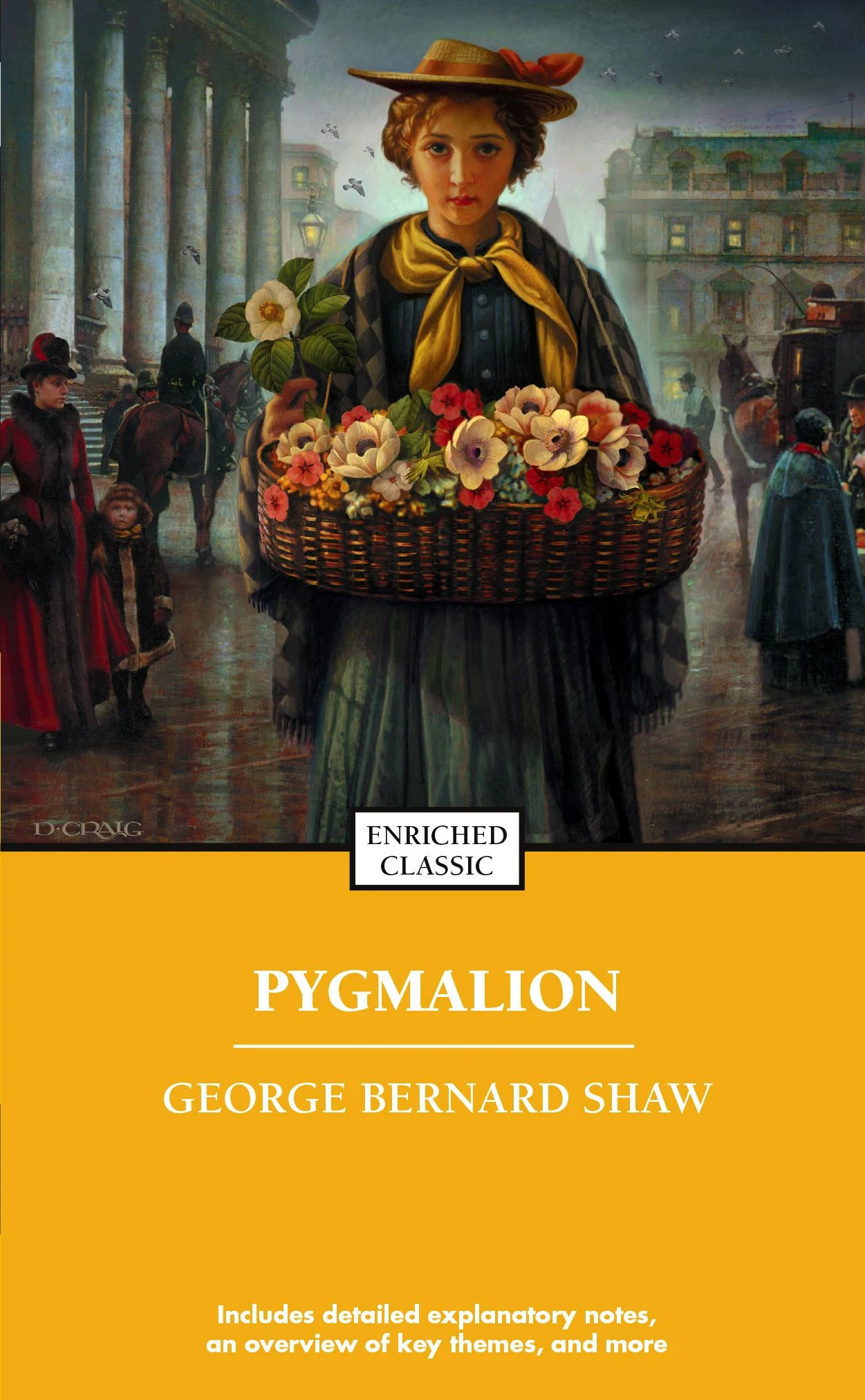
In George Bernard Shaw’s Pygmalion, a flower-seller’s accent becomes the object of a wager. Professor Henry Higgins believes he can teach Eliza Doolittle to speak so that she will pass as a duchess. But the play is not simply a demonstration of phonetics: as Eliza’s speech changes, Shaw asks who gets to define respectability, and what becomes of the person whose transformation is treated as somebody else’s experiment.
A wager made in Covent Garden
The play was written in 1912 and is set in London. Its opening brings together Eliza, a Cockney flower-girl, Higgins, a specialist in phonetics, and Colonel Pickering, a student of Indian dialects. Higgins identifies where people come from by listening to their speech and boasts that he could teach Eliza to pass as a duchess. Pickering challenges him to prove it, offering to cover the costs if Eliza can pass at an ambassador’s garden party within six months.
The premise makes language both a practical skill and a social signal. Eliza initially approaches Higgins because she wants lessons that could help her get work in a flower shop. Higgins, by contrast, regards her chiefly as material for a linguistic experiment. Pickering’s wager supplies the challenge, but Eliza’s future is what is being put at stake. Their different understandings of the arrangement give the comedy its friction and expose the unequal power behind the men’s confidence.
Eliza’s father, Alfred Doolittle, brings another perspective on class into the play. A dustman who calls himself one of the “undeserving poor”, he argues that middle-class morality places its own demands on people like him. His comic speeches complicate any simple division between respectable and disreputable: the rules of social standing can be as revealing as the accents by which people are judged.
Passing, and what it costs
Eliza’s progress is tested in stages. At a gathering at Higgins’s mother’s house, she makes a favourable first impression with her careful pronunciation, but her choice of subjects and a sudden flash of her former speech reveal more than she intends. At a later embassy reception, Higgins’s former pupil Nepommuck mistakes her for a Hungarian of royal blood, reasoning that her English is too perfect for a native speaker. Eliza has passed the test, though the success also shows how readily the people around her turn speech into a story about identity and rank.
Afterwards, Higgins and Pickering are relieved that the wager is won. Eliza, still dressed for the occasion, is left out of their conversation. Her anger is not about failing to achieve the transformation; it is about what the men believe that achievement entitles them to overlook. She asks what will happen to her now that the experiment is finished and returns the jewellery she has been wearing.
Shaw does not make Eliza’s new pronunciation a substitute for independence. In the play’s final act, she challenges Higgins’s assumption that she will return to his household and insists on making her own choices. She considers teaching phonetics or marrying Freddy Eynsford-Hill. The ending refuses a conventional marriage between Eliza and Higgins: he may miss her presence, but his affection does not erase her demand to be treated as a person rather than the product of his instruction.
Shaw’s ending, and the play’s many versions
The ending was important to Shaw because audiences and performers could be tempted to make the relationship between Higgins and Eliza into a romance. During the 1914 London run, Herbert Beerbohm Tree changed the ending without telling Shaw. Shaw objected strongly, and later added “What Happened Afterwards” to the printed play to explain why he did not believe Eliza should marry Higgins. His insistence on her independence makes the conclusion part of the play’s argument, not a loose end to be tidied into a conventional love story.
There are two main versions in circulation: the earlier text first published in 1914 and a later version, published in 1941, incorporating revisions. The play also changed in its movement between stage and screen. For the 1938 British film, Shaw and his co-writers added an embassy-ball scene; the film introduced the pronunciation exercise “the rain in Spain stays mainly in the plain”, which does not appear in the original play. The story later reached a particularly wide popular audience through the 1956 musical My Fair Lady and its 1964 film adaptation. Those versions helped carry the premise into popular culture, even as Shaw’s own ending keeps Eliza’s independence in view.
From Vienna to the West End
Pygmalion first reached the stage in a German translation at Vienna’s Hofburg Theatre on 16 October 1913. Its English-language premiere followed at His Majesty’s Theatre in London’s West End on 11 April 1914, with Herbert Beerbohm Tree as Higgins and Mrs Patrick Campbell as Eliza. The production ran for 118 performances. Shaw’s direction of rehearsals was reportedly tempestuous, and the London response was not wholly uniform: while The Times praised the characters, performances and unconventional ending, The Telegraph found the production diverting but thought it overly long and somewhat shallow.
Eliza’s famous “not bloody likely” also gave the play a life beyond its arguments about class. The expression made a mark in public discussion of language, and the play’s premise proved adaptable across languages and settings. Its central challenge—how speech can shape the way someone is classified—could be recast for different audiences without losing its connection to social division.
Why Pygmalion deserves a place in British Legacy
Pygmalion deserves a place in British Legacy because it turns an everyday marker of social identity—how a person speaks—into a vivid dramatic test of class. Higgins’s wager gives the story its momentum, but Eliza’s response gives it consequence. By making her the subject of a transformation devised by men, then allowing her to challenge their assumptions, Shaw exposes the gap between being taught to pass in polite society and having the freedom to decide what happens next. The play’s British connection is specific: it is set in London, stages distinctions associated with British speech and class, and examines who has the power to define respectability.
Its legacy also rests on the way its theatrical argument has travelled. The first production was in Vienna, but the English-language premiere followed in London, and the play went on to inspire the enduring musical My Fair Lady and its film adaptation. Different versions and adaptations have altered parts of the work; Shaw’s own care over the ending shows why its treatment of Eliza’s independence matters. Rather than relying on a general claim that the play is timeless, its continuing value can be seen in the questions it puts on stage: whether changing the way someone is heard changes their standing, and whether social acceptance is worth much without agency. Those questions make the work a distinctive contribution to British drama and a strong fit for British Legacy.
Sources
Pygmalion (play) — Wikipedia revision 1376184507
Adapted in part from Pygmalion (play) by Wikipedia contributors, under CC BY-SA 4.0. Text has been edited and combined with the existing article; this adapted text is shared under the same licence. Contributor history.