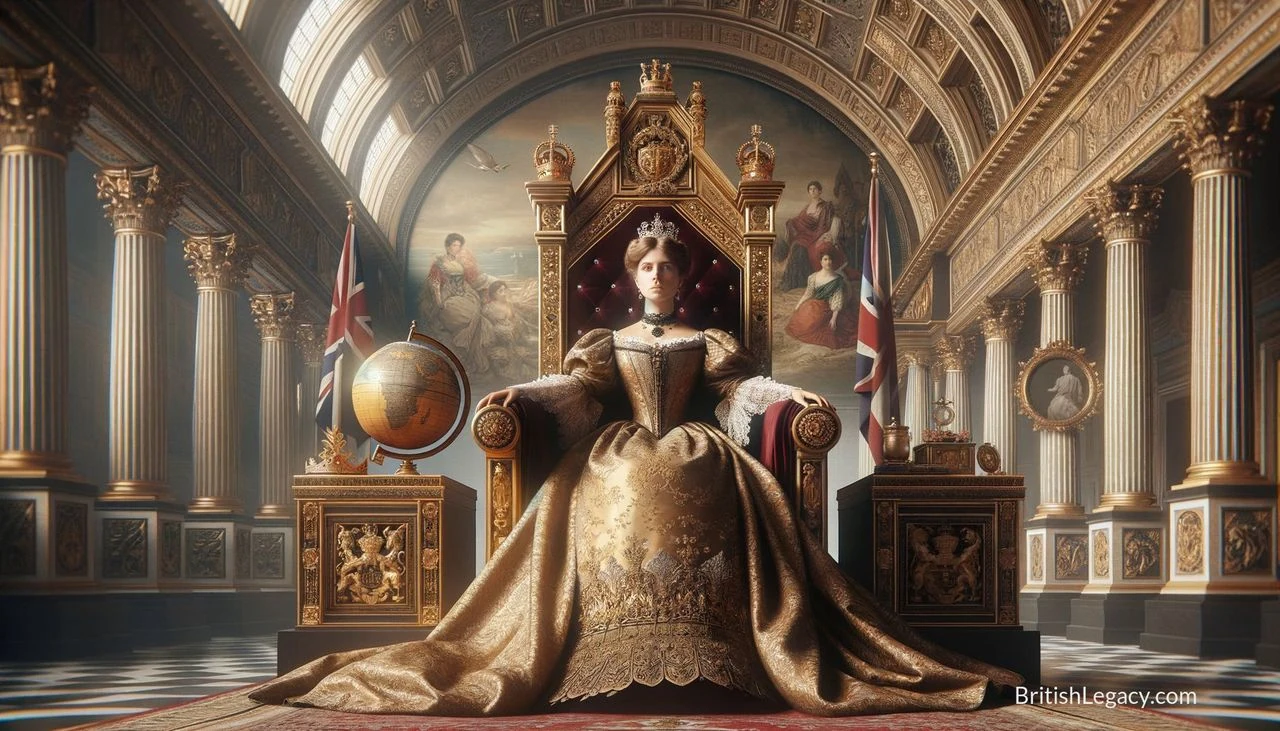
Victoria became queen in 1837, aged 18, and reigned for 63 years and 216 days. Her time on the throne encompassed the growth of railways and communications, shifts in political power, and the expansion of the British Empire. It also brought personal losses, periods of public seclusion and a changing relationship between the Crown and the nation. The Victorian era bears her name, but its history was not hers alone: governments, Parliament and people across Britain and its empire shaped the period in which she ruled.
A young queen and a constitutional role
Born Alexandrina Victoria at Kensington Palace on 24 May 1819, she was the only child of Prince Edward, Duke of Kent, and Princess Victoria of Saxe-Coburg-Saalfeld. Her father died when she was less than a year old. After the deaths of the elder sons of George III, she became heir presumptive to her uncle William IV. When he died on 20 June 1837, Victoria succeeded to the throne; she had turned 18 the previous month, so there was no need for a regency. Because Hanoverian succession law excluded women, she became queen of the United Kingdom but not of Hanover.
Her coronation took place at Westminster Abbey on 28 June 1838. Lord Melbourne, the Whig prime minister, was an important early adviser to a young monarch who had little political experience. Victoria did not simply stand outside politics: she took an interest in ministers and government, and at times tried to influence appointments. A dispute in 1839, when she resisted a proposed change to the royal household’s ladies-in-waiting, contributed to the episode known as the bedchamber crisis. The episode exposed the tension between a sovereign’s preferences and the conventions governing a parliamentary government.
In 1840 Victoria married her cousin Prince Albert of Saxe-Coburg and Gotha. They had nine children, several of whom married into European royal families; this network helped earn her the name “grandmother of Europe”. Albert was also a close adviser. His death in 1861 devastated Victoria. She withdrew from many public appearances and spent much of her time at Windsor Castle, Osborne House on the Isle of Wight and Balmoral in Scotland. Her long seclusion drew criticism and strengthened republican feeling for a time, although her public standing later recovered.
Change at home, power overseas
Victoria’s reign coincided with industrial, political, scientific and military change. Railways and the telegraph transformed travel and communication, while industrial growth altered work and daily life. These developments were not a personal programme directed by the Queen; they formed part of a wider transformation of British society. Writers including Charles Dickens, the Brontë sisters and Alfred, Lord Tennyson also produced work during the period, which became known for its distinctive cultural and architectural legacies.
Political authority continued to shift towards Parliament during Victoria’s reign. The Reform Act of 1867 extended the vote to many urban working men, enlarging the electorate, though Victoria did not support votes for women. As the constitutional monarchy became more symbolic, the sovereign’s influence was exercised through consultation and advice rather than direct rule. Victoria nevertheless took a close interest in successive prime ministers and in public affairs, sometimes supporting one minister and sometimes finding another difficult to work with.
The empire was a defining, and contested, part of the period. Following the Indian Rebellion of 1857, the East India Company’s rule ended and the British state assumed direct control over its Indian possessions. Parliament granted Victoria the title Empress of India in 1876, effective from 1 May; it was proclaimed at the Delhi Durbar in 1877. Her reign also saw imperial expansion and military conflicts, including the Anglo-Zulu War and the Second Anglo-Afghan War. Victoria supported an expansive view of Britain’s position as a great power, and often described imperial rule as protective. That view should be set against the coercion and conflicts involved in extending and maintaining British power overseas.
Events at home also tested the Crown’s relationship with the public. During the Great Famine in Ireland, Victoria made a personal donation to relief and supported a grant to the Maynooth seminary, although these actions did not resolve the crisis or the wider political tensions surrounding Ireland. In 1887 and 1897, her Golden and Diamond Jubilees drew large public celebrations and representatives from across the empire. The festivities reflected both the renewed popularity of the Queen and the reach of the imperial system over which she presided.
Widowhood, public image and final years
After Albert’s death, Victoria’s absence from public life became part of her public image. Her return to some public duties was gradual. She attended the State Opening of Parliament in 1866, the first time since his death, and her popularity rose again in later decades. The monarchy increasingly presented itself as a family institution, a public image that helped make it intelligible to a growing middle class. Victoria’s visible mourning and emphasis on family life contributed to that image, while her continuing political correspondence and influence were less apparent to the public.
In 1876 she took the title Empress of India, linking the Crown directly to Britain’s imperial rule in the subcontinent. The title sat alongside her domestic constitutional role, but it did not mean that Victoria personally governed India. Her reign’s imperial ceremonies and jubilees made the connection between monarchy and empire highly visible, even as imperial authority was exercised through government and administration.
Victoria died at Osborne House on 22 January 1901, aged 81. She was succeeded by her son Edward VII. Her reign of 63 years and 216 days had been longer than that of any British monarch before her; her great-great-granddaughter Elizabeth II later surpassed it. Victoria was the last monarch of the House of Hanover. The period named after her was therefore both a personal reign and a much broader chapter in British history: one shaped by changing institutions, industrial development, cultural production and imperial rule.
Why Queen Victoria deserves a place in British Legacy
Victoria belongs in British Legacy because her reign offers a concrete way to examine how Britain changed during the nineteenth century. She became monarch at 18 and remained on the throne through a period in which railways and the telegraph altered communication, Parliament’s authority grew, and the electorate expanded. Her reign was not a solitary achievement: ministers and legislators made policy, workers and inventors drove social and industrial change, and writers shaped the period’s culture. Victoria’s story is valuable precisely because it brings those developments into focus without confusing the monarch with their sole cause.
Her legacy also requires attention to the reach and consequences of British power. The title Empress of India, the transfer of rule from the East India Company to the British state, and the wars of imperial expansion show how the monarchy was bound up with empire. Victoria’s public image shifted from a young queen advised by Melbourne and Albert to a widowed sovereign who later became a focus of jubilees celebrated across the empire. That changing relationship between Crown, public and imperial authority makes her reign a useful subject for British Legacy: it connects constitutional history and national life with the experiences of people ruled overseas, while leaving room to recognise both cultural and technological change and the costs of empire.
Sources
Adapted in part from Queen Victoria by Wikipedia contributors, under CC BY-SA 4.0. Text has been edited and combined with the existing article; this adapted text is shared under the same licence. Contributor history.