
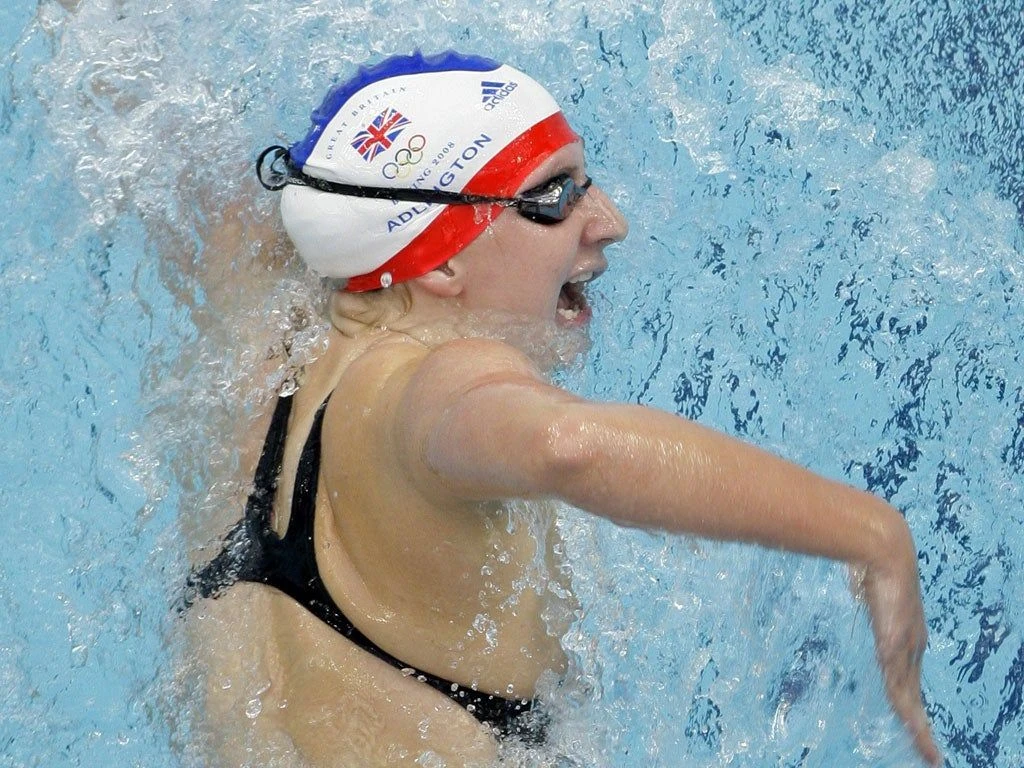
Rebecca Adlington was fifth with 100 metres to swim in the Olympic 400-metre freestyle final in Beijing. She finished first. Four days later, she won the 800 metres in a world-record time, becoming the first British swimmer to take more than one gold medal at a single Olympic Games since Henry Taylor in 1908. Those two victories, achieved when she was 19, made her one of the defining athletes of the 2008 Games. They were the high point of a career that had already included setbacks, and that continued with world, European and Commonwealth titles before she retired aged 23.
A young swimmer from Mansfield
Adlington was born in Mansfield, Nottinghamshire, on 17 February 1989. She began swimming at four and joined Sherwood Colliery Swimming Club at nine. At 12, she moved to Nova Centurion in Nottingham, where coach Bill Furniss began working with her. He remained her coach through her senior career. She attended Broomhill School and The Brunts School.
Her international progress was early but not uninterrupted. At the 2003 European Youth Olympic Festival, she won silver in both the 400 and 800 metres freestyle. The following year she tried to qualify for the Athens Olympics but fell short in all three freestyle events she entered at the trials. She won the 800 metres at the 2004 European Junior Swimming Championships, then contracted glandular fever. Post-viral fatigue disrupted her preparation and kept her out of the 2006 Commonwealth Games.
At the 2006 European Aquatics Championships in Budapest, Adlington finished second in the 800 metres, more than eight seconds behind France’s Laure Manaudou. She won the 800 metres at the British Championships that year, but progress towards the world’s leading swimmers was not yet assured. In 2007 she set a personal best to win the event at the ASA National Championships, then finished tenth in the 800 metres at the World Championships and missed the final.
That sequence makes the scale of her next season clearer. At the 2008 World Short Course Championships in Manchester, she won the 800 metres in 8:08.25, narrowly missing Kate Ziegler’s world record. She also won silver in the 4 × 200-metre relay with the British team. At the British Championships, she broke the Commonwealth record in the 400 metres and set a British record in the 200 metres. Beijing was a breakthrough built on several years of progress, not a sudden arrival.
Beijing: two races, two gold medals
Adlington qualified for the 400 and 800 metres freestyle at the British Olympic Trials. She was also named for the 4 × 200-metre relay, but rested for the heat; the team did not reach the final. In the 400-metre heats she set a Commonwealth record and qualified second fastest for the final.
In that final, Adlington turned a deficit into victory. She was fifth with 100 metres remaining, then overtook American Katie Hoff in the closing length to win in 4:03.22. It was the first Olympic swimming gold won by a British woman since Anita Lonsbrough in 1960, and Great Britain’s first Olympic swimming champion since 1988.
Her second event brought a record as well as a medal. Adlington set an Olympic record in the 800-metre heats, then won the final in 8:14.10. The time broke Janet Evans’s world record, which had stood since 1989, the year Adlington was born. She finished six seconds ahead of silver medallist Alessia Filippi of Italy. The double made her the first British swimmer to win multiple gold medals at one Games since Henry Taylor in 1908. It also matched Kelly Holmes’s two-gold achievement at the 2004 Games as the best performance by a British woman at a single Olympics.
The victories brought her home to Mansfield to a public welcome, including a parade through the town centre on an open-top bus. In November 2008, the Sports Journalists’ Association named her Sportswoman of the Year. She finished third in the BBC Sports Personality of the Year vote and was named European Swimmer of the Year by Swimming World. The next year, she received the Laureus World Breakthrough of the Year award and was appointed an Officer of the Order of the British Empire.
Building on the Olympic breakthrough
Success changed the conditions in which Adlington raced. In 2009 she spoke about the pressure of being a double Olympic champion and the effect of media commitments on her swimming. At the British Championships, she finished second to Joanne Jackson in the 400 metres; Jackson broke the world record, while Adlington recorded the second-fastest time then swum. At the World Championships in Rome, Adlington won bronze in the 400 metres and in the 4 × 200-metre relay. The British quartet also set a European record. She finished fourth in the 800 metres.
In 2010, Adlington won the 400 metres at the European Championships in Budapest and took bronze in the 4 × 200-metre relay. At the Commonwealth Games in Delhi, representing England, she won gold in both the 400 and 800 metres. She also earned bronze in the 200 metres and the relay. In the 400, she broke Sarah Hardcastle’s Games record, which had stood since 1986.
Her first long-course world title arrived in Shanghai in 2011. Adlington won the 800 metres, overtaking Denmark’s Lotte Friis in the final 100 metres, and took silver in the 400 metres behind Italy’s Federica Pellegrini. She qualified for the London 2012 Olympics by winning both distances at the British Championships. In London she added two Olympic bronze medals: one in the 400 metres, behind Camille Muffat and Allison Schmitt, and one in the 800 metres, behind the American Katie Ledecky.
Adlington said after the Games that she would not swim the 800 metres again and would not seek selection for Rio 2016. On 5 February 2013, aged 23, she announced her retirement from competitive swimming, saying she had achieved what she wanted and wished to finish on a high. At that point, her two Olympic golds made her Great Britain’s most decorated female Olympian at the Games.
After competition: coaching, access and broadcasting
Adlington’s connection with the sport continued beyond racing. She became an ambassador for the 2014 Commonwealth Games in Glasgow and a mentor to six swimmers in the World Class Swimming Programme. In 2016, Rebecca Adlington’s Swim Stars launched to help primary-school-aged children learn to swim and to support pool operators in making lessons engaging. She also co-founded Total Swimming Group with former swimmers Steve Parry and Adrian Turner, with the stated aim of making swimming more accessible. JD Sports acquired a 60 per cent stake in the company in 2022.
She has worked as a BBC swimming pundit at the Commonwealth Games and Olympics, including the 2014 and 2018 Commonwealth Games and the 2016, 2020 and 2024 Olympics. In 2016, she was inducted into the International Swimming Hall of Fame. Other recognition has been rooted in her home county: Mansfield’s Sherwood Swimming Baths, where she swam as a child, became the Rebecca Adlington Swimming Centre in 2010. Nottinghamshire County Council named her the first inductee into its Roll of Honour after her retirement, and a Nottingham tram was named after her in 2016.
Her awards also include an honorary Master of Arts degree from the University of Nottingham in 2009. A high-speed train operated by Southeastern was named after her that year. These tributes followed a career whose achievements were widely visible, but their local settings matter too: the pool in Mansfield connects the celebrated Olympic swimmer with the place where her sporting life began.
Why Rebecca Adlington deserves a place in British Legacy
Adlington’s place in British sporting history rests first on a precise achievement: two freestyle gold medals at Beijing in 2008. The 400-metre victory was won with a late surge from fifth place; the 800-metre win broke a world record that had stood for 19 years. Together, the results ended a long wait for a British Olympic swimming champion and made her the first British swimmer since 1908 to win multiple swimming golds at one Games. Her later world, European and Commonwealth titles show that Beijing was not the whole story. After the pressure of becoming an Olympic champion, she continued to win at the highest level and returned to the Olympic podium in London with two bronze medals.
Her legacy is also expressed through what she did after leaving competition. Swim Stars was established to help primary-aged children learn to swim, while Total Swimming Group set out to make the sport more accessible. Her mentoring and work as a broadcaster have kept competitive swimming in view for audiences beyond the pool. Mansfield’s swimming centre, named for her at the baths where she swam as a child, gives that legacy a tangible local home. These are specific links between achievement and participation: a world-record performance brought distinction to British sport; later work turned her experience towards young swimmers, swimming facilities and public understanding of the sport. That combination of athletic excellence and continuing service makes her story significant beyond the medal table.
Sources
Adapted in part from Rebecca Adlington by Wikipedia contributors, under CC BY-SA 4.0. Text has been edited and combined with the existing article; this adapted text is shared under the same licence. Contributor history.

_(cropped).jpg)