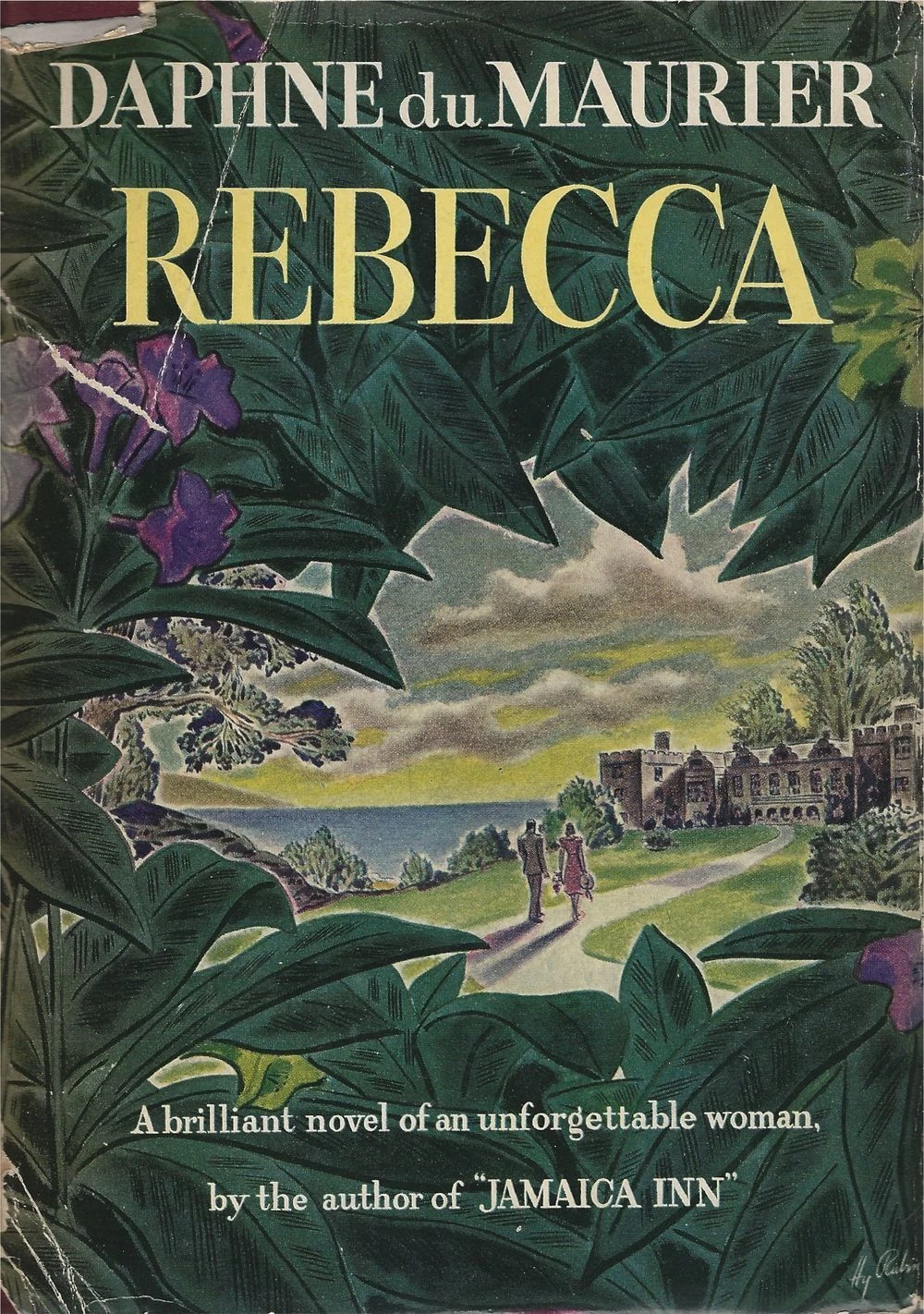
“Last night, I dreamt I went to Manderley again.” Daphne du Maurier opens Rebecca with a return that cannot happen: the narrator and her husband have left the Cornish estate behind, and it has been destroyed. The novel then reaches back to explain how they came to lose it. An unnamed young woman marries the wealthy widower Maxim de Winter and moves to Manderley, where the memory of his first wife seems to govern the house. Rebecca is dead, but her presence shapes the new bride’s sense of herself, her marriage and the home she has entered.
A new wife at Manderley
The narrator is in her early twenties and working as a companion to the wealthy American Mrs Van Hopper in Monte Carlo when she meets Maxim, a reserved English widower. After a brief courtship, she marries him and goes with him to Manderley, his estate in Cornwall. His first wife, Rebecca, drowned in a sailing accident less than a year earlier. At the house, the new Mrs de Winter encounters a household that still seems organised around Rebecca’s memory.
Mrs Danvers, the housekeeper and Rebecca’s former lady’s maid, preserves the west-wing bedroom as a shrine to her former mistress. She repeatedly suggests that the new wife cannot equal Rebecca’s beauty or assurance. The narrator, already unsure of her place, becomes isolated among people who remember Rebecca as a commanding hostess. She fears that Maxim regrets marrying her and remains in love with the woman who preceded her.
A costume ball brings that insecurity to a head. At Mrs Danvers’s suggestion, the narrator wears a dress modelled on one in a portrait of a de Winter ancestor. Maxim sees her and angrily orders her to change: Rebecca had worn the same costume to great acclaim shortly before her death. The episode makes the past feel less like recollection than a force capable of dictating what the new wife may do in her own home.
What the past conceals
Mrs Danvers urges the narrator to jump from Rebecca’s bedroom window. Before she can act, a nearby shipwreck draws attention to the sea. A diver examining the wreck discovers Rebecca’s boat, with her decomposed body still aboard. Maxim had identified another body after Rebecca’s death, and the discovery forces him to explain what happened.
He tells his wife that his marriage to Rebecca was a sham. In his account, Rebecca was unfaithful and manipulated those around her into seeing her as the perfect wife. On the night she died, she taunted him with the possibility that she was carrying another man’s child and that he could be made to accept it as his own. Maxim says that he shot her, put her body in the boat and sank it. The narrator is relieved to learn that he did not love Rebecca as she had feared, but the revelation changes the meaning of their marriage and the mystery at the centre of the novel.
The boat is raised and found to have been deliberately sunk. An inquest returns a verdict of suicide, but Rebecca’s cousin and lover, Jack Favell, tries to blackmail Maxim, arguing that a note she sent him contradicts that verdict. A doctor in London supplies a further turn: Rebecca had cancer and, because of a malformation of her uterus, could not have been pregnant. Maxim concludes that she knew she was dying and provoked him into killing her. When Mrs Danvers disappears, he senses danger and drives back towards Manderley. A glow on the horizon and ashes carried by the wind reveal that the house is burning.
Writing and publishing the novel
Du Maurier’s route to the finished novel was not straightforward. In 1937 she signed a three-book contract with the publisher Victor Gollancz and accepted an advance of £1,000. She had been turning over the theme of jealousy for several years, but initially struggled with the new book. After discarding its first 15,000 words, she apologised to Gollancz for what she called a “literary miscarriage”.
Du Maurier’s husband, Lieutenant Colonel Tommy “Boy” Browning, was posted to Alexandria with the Second Battalion of the Grenadier Guards. The couple left Britain in July 1937. She told Gollancz that progress was slow and that she was unlikely to bring back a completed manuscript in December. On returning to Britain, she spent Christmas away from her family to write. She delivered the novel less than four months later, describing it to her publisher as a “sinister tale” that was “psychological and rather macabre”.
Gollancz received the manuscript in April 1938. His editor, Norman Collins, reportedly judged that it contained everything the public could want. The publisher ordered an initial print run of 20,000 copies; the novel had sold more than twice that number within a month. Published on 5 August 1938, Rebecca became a bestseller. The supplied reference reports that 2.8 million copies were sold between publication and 1965, and that the book has remained in print.
Reception and adaptations
Early critical responses were not uniformly enthusiastic. The Times dismissed the material as modest, while V. S. Pritchett predicted in The Christian Science Monitor that the novel would be “here today, gone tomorrow”. Its commercial success and later reputation tell a different story. In the United States, du Maurier won the National Book Award for favourite novel of 1938, as voted for by members of the American Booksellers Association. The book placed 14th in the 2003 UK survey The Big Read, was voted WHSmith’s favourite book of the previous 225 years in 2017, and appeared on the BBC’s 2019 list of 100 inspiring novels.
Du Maurier adapted her novel for the stage in 1939. Its London run in 1940 exceeded 350 performances. The best-known film adaptation is Alfred Hitchcock’s 1940 production, starring Laurence Olivier, Joan Fontaine and Judith Anderson. Hollywood censorship changed a central element: in the film, Rebecca’s death is accidental, rather than the deliberate killing described in the novel. The film won the Academy Award for Best Picture.
The story has continued across media and countries. Adaptations include Orson Welles’s 1938 radio production, a BBC television serial in 1979, a 1997 television drama and a 2020 film directed by Ben Wheatley. An opera by Wilfred Josephs premiered in Leeds in 1983, and a German-language musical opened in Vienna in 2006. These versions have not all told the story in the same way; the changes made for Hitchcock’s film, in particular, show how the novel’s treatment of guilt and responsibility could be altered in adaptation.
Why Rebecca deserves a place in British Legacy
Rebecca deserves a place in British Legacy because du Maurier built a distinctive British Gothic novel around the particular pressures of a marriage, a house and an inherited past. Manderley is an estate in Cornwall, but its importance is not simply geographical. The household’s routines, the preserved west-wing bedroom and the repeated comparisons with Rebecca make the house an active part of the conflict. The unnamed narrator’s struggle to find a place there gives the mystery an intimate focus: the reader experiences the past not as distant history, but as a presence shaping the choices of the living.
The novel’s achievement also lies in how its suspense changes what the reader thinks has happened. Rebecca’s reputation first seems to explain the new wife’s insecurity; the discovery of the boat then transforms a story of grief into one of deception, violence and concealed responsibility. Its success was evident from the rapid sales after publication, and its afterlife in film, theatre, radio, television, opera and musical theatre demonstrates how readily its central tensions could be reworked. Those adaptations sometimes altered the story, but the underlying questions of memory, identity and power continued to travel with it. Du Maurier’s novel remains a substantial contribution to British literature not just because it is a celebrated Gothic mystery, but because its atmosphere, setting and unsettling account of a household’s secrets have sustained readers and artists across generations.
The original article included a purchase link for the novel: Buy Rebecca on Amazon.
Sources
Rebecca (novel), revision 1372730817
Adapted in part from Rebecca (novel) by Wikipedia contributors, under CC BY-SA 4.0. Text has been edited and combined with the existing article; this adapted text is shared under the same licence. Contributor history.