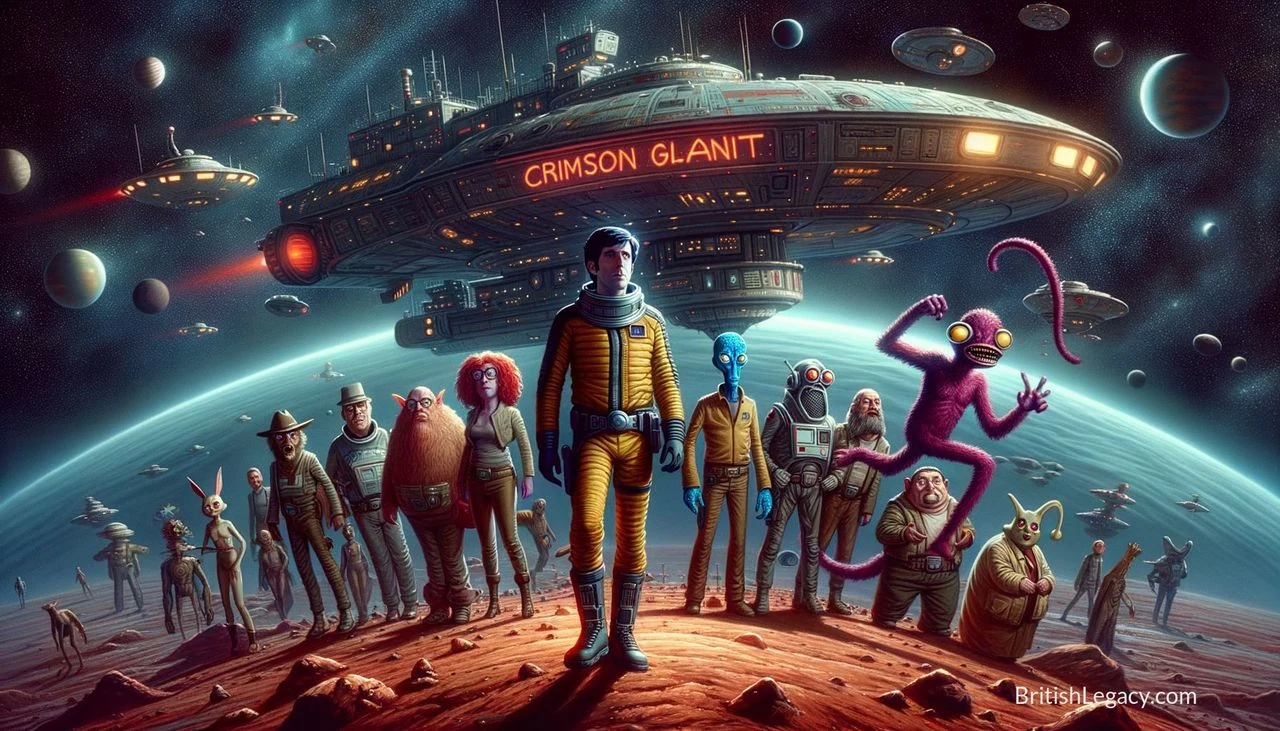
In Red Dwarf, the last known human being wakes from suspended animation three million years after a radiation accident and discovers that his companions are a hologram, an evolved cat and, later, a service mechanoid. The premise offers cosmic scale, but the comedy comes from the small irritations of living together: Dave Lister’s laziness and appetites, Arnold Rimmer’s officiousness, and the crew’s ceaseless arguments. First broadcast on BBC Two in 1988, the series made the unlikely combination of space adventure and sitcom its own.
A sitcom with the universe outside
Rob Grant and Doug Naylor developed Red Dwarf from their radio sketch series Dave Hollins: Space Cadet, heard on BBC Radio 4’s Son of Cliché in the mid-1980s. They drew on science-fiction films and television, then shaped those influences into a comedy about an ill-matched group trapped together. Their pilot script, written in 1984, was initially rejected by the BBC, which doubted that a science-fiction sitcom would find an audience. BBC North West accepted the series in 1986, and the first episode reached television on 15 February 1988.
Production did not proceed without interruption: an electricians’ strike halted rehearsals in 1987 and delayed filming. The early series were made by Paul Jackson Productions; later, production was handled by Grant Naylor Productions for BBC North. The programme’s original BBC Two run lasted from 1988 to 1999, comprising eight series. Its subsequent revivals took it to the digital channel Dave, where it returned in 2009.
The show’s production approach suited a comedy in which the characters mattered more than the machinery around them. Science-fiction devices supplied plots and complications; they did not turn the crew into fearless explorers. Lister and Rimmer are lazy, vain or frightened often enough to make heroism seem like an emergency measure. Their bickering, and the contrast between the vastness of space and their everyday concerns, became a durable comic engine.
Three million years from home
At the start of the story, a radiation leak kills the ship’s crew while Lister is in suspended animation. He had been placed there as punishment for smuggling his pregnant cat, Frankenstein, aboard the mining vessel. The ship’s computer, Holly, keeps him in stasis until the radiation subsides; when Lister wakes, three million years have passed. He is the last known surviving human being, but not alone.
Holly brings back Lister’s former bunkmate and superior, Arnold Rimmer, as a hologram, selecting him in part because he might help keep Lister sane. Cat, a humanoid life form evolved from Frankenstein’s offspring in the ship’s hold, joins them. The mechanoid Kryten becomes a regular character in the third series. Played by Robert Llewellyn, Kryten is a service android whose programmed obedience is challenged by Lister’s efforts to teach him independent thought.
The cast gives each character a different comic register. Craig Charles plays Lister as a dishevelled technician with a good heart; Chris Barrie’s Rimmer is fussy, insecure and keen on authority he rarely commands. Danny John-Jules’s Cat is preoccupied with food and appearance, while Holly’s computer logic supplies a dry counterpoint. Norman Lovett and Hattie Hayridge played Holly in different series. The ensemble also changed over time: Kristine Kochanski, played by Chloë Annett in series seven and eight, joined from an alternate universe in which she, rather than Lister, was the last living human.
Science fiction played for character
The crew encounter time distortions, strange life forms, mutant diseases and other hazards, but the series generally uses these ideas to test its characters rather than to displace the sitcom. Grant and Naylor decided early that aliens would not feature. Many of the non-human beings instead arise from Earth life, human technology or experiments; Cat’s origins are part of that design. The result draws on the scale and strangeness of science fiction without losing sight of people quarrelling aboard a ship.
The comedy moves between slapstick, wordplay, parody and character-based exchanges. References to films, books and television sit alongside invented technologies and expressions. The series also makes room for questions about isolation, free will, identity and the possible extinction of humanity. Those themes remain in service of the comedy without being mere decoration: Lister’s position as the last known human gives an absurd, lonely edge to his ordinary yearnings for home, food and company.
The show’s history included changes in both setting and production. The sixth series moved much of the action to the smaller spacecraft Starbug, with Red Dwarf lost; later, the crew returned to the ship. After a four-year gap between series six and seven, filming shifted towards a more cinematic, single-camera approach. Series eight returned to using a live audience. Changes in cast, format and circumstances became part of the programme’s history, while its central character dynamic remained at its core.
Revival, recognition and other lives
After the BBC declined to commission a ninth series, Red Dwarf returned through Dave. The three-part Back to Earth was broadcast over Easter 2009. In it, the characters arrive on Earth and discover that they are figures in a television programme called Red Dwarf. Dave followed it with series X in 2012, series XI in 2016 and series XII in 2017. The feature-length special The Promised Land followed in 2020. The revivals brought the crew back to television after a long interval, retaining the familiar central characters of Lister, Rimmer, Cat and Kryten.
The programme’s achievements include the International Emmy Award won in 1994 by the sixth-series episode “Gunmen of the Apocalypse”, in the Popular Arts category. The series also won a British Comedy Award for Best BBC Comedy Series. Its audience grew during its original run: the eighth series’ opening episode drew more than eight million viewers in 1999. Recognition continued after the revival; readers of the British Comedy Guide voted series XI both Best Returning TV Sitcom and Comedy of the Year for 2016.
Its life beyond television has included four novels published between 1989 and 1996. Grant and Naylor wrote the first two together under the name “Grant Naylor”; the creators then wrote separate continuations, Doug Naylor’s Last Human and Rob Grant’s Backwards. The series also generated a magazine, video games and two American pilots that were produced but never broadcast. Music made its own journey into the charts: “Tongue Tied”, written for the show, was released as a single by Danny John-Jules in 1993 and reached number 17 in the UK.
Why Red Dwarf deserves a place in British Legacy
Red Dwarf deserves a place in British Legacy because its central achievement is specific and lasting: it made science fiction serve the rhythms of a sitcom. Rather than presenting space as a stage for perfect officers and noble missions, Grant and Naylor built comedy around a mining ship’s badly matched crew. The contrast between enormous threats and familiar frustrations gave the series room for parody, slapstick and philosophical questions without losing its human scale. Its premise also proved adaptable. Across the BBC Two run, the Dave revival and the 2020 special, the crew’s changing circumstances repeatedly offered new routes into the same character-driven comedy.
The programme’s British television legacy is visible in its history and documented reception. It began on BBC Two, moved to a digital channel for its revival and earned both an International Emmy and a British Comedy Award. Its audience grew to more than eight million for the eighth series’ opening episode, while later series attracted recognition from British Comedy Guide readers. Beyond broadcast television, novels, a magazine, games and a charting single carried its characters and ideas into other forms. These achievements show how a distinctive television comedy can reach audiences through more than one medium. Red Dwarf remains a notable example of British writers using the possibilities of science fiction not to leave ordinary life behind, but to find new comic ways of examining it.
Sources
Red Dwarf (revision 1378329336) · Red Dwarf
Adapted in part from Red Dwarf by Wikipedia contributors, under CC BY-SA 4.0. Text has been edited and combined with the existing article; this adapted text is shared under the same licence. Contributor history.