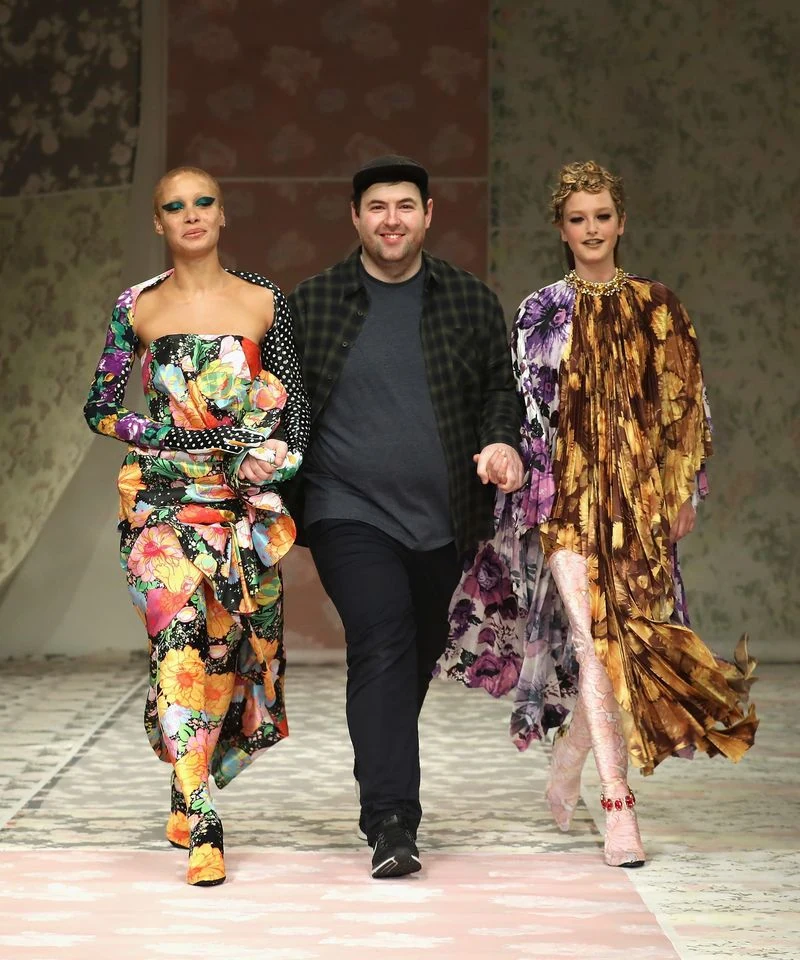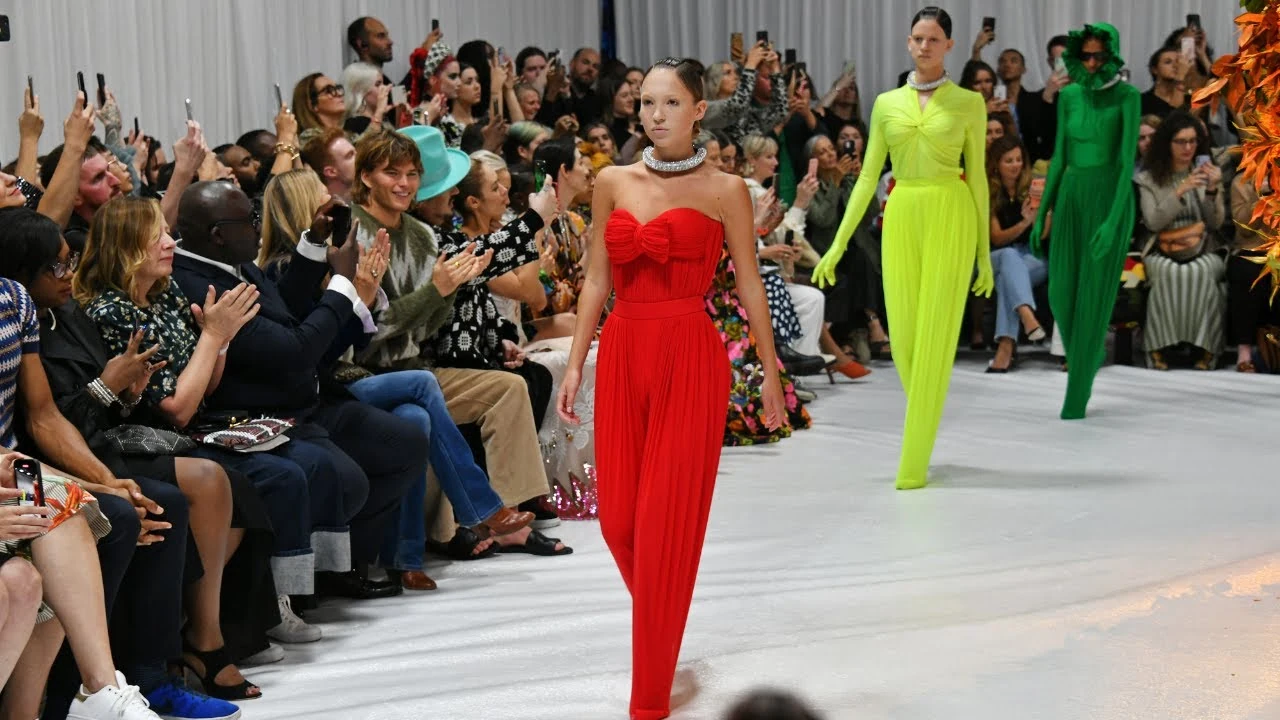
Richard Quinn’s work is described through contrasts: exuberant floral prints against carefully shaped silhouettes, and historical references alongside contemporary design. Since launching his eponymous line in 2016, he has become associated with oversized blossoms, voluminous gowns and closer-fitting looks. In 2018, Queen Elizabeth II attended his London Fashion Week show and presented him with the inaugural Queen Elizabeth II Award for British Design.
Print, colour and craft
Floral motifs and vivid colour are central to the account of Quinn’s design. Oversized blossoms spread across fabrics, making pattern a defining feature rather than a discreet finish. The source describes these prints as bold and kaleidoscopic, with an effect that is theatrical and romantic. It also presents fashion as an art form capable of bringing beauty and pleasure to its audience; that is the source’s interpretation of the work, rather than a documented statement of Quinn’s own beliefs.
The source characterises Quinn’s approach to textiles as a combination of traditional craftsmanship and technology. It describes this balance as looking both to the past and towards the future, although it gives no particular production method or garment as an example. The account also places his designs in relation to British sartorial heritage. Without more specific details, the strongest evidence in the supplied text is the visual language it describes: saturated floral pattern, considered construction and a deliberate sense of spectacle.
Silhouettes with a sense of occasion
Quinn’s clothes are said to range from voluminous gowns that recall the grandeur of the 1950s to sleek, contoured outfits that emphasise the modern form. The contrast suggests two different kinds of presence: one built through volume and movement, the other through a close outline. The source describes both as dramatic and meticulously made, with the clothes intended to command attention on the runway.
It also argues that Quinn joins grandeur with wearability, presenting his work as a way to make avant-garde fashion more accessible. That is a broad characterisation, and the supplied account offers no examples of prices, customers or garments to demonstrate how accessibility works in practice. It is more useful to retain the distinction the source makes between theatrical effect and wearability than to treat its claim about democratising high fashion as established fact.
A London Fashion Week milestone
In 2018, Queen Elizabeth II attended Quinn’s London Fashion Week show and presented him with the inaugural Queen Elizabeth II Award for British Design. The moment placed a designer’s runway presentation alongside a public recognition of British design. The source calls the Queen’s appearance a royal endorsement, but the documented event itself is enough to mark its significance without inferring a wider judgement about Quinn’s work.
The supplied account says that Quinn’s collections have also been shown in Paris, New York and Milan. It does not provide dates, collection names or further details of those appearances, so they offer only a broad indication of international presentation, not a chronology. The 2018 London event remains the most particular milestone described.
Sustainability claims and their limits
The original account says Quinn works with manufacturers that prioritise environmentally friendly processes and is transparent about production. It gives no names, examples or details of those practices, so these claims cannot be developed into a specific account of his sustainability work. They are relevant to the source’s portrayal of his design priorities, but should not be mistaken for independently established evidence of particular environmental standards.
That distinction matters because the source also makes larger claims about influence: that Quinn has helped strengthen the global perception of Britain as a creative centre, and that his work will inspire future designers. Those are assertions about impact rather than details of particular events or outcomes. The supplied material supports a more measured account: it describes a distinctive visual style, mentions presentations in several fashion cities and records a prominent British design award.
Why Richard Quinn deserves a place in British Legacy
Quinn’s place in British Legacy can be grounded in the design features described in the supplied account. Vivid floral prints, oversized blossoms and a marked contrast between voluminous gowns and contoured outfits give the work a recognisable visual character. The source also frames his practice as combining craftsmanship with technology and historical references with modern forms, while acknowledging that it does not provide detailed examples of particular techniques. That combination of bold surface, silhouette and theatrical presentation is a more precise basis for remembering his work than sweeping claims about transforming the fashion industry.
The 2018 London Fashion Week appearance adds a specific British connection: Queen Elizabeth II attended Quinn’s show and presented him with the inaugural Queen Elizabeth II Award for British Design. That event links his designs to a public recognition of British fashion without requiring an assumption of wider royal endorsement. The account’s references to Paris, New York and Milan suggest that his collections have been presented internationally, though it supplies no further detail. Taken together, the documented award and the described design vocabulary give British Legacy a grounded way to record Quinn’s contribution: as a designer associated with theatrical floral fashion and a notable moment in British design recognition.