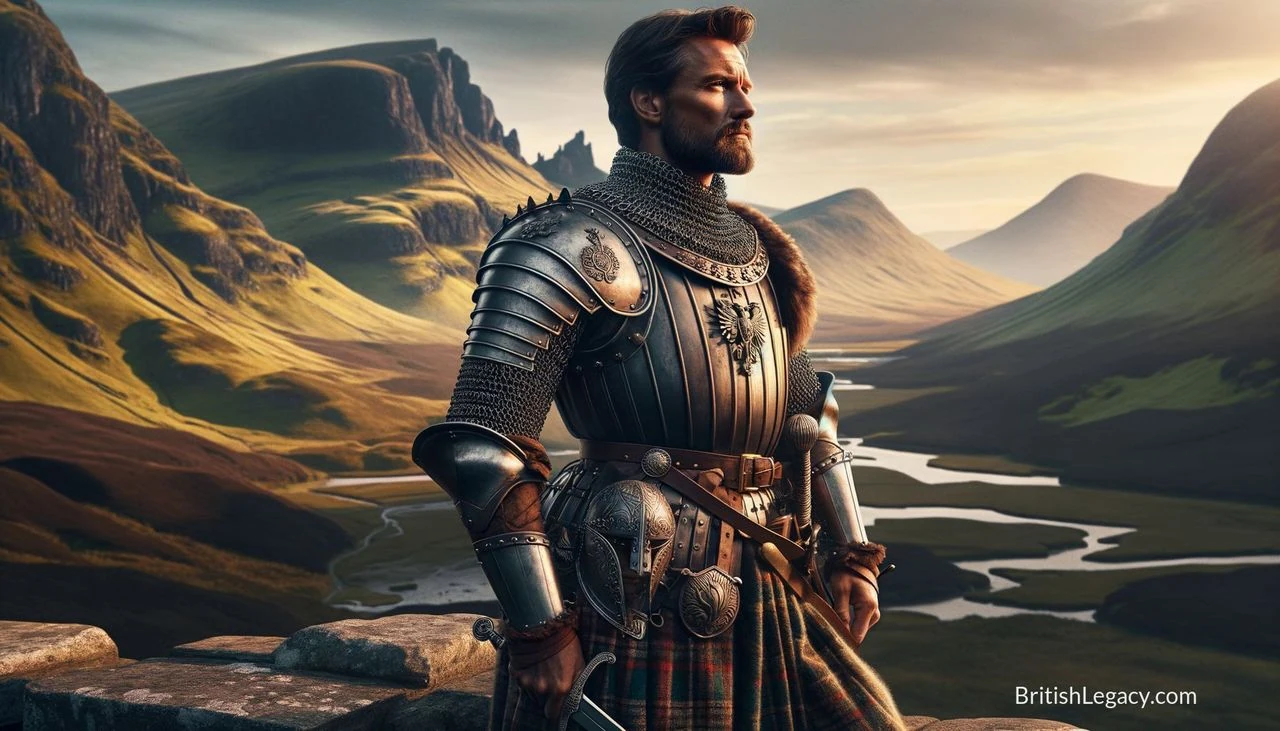
Robert the Bruce’s path to kingship was neither a straight march towards independence nor a simple story of national unity. He swore fealty to Edward I of England, submitted to him again after joining the Scottish resistance, and contended with powerful rivals at home. Crowned King of Scots in 1306, Bruce survived defeat and exile before rebuilding his forces. His victory at Bannockburn in 1314 helped restore Scotland as an independent kingdom; the English crown formally renounced its claim to sovereignty in 1328.
A nobleman with a claim to the crown
Robert I was born on 11 July 1274, probably at Turnberry Castle in Ayrshire, although his precise birthplace is uncertain. He was the eldest son of Robert de Brus, lord of Annandale, and Marjorie, Countess of Carrick. Through his father he inherited a claim to the Scottish throne; through his mother, the earldom of Carrick. His family also held substantial lands in Scotland, England and Ireland.
When Margaret, Maid of Norway, died in 1290, Robert was 16 and began to appear in Scottish political life. In 1292, Edward I selected John Balliol as king after the succession dispute known as the Great Cause. The Bruces opposed Balliol’s claim. As Edward increasingly asserted authority over Scotland, Robert and his father initially sided with the English king against Balliol and his supporters. Robert’s later struggle cannot be reduced to an early, unbroken commitment to independence: he moved between submission, resistance and negotiation as the conflict developed.
In 1297, at about 22, Robert joined the revolt against Edward. He became a Guardian of Scotland alongside John Comyn, a rival claimant, and William Lamberton, Bishop of St Andrews. The arrangement was strained by Bruce and Comyn’s opposing interests. Bruce resigned in 1300, and the guardianship passed to other leaders. In 1302 he submitted to Edward once more, amid rumours that Balliol might return. He married Elizabeth de Burgh that year; his first wife, Isabella of Mar, had died shortly after their marriage, leaving a daughter, Marjorie.
From revolt to the crown
The confrontation that changed Bruce’s prospects came in February 1306. At a meeting in the Greyfriars church in Dumfries, he killed John Comyn. The surviving accounts differ over the precise circumstances, but Bruce’s involvement brought excommunication by Pope Clement V. He moved quickly to assert his claim to the throne. On 25 March 1306, he was inaugurated King of Scots at Scone.
Edward I’s forces soon defeated him at Methven. Bruce’s family and supporters were captured; several male supporters, including his brother Nigel, were executed. Bruce himself escaped and spent months in hiding before returning to the mainland in 1307. With a small following, he began a campaign against English forces and Scottish opponents who resisted his claim. He won at Glen Trool and Loudoun Hill, then extended his control through a succession of campaigns. The fighting included the defeat of John Comyn, Earl of Buchan, at Inverurie in 1308 and the destruction of Comyn strongholds in the north.
Bruce’s recovery of territory was not a single triumph but a drawn-out campaign. He took or reduced English-held castles, made raids into northern England and held his first parliament at St Andrews in 1309. In 1310, the Scottish clergy recognised him as king at a general council. His government’s military progress strengthened his position, though Edward II continued to claim overlordship of Scotland.
Bannockburn and the struggle for recognition
The decisive battle came in June 1314. Edward II marched north with a large English army to relieve Stirling Castle, whose governor had agreed to surrender if no relief arrived by 24 June. Bruce’s forces met the English near the Bannock Burn. The marshy, confined ground restricted the English cavalry; Scottish spearmen held their formations and drove the battle towards a collapse of English control. Bruce also killed the English knight Henry de Bohun in single combat during the opening day’s fighting.
The victory at Bannockburn was a turning point, not the end of the conflict. Bruce’s forces were then able to raid northern England, while the English king still refused to give up his claim. In 1320, Scottish nobles sent the Declaration of Arbroath to Pope John XXII, affirming Bruce’s right to rule and Scotland’s status as an independent kingdom. The pope recognised Bruce as king of an independent Scotland in 1324. After Edward II was deposed, the Treaty of Edinburgh–Northampton, signed in 1328 by Edward III, recognised Scotland’s independence and renounced English claims to sovereignty.
Bruce’s campaigns also extended to Ireland. In 1315, he sent his brother Edward there to open another front against England; Edward was later crowned High King of Ireland, and Robert himself went to assist him. The campaign failed to establish lasting control. Famine and the army’s need to find supplies contributed to hardship, and Edward Bruce was killed at Faughart in 1318. This episode complicates any account of Robert’s reign as a straightforward story of liberation: his military and political ambitions reached beyond Scotland, with consequences for the people caught up in the fighting.
His final years and the making of a memory
Robert spent his final years at Cardross, where he acquired land in 1325 and established a manor house. He had been seriously ill since at least 1327, but the precise cause of his illness is uncertain. Some medieval accounts called it leprosy; that diagnosis is disputed, and the available evidence does not settle what condition he had. He died at Cardross on 7 June 1329, aged 54, and was succeeded by his son David II.
Bruce’s body was buried at Dunfermline Abbey and his heart at Melrose Abbey, fulfilling his wish that it should be taken to the Holy Land before returning to Scotland. His tomb at Dunfermline was elaborate, but it was damaged during the Reformation. In 1818, workmen uncovered a vault at the abbey, and an investigation the following year found remains consistent with the recorded burial. A plaster cast was made of the skull before the remains were reinterred.
His memory has been shaped by monuments, popular stories and later works of culture. Statues of Bruce stand at Edinburgh Castle and in Lochmaben; a memorial window at Dunfermline Abbey was installed in 1974. The familiar tale of a spider inspiring Bruce to try again appears in a much later account and should be treated as legend, not contemporary evidence. Film portrayals include Braveheart (1995), in which Angus Macfadyen plays Bruce, as well as later films focused on the king’s life and campaigns.
Why Robert the Bruce deserves a place in British Legacy
Robert the Bruce belongs in British Legacy not because his story represents an uncomplicated unity, but because it shows how the political shape of the British Isles was contested and remade. His victory at Bannockburn in 1314 helped secure the position of the Scottish kingdom; the Treaty of Edinburgh–Northampton in 1328 gave that independence formal recognition from the English crown. The distinction matters: a battlefield victory did not alone settle the question of sovereignty. Bruce’s political achievement lay in sustaining a campaign through defeat, regaining support and territory, and turning military success into diplomatic recognition.
His legacy also offers a reason to look beyond heroic shorthand. Bruce’s rise involved shifting allegiances, a violent rivalry with John Comyn, the destruction of strongholds and campaigns beyond Scotland, including the unsuccessful invasion of Ireland. Remembering those details makes the story more useful, not less significant: it lets readers see the costs and complexity behind the making of a kingdom. The Declaration of Arbroath, the later treaty and the surviving commemorations at places such as Dunfermline connect his reign to continuing debates about Scottish political identity and historical memory. His place in British Legacy rests on that specific and enduring significance: his actions changed the relationship between Scotland and England, and the consequences remain central to understanding the history of Britain.
Sources
Robert the Bruce — Wikipedia revision · Robert the Bruce — Wikipedia
Adapted in part from Robert the Bruce by Wikipedia contributors, under CC BY-SA 4.0. Text has been edited and combined with the existing article; this adapted text is shared under the same licence. Contributor history.