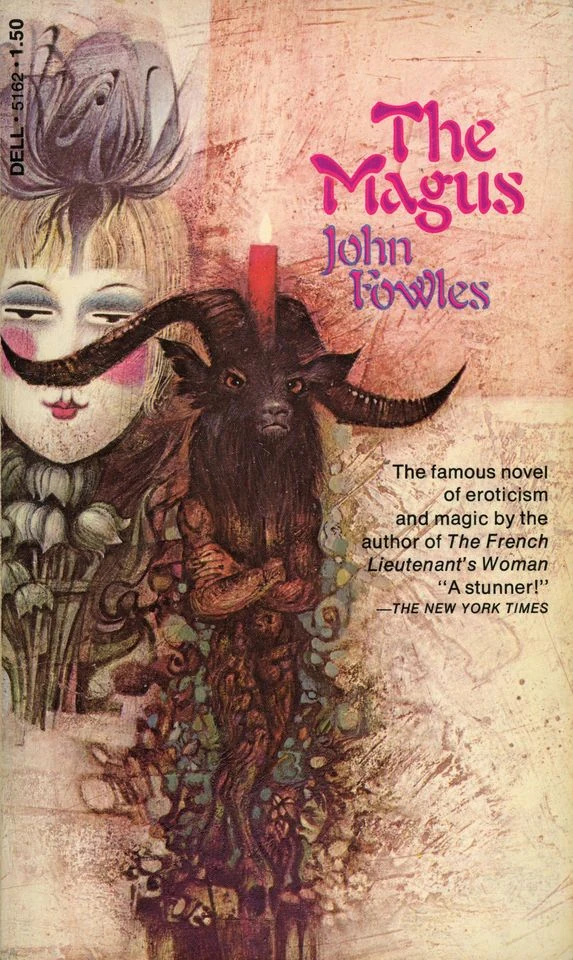
In John Fowles’s The Magus, a teaching post on a Greek island becomes the beginning of an elaborate contest over what can be known. Nicholas Urfe, a young Oxford graduate and aspiring poet, takes a job at the Lord Byron School on Phraxos. There he meets Maurice Conchis, a wealthy intellectual whose staged encounters draw Nicholas into a world of shifting identities and uncertain motives. The reader is placed inside the same problem as the protagonist: each apparent explanation may be another performance.
A novel begun before it was published
The Magus was the first book Fowles wrote, but not the first he published. He began it in the 1950s under the working title The Godgame, and spent twelve years on it before it appeared in 1965. By then, two other books had reached readers: The Collector in 1963 and The Aristos in 1964. Fowles continued revising the novel after publication; a final revised edition appeared in 1977.
The setting drew on Fowles’s own experience. He taught English for two years at the Anargyrios School on Spetses, and the island informed the novel’s Greek setting. That connection provides a biographical point of departure, not a simple equation between the author’s life and Nicholas’s story. Fowles also acknowledged literary precedents in the foreword to the revised edition. Alain-Fournier’s Le Grand Meaulnes offered the idea of a secret world to be explored; Richard Jefferies’s Bevis suggested a very different world. The revised text also refers to a “Miss Havisham”, apparently invoking Dickens’s character in Great Expectations.
Nicholas enters the godgame
Nicholas leaves England after becoming bored with a teaching job. In London he meets Alison Kelly, an Australian woman, and later accepts the post on Phraxos. The island does not give him the fresh purpose he expects. He becomes depressed and lonely, and at one point contemplates suicide. While wandering, he comes upon an estate and meets its owner, Conchis. The two develop a kind of friendship, but Conchis’s accounts of his past—including the suggestion that he collaborated with the Nazis during the Second World War—make him harder to read rather than easier.
Conchis draws Nicholas into what the novel calls the “godgame”. At first Nicholas takes the strange events for a joke. The performances grow more elaborate and troubling, however, until he can no longer tell whether he is observing a story or being made to act in one. Re-enactments of the Nazi occupation, playlets associated with the Marquis de Sade and parodies of Greek myths all contribute to the confusion. Nicholas eventually recognises that these scenes are not simply illustrations of Conchis’s life: they have become entangled with his own.
The novel’s suspense depends on this unstable position. Nicholas tries to interpret what he sees, but the interpretation itself becomes part of the game. Fowles makes the reader follow that effort from close range, through a narrative shaped by Nicholas’s perspective. The question is not only whether Conchis is telling the truth; it is also how much confidence Nicholas can place in his own judgement. The result is a story in which uncertainty operates both as plot and as form.
Choice, performance and an open ending
Fowles’s use of psychological illusion gives the book room to examine freedom and responsibility. Nicholas is repeatedly put in situations where he must decide what to believe and how to act, yet he cannot be sure how much of the situation has been arranged for him. The novel’s interest in choice therefore sits beside its interest in manipulation: a decision still matters, even when the conditions surrounding it are obscure.
Its conclusion preserves that uncertainty. The book ends without settling which of two apparently possible outcomes has occurred. Fowles received letters from readers asking for a definitive answer, but did not provide one; at times he gave different answers to different correspondents. The closing quotation is a refrain from the Pervigilium Veneris, an anonymous fourth-century Latin poem. Readers have taken it as a possible indication of how Fowles viewed the ending, but it does not close the question. The unresolved finish extends the novel’s central demand: interpretation is unavoidable, but certainty may not be available.
Publication, reception and screen versions
The novel’s place in public literary life is reflected in several recorded milestones. In 1999, it appeared on both the editors’ and readers’ lists in the Modern Library’s selection of the 100 best novels, ranked 93rd and 71st respectively. In 2003, it was placed 67th in the BBC’s The Big Read survey. These rankings document recognition in particular lists and surveys; they are more precise measures than broad claims that the book is universally acclaimed or permanently popular.
A film adaptation, written by Fowles and directed by Guy Green, was released in 1968. Michael Caine played Nicholas Urfe and Anthony Quinn played Conchis; the production was filmed on Mallorca. The adaptation was generally regarded as unsuccessful, although it received a BAFTA nomination for Best Cinematography. In 2016, BBC Radio 4 broadcast a dramatisation by Adrian Hodges, with Charles Dance as Conchis. A television miniseries was announced as in development in 2020, with Johan Renck considered to direct from a screenplay by Tom Edge; an announcement of development is not evidence that the series was completed or broadcast.
Why The Magus deserves a place in British Legacy
The Magus deserves a place in British Legacy as a major work by the British novelist John Fowles, but its significance is more specific than a label of “postmodern masterpiece” can convey. Fowles built the novel around a British protagonist who leaves England for a Greek teaching post and finds that his understanding of events is repeatedly unsettled. The formal device and the subject reinforce one another: Nicholas cannot distinguish performance from reality, while the reader is made to experience the same difficulty. In this way, the book turns questions of freedom, responsibility and interpretation into dramatic action rather than treating them as abstract themes.
Its creation also links British literary work to a precise international setting. Fowles’s teaching experience on Spetses informed the novel, while its publication history—from its beginning as The Godgame in the 1950s to the final revision in 1977—shows a writer continuing to reshape an ambitious work. The Modern Library rankings, the BBC survey placing it at 67, and later film and radio adaptations record distinct forms of recognition and reworking. Together, these details make its British legacy concrete: a British author’s sustained experiment with narrative, shaped partly by experience abroad, that has invited successive readers and adaptors to confront the limits of certainty.
Sources
The Magus (novel) — supplied revision
Adapted in part from The Magus (novel) by Wikipedia contributors, under CC BY-SA 4.0. Text has been edited and combined with the existing article; this adapted text is shared under the same licence. Contributor history.