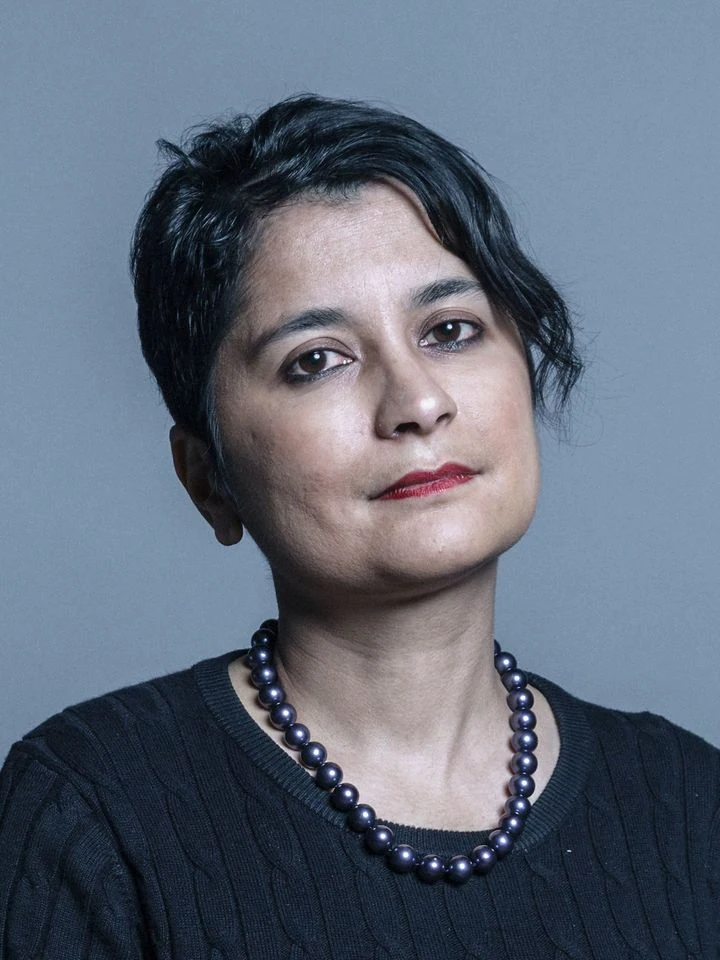
Shami Chakrabarti’s career has taken her from legal work inside the Home Office to the leadership of Liberty and, later, the House of Lords. Across those roles, she has returned to a difficult question: how should a democratic state protect the public without weakening the rights and safeguards that make its power legitimate? As director of Liberty from 2003 to 2016, she became a prominent advocate for civil liberties during years of debate about terrorism, surveillance and detention. Her influence has also extended into public discussion, the Leveson Inquiry, university life and party politics.
From legal training to the Home Office
Born Sharmishta Chakrabarti on 16 June 1969, she grew up in Kenton, in the London Borough of Harrow, in a Bengali Indian family. She attended Bentley Wood High School and Harrow Weald Sixth Form College before studying law at the London School of Economics. She graduated with an LLB in 1991, was called to the Bar by the Middle Temple in 1994 and began working as an in-house lawyer at the Home Office in 1996.
That early experience placed her within the department whose work she would later scrutinise from outside. Her career therefore linked legal practice and campaigning rather than beginning with a direct move from university into public advocacy. At the Home Office she worked as a lawyer; at Liberty she would argue about how government should use its powers and what protections citizens should be able to expect. The distinction matters. Her public case for civil liberties developed alongside an understanding of the machinery of government, not apart from it.
In 2003, aged 34, Chakrabarti became director of Liberty, a British organisation founded in 1934 to defend civil liberties and human rights. She held the post until 2016. Her leadership coincided with a period in which governments faced pressure to respond to terrorism with expanded powers. The attacks of 11 September 2001 in the United States and terrorist attacks in Britain formed part of the political context in which those proposals were debated.
Liberty and the argument over security
As director, Chakrabarti opposed measures that Liberty regarded as excessive, including anti-terror legislation introduced after the attacks of 11 September. The organisation’s objections concerned the reach of state power: detention, surveillance and the ability of authorities to intervene before a criminal offence had been established. In 2009, she described the Prevent programme as “the biggest spying operation in Britain in modern times”. The phrase was part of a wider argument about how far preventative security measures could intrude into ordinary life.
Her role was not simply to object to legislation. She became a frequent contributor to television, radio and newspapers, explaining legal and civil-liberties questions to a broad audience. Public debate about national security can turn on technical provisions, while the consequences of those provisions may affect people who are not suspected of wrongdoing. Chakrabarti’s work at Liberty brought questions about detention, privacy and official oversight into the public conversation. That advocacy did not settle every disagreement about the balance between liberty and security; it helped ensure that the balance itself remained a subject of political argument.
One example came in 2015, when Liberty and other human-rights groups brought proceedings in the Investigatory Powers Tribunal after disclosures about GCHQ interception. The tribunal found that GCHQ had breached its own internal policies in a way that violated rights under Article 8 of the Human Rights Act. The following year, Liberty campaigned against the Investigatory Powers Act, which it called the “Snoopers’ Charter”. These events illustrate the practical and political dimensions of the organisation’s work: legal challenges could test state conduct, while campaigning could question the powers Parliament was considering.
It would be misleading to credit Chakrabarti alone with the outcome of surveillance law or the work of the tribunal. She led an organisation with its own history, staff and supporters, and acted within a wider field of legal and political debate. Her significance lies instead in her public leadership of Liberty during these disputes and her contribution to making civil-liberties arguments visible beyond specialist legal circles.
Public debate, books and the Leveson Inquiry
Chakrabarti’s media work was one part of that public role. She appeared regularly on BBC radio and television and wrote for newspapers. In 2005, BBC Radio 4’s Today programme included her on a shortlist of ten people who might “run Britain”. The following year, she came second in the public vote for Channel 4’s “Most Inspiring Political Figure” award, ahead of several established political figures. Such attention reflected her prominence in contemporary debate; it was not the same thing as formal political office.
Her books have also carried her arguments beyond the immediate news cycle. Her first book, On Liberty, was published in 2014. She later wrote Of Women: In the 21st Century and Human Rights: The Case for the Defence, published in 2024. In these works, as in her campaigning, legal rights become a subject for public explanation as well as professional discussion.
In July 2011, Chakrabarti was appointed as one of the panel members of the Leveson Inquiry into phone hacking and press standards. The inquiry examined difficult questions about privacy, media power and regulation. Liberty welcomed the recommendation for a more robust and independent press self-regulator, while Chakrabarti said the organisation could not support the report’s alternative of compulsory statutory regulation. The position reflected a tension central to the inquiry: how to respond to abuses by the press without compromising press freedom. She was one of two panel members to waive the right to claim fees or expenses for the inquiry.
The appointment showed that her public standing extended beyond her leadership of Liberty. She was asked to contribute to a national inquiry where arguments about privacy and accountability involved both powerful institutions and competing rights. Her participation did not make her the author of the inquiry’s conclusions; it placed her among those advising Lord Justice Leveson as the inquiry considered the conduct and regulation of the press.
University roles and public recognition
Alongside her campaigning, Chakrabarti held senior university roles. She was Chancellor of Oxford Brookes University from 2008 to 2015. In September 2014, she became Chancellor of the University of Essex, the fifth person to hold that position and the first woman. She stood down in 2017. These appointments extended her public work into higher education, where her career connected legal debate, advocacy and civic life.
Her honours included appointment as a Commander of the Order of the British Empire in the 2007 Queen’s Birthday Honours. The British Academy awarded her its President’s Medal in 2011. She was also one of eight Olympic flag carriers at the opening ceremony of the London 2012 Summer Olympics. These recognitions marked her public profile in different settings: honours for her work, acknowledgement by a national academy and participation in a major British sporting event.
Her path into party politics began in 2016, when she chaired a Labour Party inquiry into antisemitism and other forms of racism. She joined the party during the inquiry, saying that this would help gain members’ trust and confidence while maintaining her independence. The report, published in June 2016, concluded that Labour was not “overrun” by antisemitism, Islamophobia or other forms of racism, while also identifying an “occasionally toxic atmosphere”. The inquiry and its conclusions were contentious, and the appointment that followed attracted criticism from some Labour MPs, who saw potential for a perceived conflict of interest.
From Liberty to the House of Lords
Chakrabarti stepped down as Liberty director on 31 March 2016; Martha Spurrier succeeded her. Later that year, on 6 September, Chakrabarti was created a life peer as Baroness Chakrabarti, of Kennington in the London Borough of Lambeth. The appointment followed her work chairing the Labour inquiry and was made in the Prime Minister’s Resignation Honours. In October 2016 she became Shadow Attorney General for England and Wales, serving until April 2020.
Moving into party politics and the Lords brought her into institutions where she had previously acted as a campaigner and critic. It did not remove the questions that had shaped her work at Liberty: how executive powers should be scrutinised, how rights are protected and how legal principles can be translated into public policy. In 2018, the government announced that she was to be sworn of the Privy Council. She remains a member of the House of Lords and has served on the Delegated Powers and Regulatory Reform Committee and the Joint Committee on Human Rights.
Her career has not been without criticism or controversy. Her work on the Labour inquiry was challenged by some within the party, while her views on education and other public issues have also attracted scrutiny. A fair account need not treat criticism as proof of wrongdoing, nor omit disagreement from a story of public advocacy. Chakrabarti’s significance is better measured by the institutions in which she has worked and the arguments she has helped bring into public view than by claims that every position she took was universally accepted.
Why Shami Chakrabarti deserves a place in British Legacy
Shami Chakrabarti deserves a place in British Legacy because her career makes the defence of civil liberties concrete. As a lawyer at the Home Office, she worked within government; as director of Liberty, she led an organisation challenging the scope of government powers. During her thirteen years in that role, questions about detention, preventative policing and surveillance became urgent national issues. Liberty’s legal action over GCHQ interception and its opposition to the Investigatory Powers Act show how advocacy can combine scrutiny in a tribunal with argument in public. Her contribution was not to decide every legal or political outcome, but to keep questions of rights and accountability in the debate.
That public explanation is part of the legacy too. Through broadcasting, writing and her work at the Leveson Inquiry, Chakrabarti has addressed questions that concern the relationship between citizens, government and powerful institutions. Her later service as a peer and Shadow Attorney General carried that experience into formal politics. The route—from legal training in London, through the Home Office and a British campaigning organisation, to universities and Parliament—gives her story a clear connection to Britain’s civic life. It also illustrates why civil liberties are not only a matter for lawyers: the laws and powers debated in Westminster shape privacy, fair treatment and public accountability. Her career has helped make those stakes legible to a wider audience, a lasting contribution to British democratic debate.
Sources
Adapted in part from Shami Chakrabarti by Wikipedia contributors, under CC BY-SA 4.0. Text has been edited and combined with the existing article; this adapted text is shared under the same licence. Contributor history.