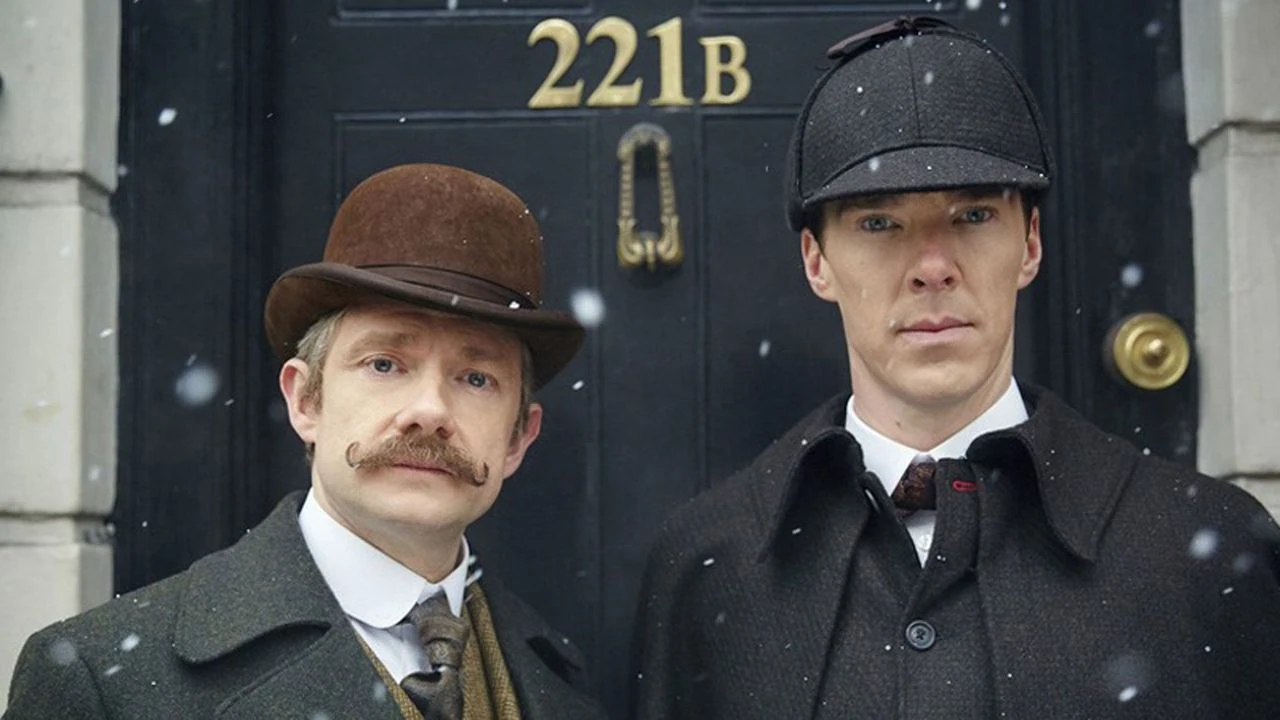
When Sherlock Holmes returned to television in 2010, he brought a mobile phone, a flatmate with a blog and a talent for turning London’s present-day details into clues. Sherlock, created by Steven Moffat and Mark Gatiss, recast Arthur Conan Doyle’s detective stories as a contemporary crime drama. Benedict Cumberbatch played Holmes and Martin Freeman played Dr John Watson; their partnership gave the series its centre, while its brisk visual style made deduction part of the action.
Holmes in the present tense
The series kept familiar elements of the original stories, including the Baker Street address and Holmes’s adversary Moriarty, but moved the cases into modern London. Holmes used texting, the internet and GPS alongside the habits of observation and experiment associated with Conan Doyle’s character. Watson, returned from military service in Afghanistan, became his friend and companion. The stories made him more than an audience surrogate: he recorded their adventures on a blog, helping turn the detective into a reluctant celebrity.
Moffat and Gatiss developed the idea while travelling by train to Cardiff, where Doctor Who was being made. Both were Holmes readers and television writers; they wanted an adaptation with the irreverence and pace of earlier versions set in their own time, rather than a reverential period reconstruction. Producer Sue Vertue encouraged them to develop the project themselves. The BBC initially planned a single 60-minute drama and a possible run of six episodes. After a pilot was filmed, the format changed to three longer episodes for the first series, each running about 85 to 90 minutes. The pilot was not broadcast, but was later included on the first series’ DVD.
The eventual programme comprised four three-episode series, broadcast between 2010 and 2017, and a separate special set in Victorian London. The special, screened on 1 January 2016, was designed as its own story rather than part of the contemporary series’ usual run. The change of period made the contrast with the modern episodes explicit while allowing the programme to play with the visual world of the original Holmes stories.
Two leads, and a distinctive screen language
Cumberbatch’s Holmes was quick, self-possessed and often difficult company. Freeman’s Watson supplied a contrasting warmth and a moral perspective, and the friendship between them developed over the series. Their casting helped define the drama: the writers saw Watson not as a fool but as a perceptive companion whose judgement could expose what Holmes overlooked. Rupert Graves played Detective Inspector Greg Lestrade, whose initial wariness gave way to respect for Holmes’s usefulness. Other recurring characters included Una Stubbs as Mrs Hudson, Mark Gatiss as Mycroft Holmes and Andrew Scott as Moriarty.
The programme made Holmes’s reasoning visible. Text appeared on screen to show messages and fragments of thought, rather than relying on repeated shots of characters looking at phones or silently studying clues. London was treated as an active part of the drama, but production was based largely in Cardiff. The city offered locations that could stand in for London, with exterior shots for the Baker Street residence filmed at 187 North Gower Street. The production also used studios in Cardiff, where making the drama was less costly than filming everything in London.
David Arnold and Michael Price composed the theme and incidental music. Their score combined electronic sounds with recorded musicians, helping distinguish the programme’s quick, contemporary storytelling from the older material it reworked. The first series was directed by Coky Giedroyc, Paul McGuigan and Euros Lyn; later episodes involved a wider group of writers and directors, including Stephen Thompson and Toby Haynes.
From the first cases to the final series
The first series introduced Holmes and Watson, the Baker Street flat and Moriarty. Its opening episode, “A Study in Pink”, took its starting point from A Study in Scarlet. The second series, broadcast in 2012, drew on three particularly well-known stories: “A Scandal in Bohemia”, “The Hound of the Baskervilles” and “The Final Problem”. Its final episode, “The Reichenbach Fall”, left Holmes apparently dead and set up the discussion and speculation that followed.
Holmes returned in the third series, which began in 2014. “The Empty Hearse” adapted elements of “The Adventure of the Empty House”; later, Watson married Mary Morstan. The run concluded with a case involving Charles Augustus Magnussen and the sudden reappearance of Moriarty on screens across London. Between that series and the fourth, the 2016 Victorian special offered a self-contained shift in setting. The final three episodes began in January 2017, ending the programme’s original television run.
The series received particular critical praise for its first three runs, especially its writing, acting and direction; the fourth received a more mixed response. It won the 2011 BAFTA for Best Drama Series, while Freeman won for Best Supporting Actor. At the 2014 Primetime Emmy Awards, Cumberbatch and Freeman won acting awards and Moffat won for writing; the programme later won the Emmy for Outstanding Television Movie for the 2016 special. It also received a Peabody Award in 2011. These honours reflect specific achievements in performance, writing and drama production, rather than proving that every part of the series was equally received.
A drama that travelled beyond the screen
Sherlock found audiences outside the UK as well as at home. It was made by Hartswood Films with BBC Wales, with American public broadcaster PBS supporting the programme for its Masterpiece strand. The series was sold to 180 territories. Its third series became the most-watched UK drama series since 2001, according to the article’s account of its audience figures, and the 2016 special drew a large television audience in Britain and the United States.
The programme also created routes back to Conan Doyle’s books. BBC Books issued tie-in editions of the original stories with introductions by members of the creative team and cast. Publishers and retailers reported increased sales of Holmes books during the first series’ broadcast. Companion books, a manga adaptation in Japan and BBC websites built around Watson’s blog and Holmes’s cases extended the fictional world in different formats. Its reach also showed in the market for the detective’s clothes: retailers reported interest in coats like Cumberbatch’s, and Belstaff put the trench coat worn in the series back into production.
Why Sherlock deserves a place in British Legacy
Sherlock deserves a place in British Legacy for the way it made a British literary character newly legible to television audiences without simply reproducing the period setting. Moffat and Gatiss retained recognisable elements of Conan Doyle’s stories, then brought Holmes’s methods into contact with phones, websites and contemporary London. The result was not just a modern costume for an old detective: Watson’s blog, the visible on-screen messages and the changing relationship between the two leads made the adaptation’s form part of its interpretation of the character.
Its British connection is concrete. The programme was made for BBC One with BBC Wales and Hartswood Films, and much of its production took place in Cardiff, even as locations in London supplied the setting’s most recognisable exterior. Its international distribution carried that production beyond Britain, while awards for the drama, its performers and its writing recognised achievements across different parts of the work. The series also gave viewers new points of entry to the source material: tie-in editions and reported rises in sales connected the television adaptation back to Conan Doyle’s books. Its legacy lies in that productive exchange between British television-making and a story with a long afterlife: a distinct contemporary drama that renewed interest in the Holmes canon and travelled widely without losing its connection to the people and places that made it.
Sources
Sherlock (TV series), revision 1379338687
Adapted in part from Sherlock (TV series) by Wikipedia contributors, under CC BY-SA 4.0. Text has been edited and combined with the existing article; this adapted text is shared under the same licence. Contributor history.