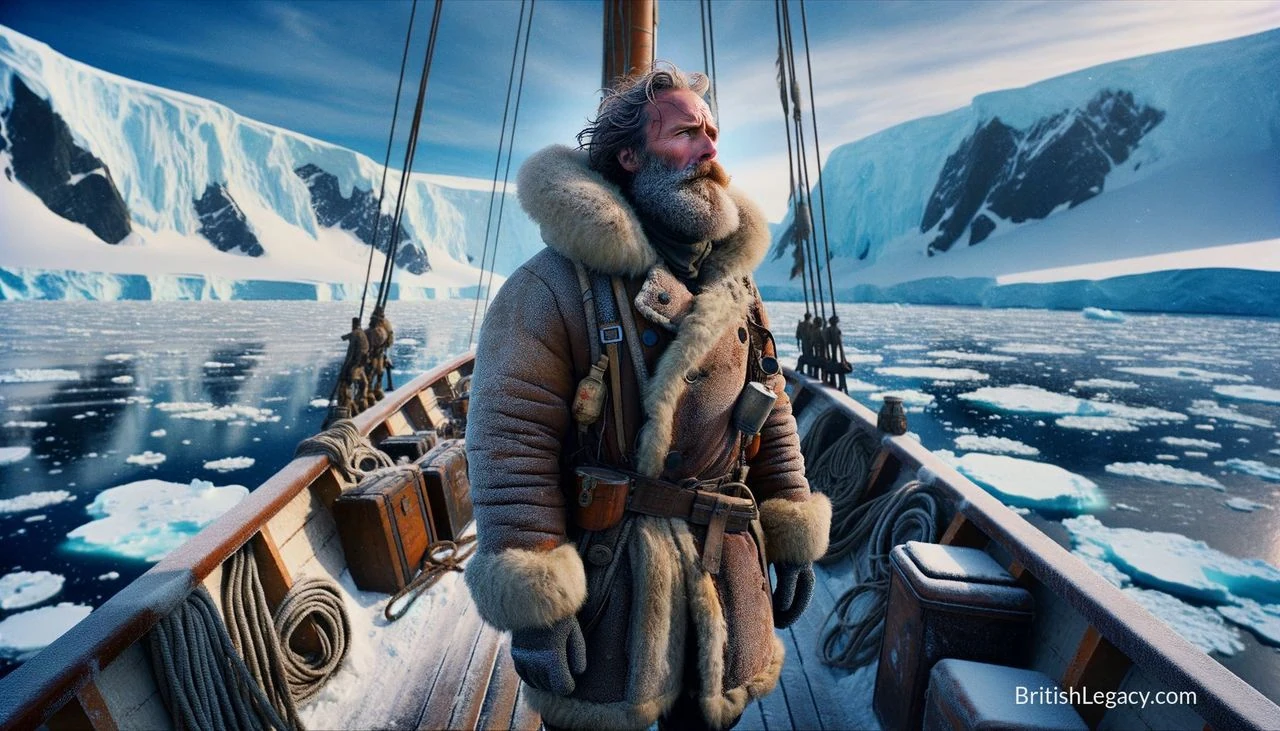
Ernest Shackleton set out to cross Antarctica. His ship, Endurance, never reached its destination: trapped in the Weddell Sea pack ice, it was crushed and sank in November 1915. The expedition’s original purpose had failed, but Shackleton and his crew survived a sequence of hazardous journeys that ended with every member of the Endurance party rescued. That outcome, rather than a march across the continent, became the defining achievement of his Antarctic career.
From County Kildare to the polar regions
Shackleton was born in Kilkea, County Kildare, Ireland, on 15 February 1874. His family moved to Sydenham, south London, when he was ten. He was educated at Dulwich College and left school at sixteen to go to sea. After training aboard a sailing ship, he built a career in the merchant navy, gaining the qualifications that enabled him to command a British ship. In 1900, he joined the Union-Castle Line, which carried passengers and mail between Britain and South Africa.
His route into polar exploration began through maritime connections. In 1901, he became third officer on Captain Robert Falcon Scott’s Discovery expedition, the British National Antarctic Expedition. The ship reached Antarctica in January 1902. Shackleton helped with early sledging journeys and edited the expedition’s winter magazine, the South Polar Times. Scott then chose him to join a southern journey with Edward Wilson. The party reached a record latitude of 82°17′ south, but the return was arduous. Shackleton became seriously unwell and was sent home in February 1903 aboard a relief ship.
After recovering, he held several posts ashore, including secretary of the Royal Scottish Geographical Society. He married Emily Dorman in 1904; they had three children. He also worked for industrialist William Beardmore and pursued other business and political ventures, with limited success. His ambition to lead an Antarctic expedition of his own, however, remained.
The Nimrod expedition and a near approach to the Pole
Shackleton’s first independent expedition sailed aboard Nimrod in 1907. Financial support came from several private backers, and the New Zealand government and a shipping company helped with the cost of towing the vessel towards Antarctica. Shackleton had promised Scott that he would not use the old Discovery base at McMurdo Sound. When ice made other proposed bases impracticable, he eventually chose McMurdo, a decision he regarded as necessary in the circumstances.
In 1908, Shackleton and three companions set out on a journey towards the South Pole. They reached 88°23′ south, a new record, before turning back while they still had a chance of returning safely. The party’s return became a race against starvation. One companion, Frank Wild, later recorded that Shackleton gave him his own daily biscuit when Wild was ill. Other achievements included the first ascent of Mount Erebus and the discovery of the approximate location of the South Magnetic Pole by a party led by Edgeworth David.
The expedition did not reach the geographical South Pole, but its results brought Shackleton public recognition. He was knighted in 1909, received the Royal Victorian Order and the Polar Medal, and published an account of the expedition, The Heart of the Antarctic. The distinction between exploration’s measured achievements and its celebrated personalities was already apparent: the expedition set records and produced scientific results, but also left Shackleton with substantial debts.
Endurance: from expedition to rescue
After Norwegian explorer Roald Amundsen reached the South Pole in 1911, Shackleton turned to a different objective: crossing the Antarctic continent from the Weddell Sea to McMurdo Sound. The Imperial Trans-Antarctic Expedition used two ships. Endurance carried Shackleton’s party towards the Weddell Sea; Aurora was to support the crossing from the other side by laying supply depots. The expedition left during the First World War, in 1914, and was financed largely by private donations, alongside government support.
Endurance became trapped in pack ice in January 1915. The ship drifted with the ice for months before being abandoned; it sank on 21 November. Shackleton and his men camped on the ice, then took to three lifeboats when their floe broke up. After five days at sea, they reached Elephant Island. They had been away from solid ground for 497 days, and the island was remote from ordinary shipping routes.
Shackleton judged that waiting for a chance rescue was unlikely to succeed. He took five companions in the small lifeboat James Caird on a hazardous voyage to South Georgia, where he knew help could be found. Navigator Frank Worsley guided the boat through stormy seas; South Georgia came into view after fifteen days. The landing was on the island’s unoccupied southern coast, so Shackleton, Worsley and Tom Crean crossed mountainous terrain to reach the whaling station at Stromness.
Rescue efforts for the men left on Elephant Island were delayed by sea ice. Shackleton eventually secured the Chilean tug Yelcho, commanded by Luis Pardo. On 30 August 1916, the party reached the island and took off all 22 men. The supporting Ross Sea party had faced its own hardships while laying depots; three of its members died. The rescue of the Endurance crew should not obscure that loss or the separate work of the other ship’s party.
War, a final voyage and an early death
Shackleton returned to Britain in 1917 and volunteered for army service. He served in northern Russia during the Russian Civil War, advising British forces on equipment and training for Arctic conditions. He was appointed an Officer of the Order of the British Empire for his services there. After the war, he returned to lecturing and to planning another expedition.
With financial support from John Quiller Rowett, Shackleton acquired the vessel Quest for what became the Shackleton–Rowett Expedition. It sailed in 1921, with an Antarctic destination and oceanographic work among its aims. Shackleton died of a heart attack at Grytviken, South Georgia, on 5 January 1922, aged 47, while the ship was moored there. At his wife’s request, he was buried in the cemetery at Grytviken. His will was proved in London later that year; he had died heavily in debt.
A reputation remade
Shackleton’s public reputation changed over time. In the years after his death, memorials and popular accounts paid far more attention to Scott. Later books and retellings helped bring Shackleton’s story back to prominence, with the rescue of the Endurance crew at its centre. A 2002 BBC poll of the 100 Greatest Britons ranked him eleventh. His name also entered discussions of leadership: his decisions during the crisis are used as examples in management and leadership education. That modern reputation sits alongside a less triumphant record of business ventures that failed to prosper and expedition debts that he could not clear.
Why Sir Ernest Shackleton deserves a place in British Legacy
Shackleton’s place in British Legacy rests on a specific achievement, not on a general claim about national character. He led British Antarctic expeditions that advanced geographical and scientific work: the Nimrod party set a new southern latitude record, climbed Mount Erebus and located the South Magnetic Pole. On the Endurance expedition, the planned crossing failed, but he responded to the changing circumstances by prioritising the survival of his party. The boat voyage to South Georgia and the eventual rescue of the men on Elephant Island made seamanship, navigation and practical judgement central to the expedition’s outcome.
His story also gives a fuller account of exploration than a simple tale of triumph. The Aurora party’s depot-laying work came at a cost of three lives; Shackleton’s wider career included debt and business ventures that did not succeed. Those details do not diminish the rescue, but they distinguish evidence from legend. His later influence can be seen in the books, public memorials and leadership teaching that renewed attention to his methods under extreme pressure. Remembering Shackleton means recognising both the limits of his expeditions and the consequential choices he made when their original plans became impossible.
Sources
Ernest Shackleton — revision 1378599456 · Ernest Shackleton
Adapted in part from Ernest Shackleton by Wikipedia contributors, under CC BY-SA 4.0. Text has been edited and combined with the existing article; this adapted text is shared under the same licence. Contributor history.