
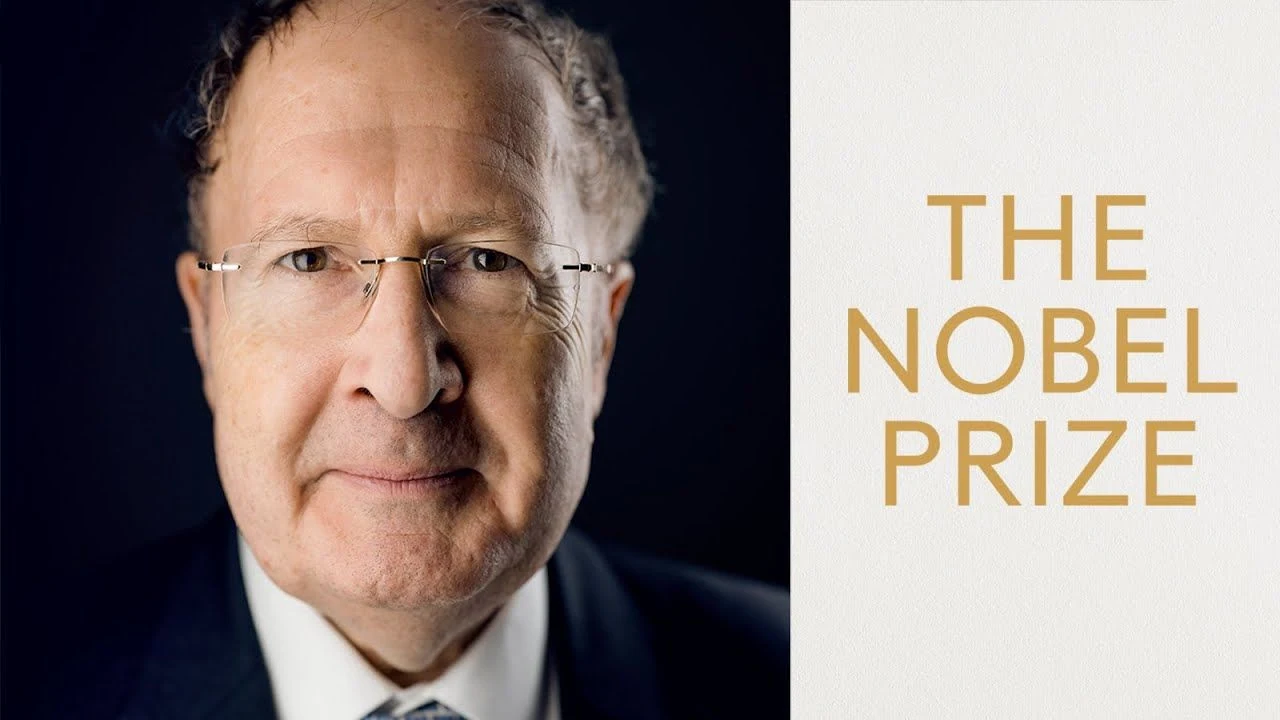
Sir Gregory Paul Winter’s work changed how antibodies could be adapted and developed for medical use. By engineering antibodies and using phage display to identify useful forms, he helped turn a biological defence mechanism into a platform for therapeutic drugs. The work earned him half of the 2018 Nobel Prize in Chemistry and grew from a long research career in Cambridge, alongside ventures that carried antibody engineering into biotechnology.
Education and research in Cambridge
Winter was born in Leicester on 14 April 1951. He studied at the Royal Grammar School in Newcastle upon Tyne, then read Natural Sciences at Trinity College, Cambridge, graduating in 1973. He completed a PhD at the Medical Research Council’s Laboratory of Molecular Biology (LMB), supervised by Brian S. Hartley. His doctoral research examined the amino-acid sequence of tryptophanyl tRNA synthetase from a bacterium.
After postdoctoral work at the LMB, Winter became a group leader there in 1981. His research focused on proteins and nucleic acids. He also held senior roles at the LMB and the MRC Centre for Protein Engineering: he headed the Division of Protein and Nucleic Acids Chemistry from 1994 to 2006 and was deputy director of the centre from 1990 until it closed in 2010. From 2006 to 2011 he was an LMB deputy director, including a period as acting director in 2007–08.
Engineering antibodies for treatment
Antibodies recognise particular targets, but early therapeutic uses faced a problem: antibodies taken from mice could provoke an immune response in people, limiting their usefulness. Winter developed methods to alter antibodies so that they were more suitable for human treatment. His 1986 technique for humanising mouse monoclonal antibodies helped establish a route towards therapies that retained the ability to recognise a target while reducing the problems associated with their mouse origin.
One result of this research was Campath-1H, developed by scientists at the LMB and the University of Cambridge. It later received regulatory approval for treating multiple sclerosis and chronic lymphocytic leukaemia. Winter’s work also helped make humanised antibodies a major category of antibody-based medicines, including drugs such as Keytruda.
Phage display provided a further means of developing antibodies. In this method, genetic instructions for antibody fragments are linked to bacteriophages, viruses that infect bacteria. The resulting phages display the corresponding fragments; researchers can select those that bind to a chosen target and refine candidates through repeated rounds of selection. Winter pioneered the use of this approach to develop fully human antibodies. The Nobel Prize recognised his work on phage display for antibodies, shared with George Smith, whose earlier work established the method, while Frances Arnold received the other half of the 2018 chemistry prize for directed evolution of enzymes.
From laboratory research to companies
Winter’s career connected academic research with commercial biotechnology. In 1989 he founded Cambridge Antibody Technology, one of the early companies specialising in antibody engineering. The company discovered the antibody D2E7, later known as adalimumab and marketed as Humira. Abbott Laboratories developed and marketed the drug. It became a leading commercial success; the distinction matters, because Winter’s contribution was to the research and company behind its discovery, not sole responsibility for every stage of its development.
Cambridge Antibody Technology was acquired by AstraZeneca in 2006. Winter had also founded Domantis in 2000 to develop domain antibodies, which use the active portion of a full-sized antibody. GlaxoSmithKline acquired Domantis in December 2006. He subsequently founded Bicycle Therapeutics, a company developing small protein mimics. These ventures extended his work beyond the laboratory, bringing antibody engineering and related research into commercial organisations.
Honours and academic service
Winter was elected a Fellow of the Royal Society in 1990 and appointed a Commander of the Order of the British Empire in 1997. He was knighted in 2004. Among his other honours were the Royal Society’s Royal Medal in 2011 and the Prince Mahidol Award in 2016. In 2018 he shared the Nobel Prize in Chemistry with George Smith for their work on phage display of peptides and antibodies. The Royal Society awarded him the Copley Medal in 2024.
His institutional service included a long association with Cambridge and the MRC research community. He was appointed Master of Trinity College, Cambridge, in 2012 and held the post until 2019. The combination of research leadership, company founding and college service gives a fuller account of his public scientific role than the prize record alone.
Why Sir Gregory P. Winter deserves a place in British Legacy
Winter’s place in British Legacy rests on specific work undertaken through British research institutions and carried into medicine. At the MRC Laboratory of Molecular Biology in Cambridge, he developed techniques for engineering antibodies, including methods to humanise mouse antibodies and later to use phage display in developing fully human ones. These approaches addressed a practical obstacle to treatment: an antibody that works against a target may still be unsuitable if the patient’s immune system reacts against it. Engineering and selection methods helped researchers pursue antibodies that could be used as therapies.
The consequences extended beyond a laboratory finding. Campath-1H, developed by LMB and Cambridge scientists, went on to receive approval for two conditions; antibody engineering also underpins medicines such as Keytruda. Through Cambridge Antibody Technology, Domantis and Bicycle Therapeutics, Winter helped establish companies working to turn research into products and further development. His career therefore illustrates a clear British connection: research conducted in Cambridge, public scientific institutions and a university community contributed to technologies with international medical and commercial reach. The Nobel Prize recognised the significance of the science, while the companies and therapeutic applications show how that science could be put to work.
Sources
Gregory Winter — revision 1364582294
Adapted in part from Gregory Winter by Wikipedia contributors, under CC BY-SA 4.0. Text has been edited and combined with the existing article; this adapted text is shared under the same licence. Contributor history.
.jpg)