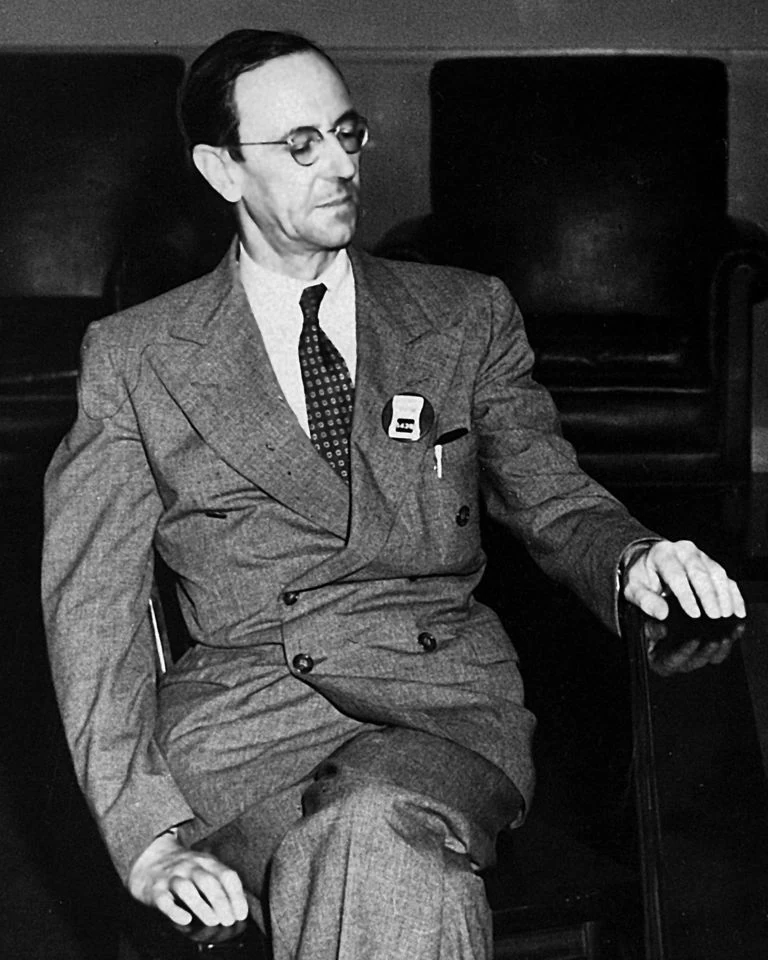
In 1932, after a concentrated run of experiments at the University of Cambridge’s Cavendish Laboratory, James Chadwick made the case for a particle with no electric charge: the neutron. Its discovery changed the understanding of the atomic nucleus. It also began a career in which fundamental physics, university-building and Britain’s wartime atomic programme became closely connected.
A physicist formed in Manchester
Chadwick was born in Cheshire on 20 October 1891. His parents moved to Manchester when he was young, and he attended the Central Grammar School for Boys there after his family could not afford the fees at Manchester Grammar School. At 16, he won two university scholarship examinations. He entered the Victoria University of Manchester in 1908, intending to study mathematics, but enrolled in physics instead.
Ernest Rutherford, who led the university’s physics department, set Chadwick a research problem: devise a way to compare the radioactive energy of two sources. Chadwick found a workable method, and the resulting paper, written with Rutherford, was his first. He graduated with first-class honours in 1911, gained an MSc in 1913 and received an 1851 Exhibition Scholarship. That scholarship took him to Germany, where he studied beta radiation with Hans Geiger. Using Geiger’s counter, Chadwick showed that beta radiation produced a continuous spectrum rather than the discrete lines then expected.
The outbreak of the First World War found him in Germany. He was interned at the Ruhleben camp near Berlin for four years. There, with improvised equipment and the assistance of fellow internee Charles Drummond Ellis, he continued scientific work. Released after the Armistice, he returned to Manchester and wrote up his findings. In 1919 he followed Rutherford to Cambridge, joining the Cavendish Laboratory. He completed a PhD at Gonville and Caius College in 1921 and became Rutherford’s assistant director of research in 1923.
Establishing the neutron
Chadwick’s route to the neutron involved results that did not fit comfortably with the existing picture of the nucleus. In Germany, Walther Bothe and Herbert Becker had found that bombarding beryllium with alpha particles produced an unusual radiation. Chadwick asked his student Hugh Webster to repeat their work. The results suggested a neutral particle of the kind Rutherford had considered theoretically.
A further clue came from work by Frédéric and Irène Joliot-Curie. They had used the radiation from polonium and beryllium to knock protons out of paraffin wax, interpreting the radiation as gamma rays. Rutherford and Chadwick thought gamma rays could not readily account for the result. A neutral particle, however, could strike a proton without first overcoming the electrical repulsion that would obstruct a positively charged particle. Chadwick set aside other work to test that explanation, assisted by Norman Feather.
His apparatus was simple: a polonium source and a beryllium target sent radiation towards materials such as paraffin, while a small ionisation chamber and an oscilloscope detected the displaced protons. In February 1932 he announced the possible existence of the neutron in Nature; a fuller account, “The Existence of a Neutron”, followed in the Proceedings of the Royal Society A in May. The discovery helped physicists make sense of the nucleus and of properties, including nuclear spin, that the earlier model could not explain. Chadwick later measured the neutron’s mass with Maurice Goldhaber, establishing that it was too heavy to be a proton–electron pair.
The neutron’s lack of electric charge also made it an effective means of probing and transforming atomic nuclei: unlike positively charged particles, it did not have to overcome the same electrical repulsion to enter a nucleus. The discovery opened important lines of research in nuclear physics, including the production of heavier elements. Chadwick received the Hughes Medal in 1932 and the Nobel Prize in Physics in 1935, awarded “for the discovery of the neutron”. Further distinctions included the Copley Medal and Faraday Medal in 1950 and the Franklin Medal in 1951.
Liverpool: building a centre for nuclear physics
Chadwick left Cambridge in 1935 to take the Lyon Jones Chair of Physics at the University of Liverpool. The laboratory was old and still used direct-current electricity. He began its renewal, securing funds from the university and the Royal Society and assembling expertise to build a cyclotron. The project drew on local industry: a cable manufacturer donated copper conductor, while Metropolitan-Vickers made the 50-ton magnet and vacuum chamber. The cyclotron was installed and running in July 1939. Its total cost exceeded the grants, and Chadwick used part of his Nobel Prize money to meet the shortfall.
For Chadwick, the equipment served scientific questions, not simply institutional prestige. Liverpool’s medicine and science faculties worked closely together, and he joined a commission examining cancer-treatment arrangements in the city. He anticipated that neutrons and radioactive isotopes produced by the cyclotron might help researchers study biochemical processes and investigate cancer. His work at Liverpool thus linked experimental physics with a developing research infrastructure and possible medical applications.
Wartime science and public responsibility
When war came, Chadwick’s research shifted towards the feasibility of an atomic bomb. He worked on Britain’s Tube Alloys project and led a team investigating uranium. In 1941 he wrote the final draft of the MAUD Report, which concluded that an atomic bomb was feasible and helped prompt the United States government to pursue serious bomb research. His role was therefore not simply that of a scientist who later joined an American project: he helped develop the British scientific assessment that preceded it.
As the scale of the work outstripped Britain’s resources, cooperation with the United States became central. Under the 1943 Quebec Agreement, the British project was joined with the Manhattan Project. Chadwick became head of the British Mission and technical adviser to the Combined Policy Committee. He visited American research and production facilities and worked to bring British scientists into the project. In 1944 he moved to Los Alamos with his family. He was present at the Trinity test in July 1945, the first detonation of an atomic bomb.
Chadwick’s contribution placed him at the meeting point of experimental discovery, government decision-making and the development of nuclear weapons. The same neutron whose properties he had established in the laboratory was part of the technology used in the bomb programme. That connection makes his wartime work consequential, but it also complicates any account that treats scientific progress as detached from its uses. Chadwick was knighted in 1945 for his work in nuclear physics.
College leadership and later recognition
After the war, Chadwick served as Britain’s scientific adviser to the United Nations Atomic Energy Commission. In 1948 he became Master of Gonville and Caius College, Cambridge, a position he held until his retirement in 1958. He worked to strengthen the college’s academic standing and increase its research fellowships. His career had by then moved from student and experimental researcher to laboratory-builder, wartime scientific leader and head of a Cambridge college.
Chadwick died in Cambridge on 24 July 1974, aged 82. His scientific work is commemorated at Liverpool, where the university’s Chadwick Laboratory and Sir James Chadwick Chair of Experimental Physics bear his name. His papers are held at the Churchill Archives Centre in Cambridge. These memorials reflect both the discovery associated with his name and his work in building institutions in which experimental science could continue.
Why Sir James Chadwick deserves a place in British Legacy
Chadwick’s place in British Legacy rests first on a specific achievement: he provided convincing experimental evidence for the neutron and established it as a new nuclear particle. The discovery helped resolve problems in the contemporary understanding of atomic structure and opened routes for further work in nuclear physics. His path to it was not a single flash of inspiration. It involved following evidence from other laboratories, testing an interpretation against the behaviour of protons, and designing experiments capable of distinguishing a neutral particle from gamma radiation. The Nobel Prize recognised that finding, but its importance is also visible in the research and applications that followed.
His British significance is equally visible in the institutions and public responsibilities around the science. At Liverpool, Chadwick secured resources, drew on local industry and built a cyclotron that helped turn an antiquated laboratory into a centre for nuclear physics. During the war, he led the British Mission to the Manhattan Project after writing the final draft of the MAUD Report, placing British scientific judgement within decisions with immense consequences. Remembering him therefore requires more than celebrating a Nobel-winning discovery: it means recognising both the practical work that made research possible and the difficult responsibilities that came with its application. His career offers a grounded account of British scientific achievement, and of the choices and consequences that can accompany it.
Sources
James Chadwick — Wikipedia revision
Adapted in part from James Chadwick by Wikipedia contributors, under CC BY-SA 4.0. Text has been edited and combined with the existing article; this adapted text is shared under the same licence. Contributor history.