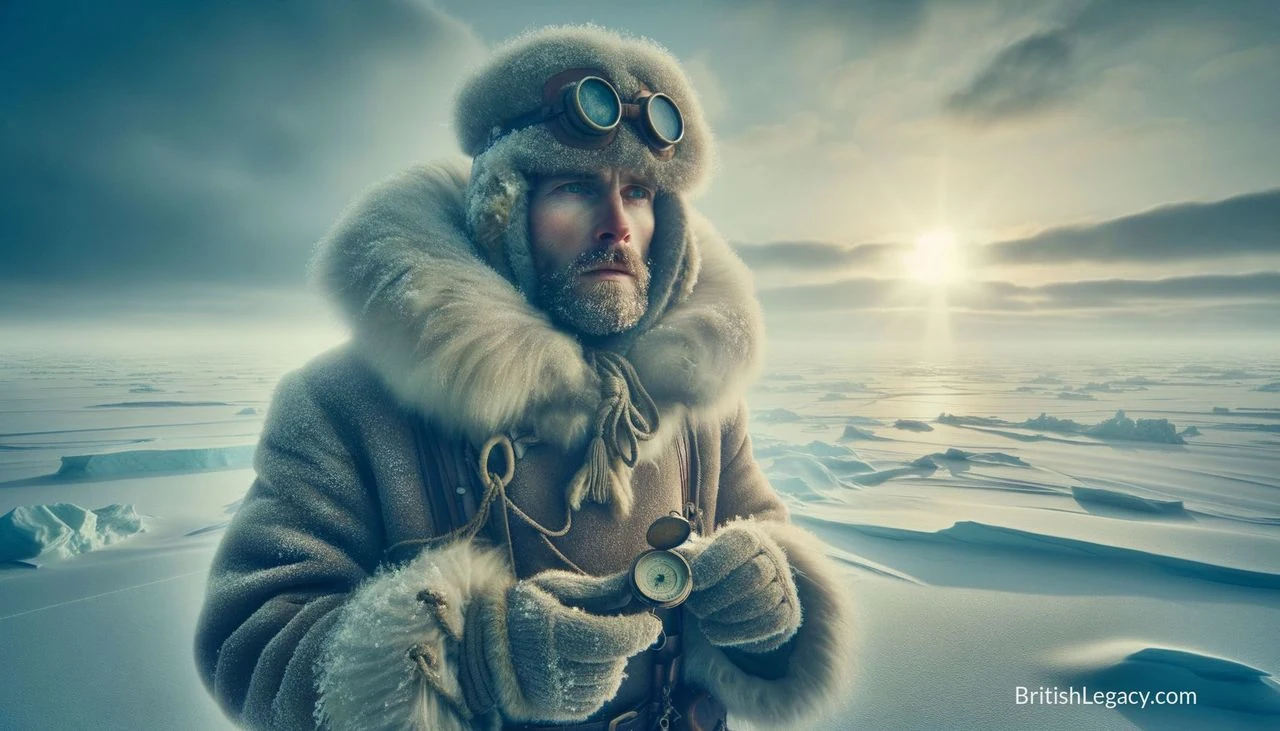
Sir John Franklin’s name is inseparable from the search for the Northwest Passage, but the story reaches beyond the disappearance of two ships. A Royal Navy officer who served in the Napoleonic Wars and the War of 1812, he led expeditions across the Canadian Arctic and later governed Van Diemen’s Land. In 1845, at the age of 59, he accepted command of a final voyage to chart the remaining sections of the passage. He died in the Arctic; every member of his expedition was lost. The search that followed became an extensive undertaking in its own right, adding to geographical knowledge while leaving painful questions about the men’s fate and the treatment of Indigenous people in the places Franklin served.
From Lincolnshire to the Royal Navy
Franklin was born in Spilsby, Lincolnshire, on 16 April 1786, the ninth of twelve children of Willingham Franklin and Hannah Weekes. He attended King Edward VI Grammar School in Louth. His father initially expected him to enter the Church or business, but a trial voyage on a merchant ship when John was 12 confirmed his interest in the sea. In March 1800, his father secured him an appointment in the Royal Navy.
Franklin first served aboard HMS Polyphemus, which took part in the Battle of Copenhagen in 1801. He later joined his cousin Matthew Flinders’s expedition around Australia aboard HMS Investigator. On the return voyage, Franklin survived the wreck of HMS Porpoise. He was aboard HMS Bellerophon at Trafalgar in 1805, and, as a lieutenant during the War of 1812, was wounded at the Battle of Lake Borgne in December 1814.
In 1818 he commanded HMS Trent on an Arctic voyage led by Captain David Buchan. The following year, Franklin was appointed to lead an overland expedition from Hudson Bay to chart the Canadian coast eastwards from the Coppermine River. The party faced severe privation: 11 of its 20 members died, mostly from starvation or exhaustion. Survivors resorted to eating lichen and leather boots, giving Franklin the enduring nickname “the man who ate his boots”.
Mapping the northern coast
Franklin’s next land expedition began in 1825. Its aim was to reach the mouth of the Mackenzie River and survey the coast westwards, while John Richardson travelled east from the river towards the Coppermine. Franklin reached the Arctic coast in August 1825 and returned the following summer to continue the survey. He travelled west for several hundred miles before turning back at Return Reef. The expedition extended British geographical knowledge of the northern coast, though the intended meeting with other exploring parties did not take place.
In 1823, before that journey, Franklin had married the poet Eleanor Anne Porden; their daughter, Eleanor Isabella, was born the following year. Porden died of tuberculosis in 1825. Franklin married Jane Griffin, a friend of his first wife, in 1828. The following year, George IV knighted him. Franklin was appointed Lieutenant-Governor of Van Diemen’s Land in 1837, serving until his removal from office in 1843.
His time in Tasmania forms a less celebratory part of his record. Franklin and Jane took Mathinna, the daughter of an Indigenous Tasmanian woman, into their household and raised her alongside Eleanor. When the Franklins returned to England in 1843, they left Mathinna at an orphanage. The episode sits within the wider history of British colonial rule and the forced removal of Indigenous people in Tasmania; it complicates any account that treats Franklin’s career only as a story of exploration.
The final voyage
In 1845, the Admiralty chose Franklin to command an expedition intended to complete the charting of the Northwest Passage. He was given command on 7 February. HMS Erebus and HMS Terror were strengthened for polar conditions and carried steam engines, heating and distillation equipment, libraries and preserved food intended to last for three years. Their equipment reflected the naval confidence of the period, but it could not overcome the dangers of the Arctic environment.
The expedition left Greenhithe on 19 May 1845 with 24 officers and 110 men. After five crew members were sent home, 129 remained aboard the two ships. Europeans last saw Erebus and Terror on 26 July, moored to an iceberg in Lancaster Sound. They later became trapped in ice off King William Island. A note found on the island recorded that Franklin died on 11 June 1847; the location of his grave is unknown.
The ships were abandoned ten months after Franklin’s death. No one from the expedition survived. The evidence points to starvation, hypothermia and scurvy among the causes of death. Lead poisoning from the expedition’s provisions or water system has also been considered a possible contributing factor, but it should not be treated as an established explanation for the expedition’s fate.
The search, the evidence and the wrecks
When the expedition failed to return, Franklin’s wife urged the Admiralty to organise a search. The first searches began after a delay, and Lady Franklin continued to press for news. In 1850, search parties found the graves of three crew members on Beechey Island. The Scottish explorer John Rae later reported, in 1854, what he had learned from Inuit hunters: the ships had been trapped in ice and the men had died while trying to reach safety. Inuit testimony also described evidence of cannibalism. Later examination of remains found cut marks consistent with those accounts.
The searches did more than investigate Franklin’s fate. Expeditions over several decades contributed substantially to the mapping of the Arctic, although they did not immediately settle what had happened to the ships or their crews. Scientific studies in the 1980s examined remains from Beechey Island and considered pneumonia, tuberculosis and lead exposure. No single explanation accounts for all the circumstances of the disaster.
The wreck of Erebus was found in 2014, and Terror in 2016, both in waters around King William Island. Their discovery renewed public and scholarly interest in the expedition and offered physical evidence to complement written records, Inuit testimony and recovered artefacts. The wrecks are protected as the Wrecks of HMS Erebus and HMS Terror National Historic Site; their precise locations have not been disclosed.
Why Sir John Franklin deserves a place in British Legacy
Franklin’s place in British history rests on a career that linked naval service, geographical exploration and colonial administration. His two overland expeditions helped chart sections of the Canadian Arctic coast, and the searches for his lost party extended that work. This legacy is concrete: the pursuit of information about the expedition generated decades of surveying and mapping, while the later discovery of the ships has brought new material evidence to a story long shaped by incomplete records.
That achievement should not be separated from the human consequences. Franklin’s first Arctic expedition cost 11 of its 20 members their lives; the final voyage killed all 129 men who remained aboard. Inuit knowledge helped reveal the fate of the crew, and later evidence supported some of what Inuit hunters had reported. Franklin’s record in Tasmania also includes the abandonment of Mathinna after she had been raised in his household. Remembering these details makes the legacy more truthful: exploration produced geographical knowledge, but it also involved deadly hardship and took place amid colonial power. British Legacy can recognise Franklin’s role in Arctic history without turning tragedy into uncomplicated heroism.
Sources
John Franklin — Wikipedia revision 1378208260 · John Franklin — Wikipedia
Adapted in part from John Franklin by Wikipedia contributors, under CC BY-SA 4.0. Text has been edited and combined with the existing article; this adapted text is shared under the same licence. Contributor history.