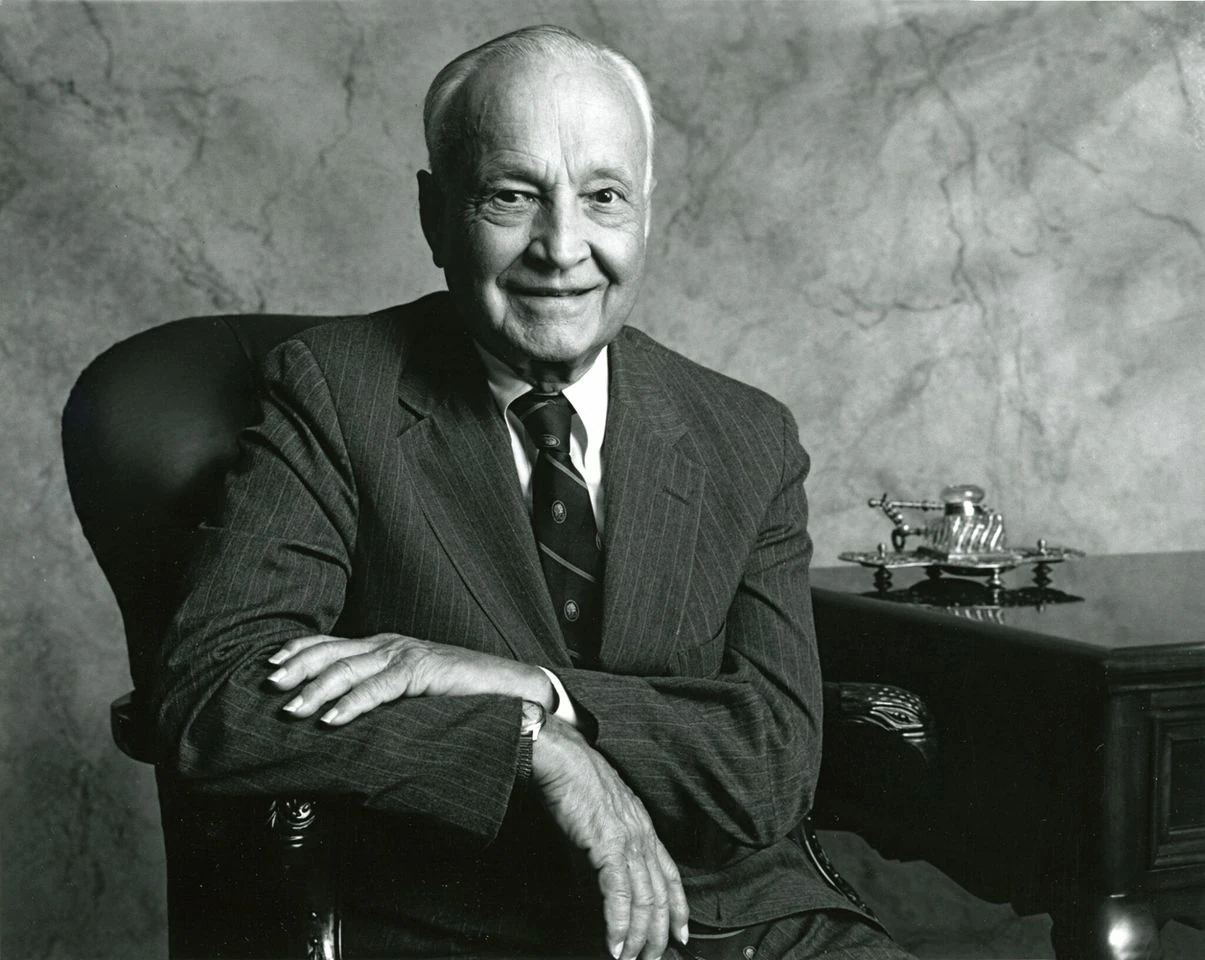
John Marks Templeton’s life joined three spheres that are often kept apart: international investment, Christian faith and the study of questions about spiritual reality. Born in Tennessee, he became a British citizen after studying at Oxford as a Rhodes Scholar. He made his fortune as an investor, then directed much of it towards institutions and research, including the Templeton Prize and a foundation that supports inquiry into what he called the “big questions”.
From Tennessee to Oxford
Templeton was born in Winchester, Tennessee, on 29 November 1912. He studied at Yale University, graduating in 1934, before going to Balliol College, Oxford, as a Rhodes Scholar. He earned a master’s degree in law at Oxford. His education there became an important part of his British connection and helped shape his interest in looking beyond the United States when considering investment opportunities.
In the late 1930s, during the Depression, Templeton took an unusually broad approach to share-buying. In 1939, he instructed his broker to buy 100 shares in each New York Stock Exchange-listed company then selling for less than one dollar. The resulting portfolio included 104 companies, 37 of them in bankruptcy. As US industry recovered during the Second World War, many of the investments returned several times their purchase price.
In 1954, Templeton created the Templeton Growth Fund. Its approach was to seek out shares he considered undervalued, including in markets that other investors overlooked, and to sell when prices approached what he judged to be fair value. The fund averaged growth of more than 15 per cent a year over 38 years, according to the biographical account. It invested in Japan from the mid-1960s, when Templeton’s firm was among the early American investors to enter that market. His career established a reputation for looking beyond fashionable stocks and familiar markets.
A disciplined, international investor
Templeton’s method was not simply to buy any share that had fallen in price. He looked for companies he considered profitable, competently managed and capable of performing well over the long term. Rather than attempt to forecast short-term market movements, he used fundamental analysis and paid attention to the price he was being asked to pay. He typically held an investment for about four years, selling when its price reached his estimate of fair value.
This approach could look unremarkable during a rising market, when investors were attracted to the stocks and sectors in fashion. Templeton’s advantage, as described in the account of his investment career, tended to appear during crashes and bear markets, when his fund often lost less than the wider market or made modest gains against it. The aim was not to follow a crowd into a rising price, but to look for value where pessimism had made an asset unpopular.
Templeton’s financial success brought public recognition. In 1999, Money magazine called him “arguably the greatest global stock picker of the century”. He was also a Chartered Financial Analyst and received the Association for Investment Management and Research’s first award for professional excellence in 1991. He was created a Knight Bachelor in 1987 for his philanthropic efforts.
Prizes, foundations and spiritual questions
Templeton’s philanthropy grew from his Presbyterian faith and a belief that scientific investigation and spiritual inquiry need not be opponents. He established the Templeton Prize in 1972 to recognise contributions to research or discoveries about spiritual realities. Its recipients have included Mother Teresa, the Dalai Lama and Archbishop Desmond Tutu.
He established the Templeton Religion Trust in 1984 and the John Templeton Foundation in 1987. The organisations are separate charitable entities. The Foundation supports research into broad questions about nature and the universe, as well as subjects such as love, gratitude, forgiveness and creativity. Templeton argued for what he called a humble approach to theology: a willingness to recognise how much remained unknown and to learn from different religious traditions.
In 2004, he gave a further $550 million to the John Templeton Foundation. Across his philanthropy, he gave away more than $1 billion to charitable causes. The Templeton World Charity Foundation was another of the charitable entities he established. His giving was not confined to research into religion: in 1983 he endowed Oxford’s Centre for Management Studies, which later became Templeton College. The college received a royal charter in 1995 and merged with Green College in 2008 to form Green Templeton College.
Citizenship and later life
Templeton renounced his US citizenship in 1964 and held British citizenship. He moved to the Bahamas full-time in 1968, where he lived for the rest of his life. In a 1997 interview, he denied that he had given up US citizenship to avoid American taxes, saying he intended to live in the Bahamas and felt obligated to do so.
He died in Nassau on 8 July 2008, aged 95. In the years before his death, Templeton continued to write about investing, faith and personal conduct. His books included The Humble Approach: Scientists Discover God (1981), Discovering the Laws of Life (1994) and Worldwide Laws of Life (1998). In 2007, Time named him one of the world’s 100 most influential people, citing his pursuit of spiritual understanding through scientific research.
Why Sir John Templeton deserves a place in British Legacy
Templeton’s place in British Legacy rests on a specific, documented connection: he came to Oxford as a Rhodes Scholar, earned a master’s degree at Balliol College and later held British citizenship. Oxford was more than a biographical stop. He endowed the Centre for Management Studies, helping it develop into Templeton College, which became part of Green Templeton College after its merger with Green College. That institutional legacy links his financial success to continuing education in the UK.
His wider contribution was to direct wealth towards inquiry rather than treat investment and philanthropy as separate lives. The Templeton Prize and his foundations supported work on spiritual realities and on questions that cross boundaries between science, religion and human experience. His approach was founded on an acknowledgement of uncertainty: knowledge, he argued, remained incomplete, and investigation should be open to new understanding. That principle, alongside his Oxford connection and support for an Oxford college, gives his legacy a clear British dimension without obscuring his American birth or the global reach of his work. Templeton’s career also illustrates how capital gained in international markets can support institutions and research long after the investment decisions that created it.
Sources
John Templeton, revision 1372648979 · John Templeton
Adapted in part from John Templeton by Wikipedia contributors, under CC BY-SA 4.0. Text has been edited and combined with the existing article; this adapted text is shared under the same licence. Contributor history.