
Sir Martin Frobisher’s career joined Arctic exploration to privateering and naval warfare. In the 1570s he led three expeditions across the North Atlantic in search of a north-west passage to Asia. The voyages reached the waters of present-day Baffin Island, but their commercial ambition became entangled with a disastrous hunt for supposed gold. A decade later, Frobisher commanded English ships against the Spanish Armada and was knighted for his service. His life was marked by ambition and command, but also by the violence inflicted on people encountered by the expeditions.
A Yorkshire youth, then a life at sea
Frobisher was born at Altofts in Yorkshire, probably around 1535 or 1536, though the date is also given as 1539. His father, Bernard Frobisher, died in 1542, and Martin and his siblings were placed in the care of their uncle, Francis. In 1549, he was sent to London to live with his maternal relative Sir John York, a wealthy merchant with connections to the royal government. Little is known of Frobisher’s early education.
His first recorded expeditions took him to West Africa. In 1553, he joined Thomas Wyndham’s fleet, which traded on the Gold Coast and in Benin after plundering Portuguese ships near Madeira. Disease killed many of the English crew, including Wyndham, and only 40 of the original 140 men returned. Frobisher survived and went on another African trading voyage in 1554. During that expedition he volunteered as a hostage in negotiations with a local governor. When Portuguese ships disrupted the talks, the English fleet left without him. He was handed over to the Portuguese, imprisoned at São Jorge da Mina and eventually returned to England around 1558.
Frobisher’s subsequent maritime career included privateering, arrests and service to the Crown. In 1563, he captained a vessel in a venture against French shipping, but was arrested after the seizure of a Spanish ship was linked to the deaths of Englishmen. He was imprisoned again after a proposed trading voyage in 1565 and, later, for seizing ships beyond the limits of his authorisation. Released in 1570, he undertook naval duties for the government, including work against pirates and smugglers and logistical support for the English campaign in Ireland.
Seeking a route through the Arctic
For much of the sixteenth century, English merchants and navigators sought a northern sea route to Cathay and the East Indies. Frobisher petitioned the Privy Council in 1574 for backing to find a passage westwards to the Pacific. The Muscovy Company, which held commercial interests in northern routes, eventually licensed his expedition. With help from the company’s director, Michael Lok, Frobisher raised enough money for three small vessels: the Gabriel, the Michael and a pinnace.
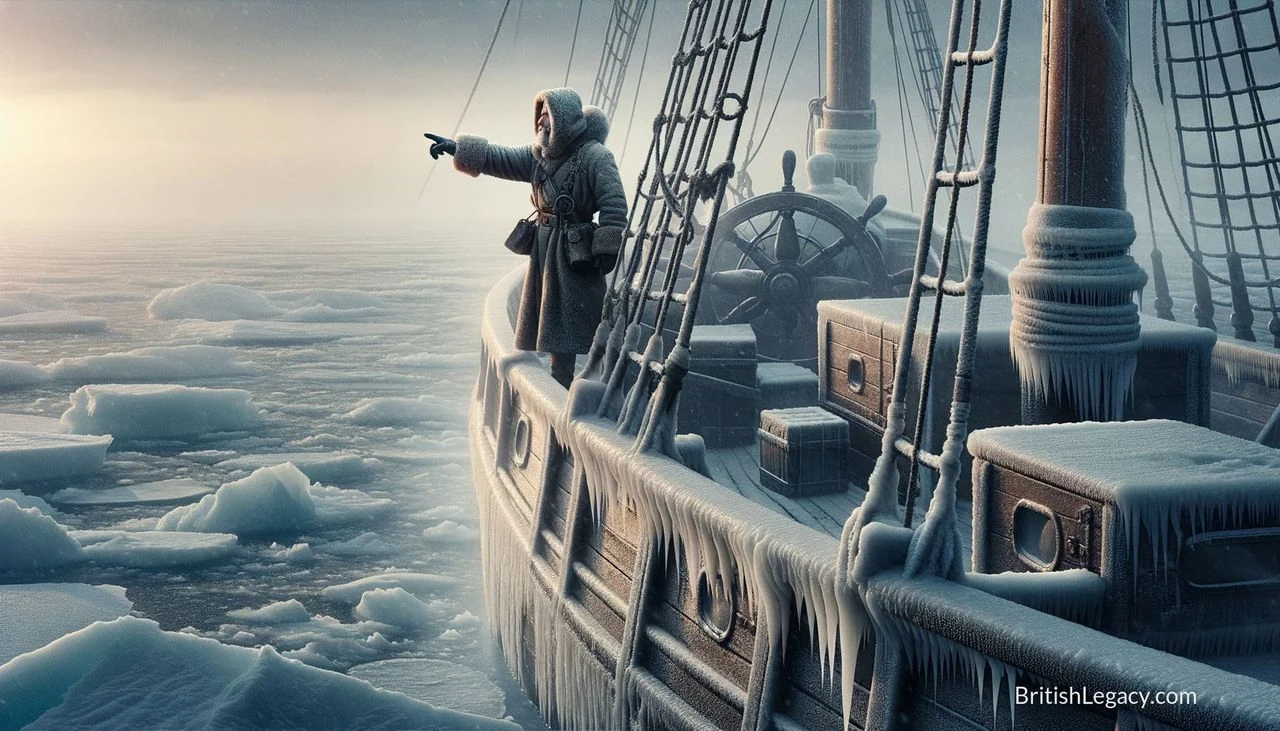
The fleet left Blackwall on 7 June 1576. Storms scattered the ships, the pinnace sank, and the Michael turned back. Frobisher continued in the Gabriel, crossed the Davis Strait and entered the bay that bears his name. He believed it might lead through the continent towards the Pacific. Ice and weather restricted the voyage, and the search for a route yielded no passage. Instead, a black stone brought back from the region became the focus of hopes for mineral wealth. Some assayers considered it worthless; an alchemist claimed it contained gold, helping persuade investors to finance a return.
The expeditions were not encounters between explorers and an empty landscape. In 1576, after five of Frobisher’s men were taken by Inuit people, his crew seized an Inuit man in an attempted exchange. The missing Englishmen were never recovered. In 1577, Frobisher’s party forcibly took three Inuit people to England: a man, a woman and a child. All died soon after arriving. The episode belongs in any account of the voyages, alongside the navigation and the ambitions that drove them.
Ore, ships and failed settlement
The second expedition, in 1577, had a larger vessel, the Aid, as well as the Gabriel and Michael. Queen Elizabeth I invested in the venture. Frobisher returned from Baffin Island with about 200 tons of ore, while the expedition’s instructions prioritised collecting material over further searching for the passage. The ore’s value remained disputed, and its testing produced arguments among the investors.
In 1578, the Crown and investors committed to a much larger venture. Fifteen vessels carried more than 400 men, including miners, blacksmiths and assayers, with the aim of collecting ore and establishing a settlement. Storms and ice disrupted the fleet; one ship was wrecked on an iceberg, and the vessels were separated before regrouping in Frobisher Bay. Frobisher explored a waterway now known as Hudson Strait, but turned back without finding a passage. The planned colony did not succeed. The fleet carried a large quantity of ore to England, where years of smelting and testing showed it to be worthless rock containing hornblende. The Company of Cathay went bankrupt, and Michael Lok was repeatedly imprisoned for debt.
From Ireland and the Caribbean to the Armada
The failure of the Arctic enterprise damaged Frobisher’s prospects as an explorer, but he continued in naval service. In 1580, he took command of the Foresight in the English campaign against the Desmond Rebellion in Ireland. In 1585, he served as vice-admiral in Francis Drake’s expedition against Spanish ports and shipping in the West Indies.
During the Spanish Armada campaign of 1588, Frobisher commanded the Triumph, the largest ship in the Royal Navy, and led one of the English fleet’s squadrons. He took part in engagements with Spanish ships in the Channel, including the fighting around Gravelines. On 26 July, Lord Howard knighted him for valour. The honour came after years in which Frobisher’s fortunes had shifted between royal employment, imprisonment, exploration and commercial failure.
Frobisher remained at sea in the years that followed. In 1590, he commanded an effort to intercept Spanish treasure ships. He later led English forces in France, including the 1594 sieges of Morlaix and Brest. During the siege of Fort Crozon, he was shot in the thigh. The surgeon who removed the bullet left wadding in the wound; infection followed, and Frobisher died at Plymouth on 22 November 1594. His heart was buried at St Andrew’s Church in Plymouth, while his body was taken to London and buried at St Giles-without-Cripplegate.
Why Sir Martin Frobisher deserves a place in British Legacy
Frobisher’s place in British history rests on more than a search that failed. His three Arctic voyages were major Elizabethan expeditions: they carried crews across the North Atlantic, explored the entrance to Frobisher Bay and prompted England to invest in a northern route to Asia. Their failure is part of their significance. The supposed gold ore consumed resources, ruined the Company of Cathay and exposed the risks of turning geographic exploration into a speculative enterprise. The story also requires an honest account of its human cost. Frobisher’s men and the Inuit people they encountered were not participants on equal terms; Inuit people were taken captive, and three died after being forcibly transported to England.
Frobisher’s later service links exploration to the defence of England during the Armada campaign. As commander of the Triumph and a fleet squadron, he held significant responsibility in the fighting for which he was knighted. His name remains attached to places and institutions in Britain and Canada: Frobisher Bay is named after him, as are Frobisher Crescent in London and a school at Altofts, near his birthplace. These memorials sit alongside a more complicated record of ambition, state service, commercial collapse and coercion. Remembering that record offers a fuller account of Elizabethan seafaring than a celebration of daring alone.
Sources
Martin Frobisher — revision 1364044039 · Martin Frobisher
Adapted in part from Martin Frobisher by Wikipedia contributors, under CC BY-SA 4.0. Text has been edited and combined with the existing article; this adapted text is shared under the same licence. Contributor history.
.png)