
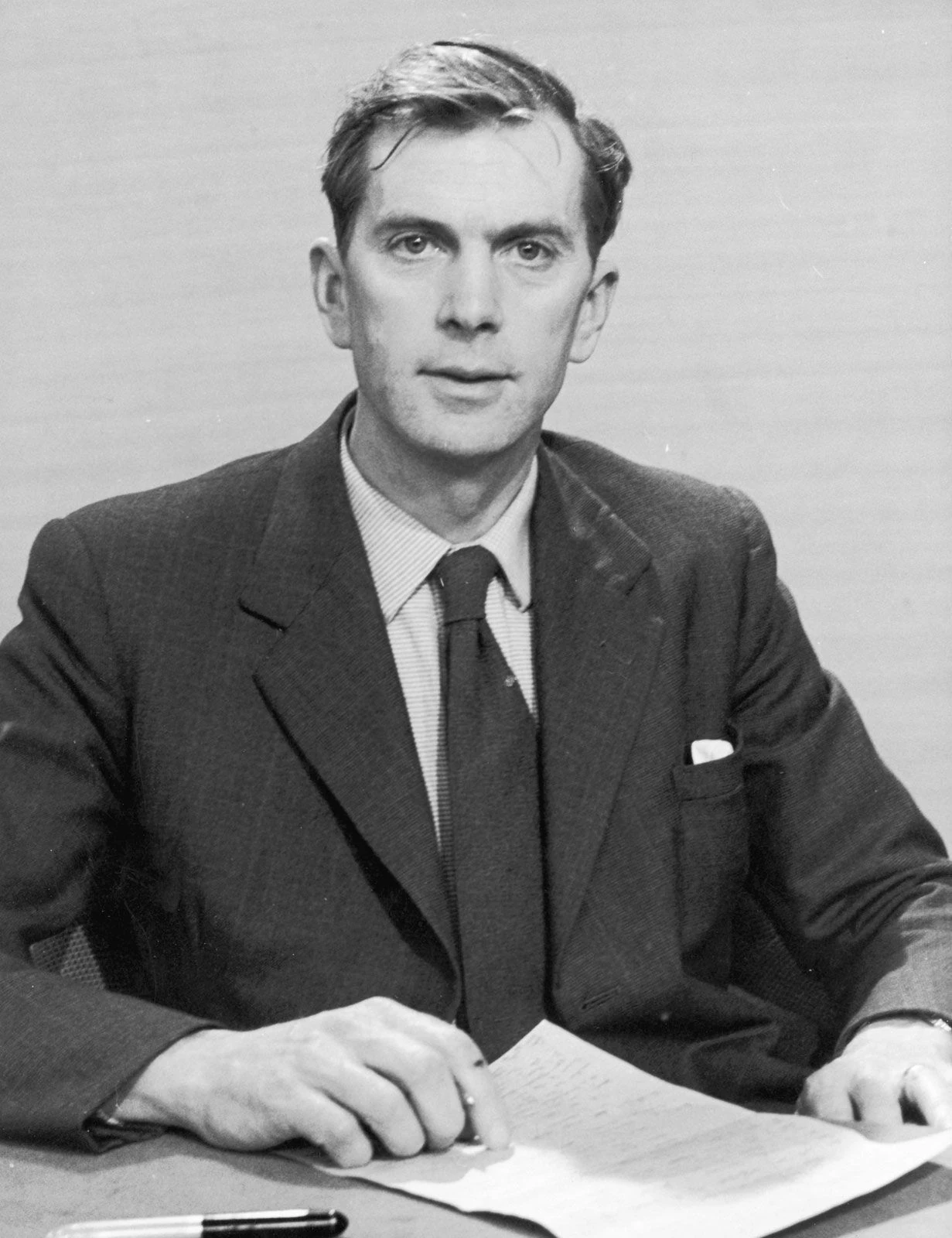
Sir Martin Ryle changed what radio astronomers could see. By developing interferometry and aperture synthesis, he helped make it possible to combine observations from separate radio antennas into sharper images of the sky. The work grew from a practical question about how to improve astronomical measurements, and made Ryle a leading figure in a field built around new instruments as much as new ideas. In 1974, he shared the Nobel Prize in Physics with Antony Hewish.
From Oxford physics to wartime radar
Ryle was born in Brighton on 27 September 1918, the son of Professor John Alfred Ryle and Miriam Ryle. After attending Bradfield College, he studied physics at Christ Church, Oxford. He was interested in radio from an early age: while still at school, he built a transmitter, obtained a licence to operate it and became an amateur radio operator. At Oxford, he took part in the university’s wireless society.
When the Second World War began, Ryle joined the Telecommunications Research Establishment. His work included designing antennas for airborne radar equipment and contributing to radar countermeasures. After the war, he returned to Cambridge intending to concentrate on scientific research, and received a fellowship at the Cavendish Laboratory.
Ryle’s early research at Cambridge focused on radio waves from the Sun; his interests soon widened to other astronomical sources. He pressed the Cambridge group to develop new observing techniques rather than rely only on existing methods. This emphasis on instruments and measurement would shape his contribution to radio astronomy.
Building a new way to observe the sky
In 1946, Ryle and Derek Vonberg published the first interferometric astronomical measurements at radio wavelengths. That year, Ryle also built the first multi-element astronomical radio interferometer. By combining signals from separate antennas, this approach gave astronomers new ways to study radio sources. Ryle became a driving force in the creation and improvement of astronomical interferometry and aperture synthesis.
Aperture synthesis uses observations made with an array of antennas to produce information comparable to that gathered with a much larger aperture. The method improved the quality of radio astronomical data and enabled more accurate locations and images of weak radio sources. Ryle’s role was not limited to proposing a technique: he helped lead a research group that developed observing systems and used them to investigate the sky.
His group also produced catalogues of radio sources. The Third Cambridge Catalogue, published in 1959, helped lead to the discovery of the first quasi-stellar object, or quasar. Ryle’s work thus joined the development of new ways to observe faint sources with the systematic study of what those observations revealed.
Cambridge leadership and international recognition
Ryle became a university lecturer in physics at Cambridge in 1948. He was appointed director of the Mullard Radio Astronomy Observatory in 1957 and became the university’s first Professor of Radio Astronomy in 1959. In 1968, he also served as professor of astronomy at Gresham College in London. At Cambridge, he helped build a research effort that brought instrument-making together with the study of radio sources.
In 1974, Ryle and Antony Hewish shared the Nobel Prize in Physics. It was the first Nobel Prize awarded in recognition of astronomical research. Ryle had been elected a Fellow of the Royal Society in 1952, received the Royal Astronomical Society’s Gold Medal in 1964 and was knighted in 1966. Further honours included the Royal Medal in 1973 and the Bruce Medal in 1974. The Ryle Telescope at the Mullard Radio Astronomy Observatory bears his name.
From 1972 to 1982, Ryle served as Astronomer Royal. The appointment followed a career in which he helped establish radio astronomy as a powerful means of observing sources that could not be studied in the same way through conventional optical methods. The Nobel award and his British appointments reflected both his research and the importance of the instruments and techniques developed by the Cambridge group.
Science, responsibility and practical work
During the 1970s, Ryle devoted much of his attention to social and political questions that he considered urgent. He warned about the dangers of nuclear weapons, criticised nuclear power and argued for research into alternative energy and energy efficiency. His pamphlet Towards the Nuclear Holocaust addressed nuclear armaments; his other writing considered nuclear power, energy storage and the availability of wind power.
These concerns sat alongside a practical, hands-on side to his scientific career. Ryle and his elder brother received lessons in carpentry and manual skills when young. He later built boats to his own designs, and practical engineering formed part of his wartime radar work and post-war radio-telescope building. He was also a keen sailor. In the 1970s, he turned research attention towards wind energy, bringing his engineering interests into contact with his concerns about how energy was produced and used.
In 1983, Ryle responded to a request from the president of the Pontifical Academy of Sciences for suggestions for a meeting on science and peace. His letter was published after his death. He continued to write about the responsible use of science and technology until his final years, despite illness.
Family, character and final years
Ryle married Rowena Palmer in 1947. They had three children and lived in Cambridge. Alongside his scientific work, he kept up his interests in sailing, amateur radio and making things. His career was not that of a researcher separated from the tools of research: he took part in designing, constructing and improving the equipment that made his astronomical work possible.
Accounts of Ryle describe an intense and sometimes difficult colleague, as well as an idealist concerned about the consequences of scientific work. The supplied biographical account notes his impatience and his quick temper, alongside his sensitivity, care and concern. These aspects belong in the history of his career too: the drive that helped push a research group towards new techniques did not always make collaboration easy.
Ryle died in Cambridge on 14 October 1984, aged 66. His influence has distinct strands: the technical capacity to locate and image radio sources, the Cambridge research group and observatory he helped shape, and his public arguments about the risks and responsibilities of science. He was also celebrated on a first-class stamp issued in 2009 as part of an Eminent Britons set.
Why Sir Martin Ryle deserves a place in British Legacy
Ryle deserves a place in British Legacy because his work at Cambridge helped change the practice of astronomy. He did more than become associated with aperture synthesis: he helped build instruments and develop observing methods that made radio interferometry more useful. Those methods improved the quality of astronomical data and supported the accurate location and imaging of weak sources. The Cambridge group’s catalogues helped lead to the discovery of the first quasar. In 1974, Ryle shared the Nobel Prize in Physics with Antony Hewish, the first such award to recognise astronomical research.
His British legacy also rests on the institutions and responsibilities that shaped his career. As Cambridge’s first Professor of Radio Astronomy, director of the Mullard Radio Astronomy Observatory and later Astronomer Royal, he contributed to British research and its public standing. His practical engagement with equipment linked scientific questions to the tools needed to investigate them. Later, he used his scientific authority to argue about nuclear dangers, energy and social responsibility. That combination matters: Ryle’s record shows how research in Britain could extend knowledge through technical invention, while also prompting debate about the purposes and risks of scientific work. The observatory and telescope associated with his career preserve that connection between discovery, engineering and a continuing public conversation about science.
Sources
Martin Ryle — Wikipedia revision
Adapted in part from Martin Ryle by Wikipedia contributors, under CC BY-SA 4.0. Text has been edited and combined with the existing article; this adapted text is shared under the same licence. Contributor history.
.jpg)