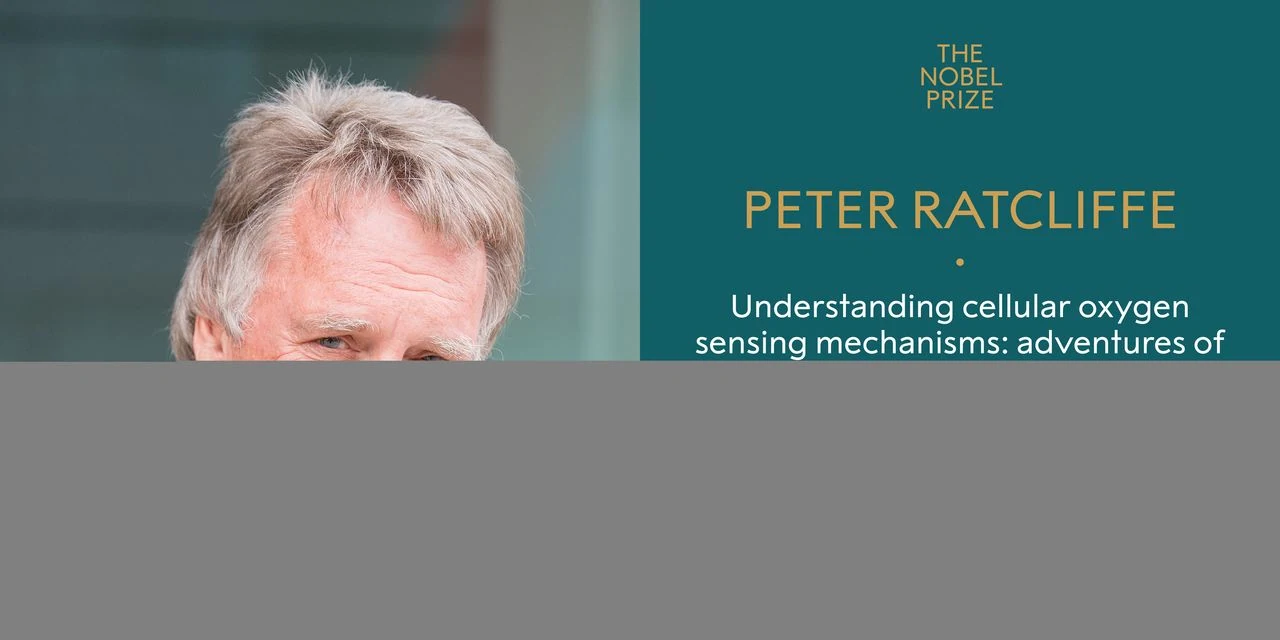
Oxygen is essential to human life, but its supply to tissues can vary. Sir Peter John Ratcliffe helped establish how cells detect when oxygen levels fall and adjust their activity in response. His research traced the pathway from the kidney’s production of a hormone that stimulates red blood cell production to the molecular machinery that switches genes on under low-oxygen conditions. In 2019, he shared the Nobel Prize in Physiology or Medicine for discoveries of how cells sense and adapt to oxygen availability.
Medical training and a research question
Ratcliffe was born in Morecambe, Lancashire, on 14 May 1954. He attended Lancaster Royal Grammar School from 1965 to 1972, then won an open scholarship to study medicine at Gonville and Caius College, Cambridge. He completed his medical degree with distinction at St Bartholomew’s Hospital Medical College in 1978.
After qualifying, he trained in renal medicine at Oxford, where he focused on oxygenation in the kidney. That clinical interest became the starting point for a basic research problem: how did the body detect low oxygen in the blood and, in response, produce erythropoietin (EPO), the hormone that stimulates the formation of red blood cells? Ratcliffe earned a higher MD degree from the University of Cambridge in 1987.
In 1989, he established a laboratory in the Nuffield Department of Medicine at Oxford to study the regulation of EPO. His research showed that the molecular signal involved in detecting hypoxia—the condition of insufficient oxygen—was not confined to the kidney. Related messenger RNA was present in several other organs, including the spleen, brain and testes, in humans and other animals. Cells from those organs could switch on EPO production when deprived of oxygen; Ratcliffe’s group also showed that other cells could be given oxygen-sensing capabilities.
Following the oxygen signal
This work helped build a wider account of how cells respond to low oxygen. Ratcliffe’s group, in collaborative studies with William Kaelin Jr and Gregg Semenza, contributed to identifying the molecular sequence involving hypoxia-inducible factors, or HIFs. HIF is a transcription factor: it helps activate particular genes, including the EPO gene.
When oxygen is available, oxygen-dependent enzymes called prolyl hydroxylases act on HIF. The resulting modification allows the von Hippel–Lindau (VHL) protein to bind HIF. VHL then helps mark the HIF protein for destruction. When oxygen falls, the hydroxylases no longer act in the same way, VHL does not bind HIF, and HIF can persist and activate genes involved in the response to hypoxia. The sequence can take minutes, enabling a relatively rapid response to changing oxygen levels.
The discovery was more specific than the general idea that cells alter gene activity when oxygen is scarce: it identified a molecular mechanism linking oxygen availability to the control of gene expression. The pathway also operates in tumours, where it can help drive the formation of new blood vessels. The research into hypoxia and EPO has contributed to the development of drugs that block VHL from binding HIF, with applications in treating patients with anaemia and kidney failure.
Oxford, the Crick and scientific recognition
Ratcliffe received a Wellcome Trust Senior Fellowship in 1990 to investigate cellular responses to hypoxia. From 1992 to 2004, he was a senior research fellow in clinical medicine at Jesus College, Oxford. In 2003, he was appointed Nuffield Professor and head of the Nuffield Department of Clinical Medicine at the University of Oxford; he had become a Fellow of Magdalen College the previous year. He served as a practising clinician at the John Radcliffe Hospital and led the Nuffield department from 2004 to 2016.
In 2012, he joined the Ludwig Institute for Cancer Research as a member. In 2016, he became Clinical Research Director at the Francis Crick Institute, while retaining roles at Oxford as a member of the Ludwig Institute and director of the university’s Target Discovery Institute. His career joined clinical medicine with laboratory research and institutional leadership, while the work itself brought together investigators studying the same oxygen-sensing system.
Before the Nobel Prize, Ratcliffe shared the 2016 Lasker Award with Kaelin and Semenza and received the Buchanan Medal of the Royal Society in 2017 and the Massry Prize in 2018. In 2019, the Nobel committee awarded the three scientists the prize in Physiology or Medicine for their discoveries of how cells sense and adapt to oxygen availability. Ratcliffe was knighted in the 2014 New Year Honours for services to clinical medicine.
Why Sir Peter J. Ratcliffe deserves a place in British Legacy
Ratcliffe’s place in British Legacy rests on a body of work that began with a clinical question and developed into a fundamental explanation of how cells respond to oxygen. His Oxford research connected the kidney’s response to low oxygen with EPO production, then helped uncover how oxygen-dependent enzymes, HIF and the VHL protein regulate the process. The Nobel Prize recognised the importance of that discovery, but its significance is also evident in the way it links a basic biological signal to gene activity and the body’s response to changing conditions.
The British connection is grounded in his education and career: he trained at Cambridge and St Bartholomew’s, developed his research programme at Oxford, held senior clinical and academic posts there, and later took a research leadership role at the Francis Crick Institute. This work has helped deepen understanding of hypoxia and has supported the development of drugs aimed at the HIF pathway for patients with anaemia and kidney failure. His career also shows the value of sustained investigation across medicine and biology: the question of how the kidney responds to oxygen scarcity opened onto a mechanism found across cells and organs. That combination of clinical relevance, molecular explanation and research leadership gives his achievements a lasting place in the story of British science.
Sources
Peter J. Ratcliffe — revision 1378438998 · Peter J. Ratcliffe
Adapted in part from Peter J. Ratcliffe by Wikipedia contributors, under CC BY-SA 4.0. Text has been edited and combined with the existing article; this adapted text is shared under the same licence. Contributor history.