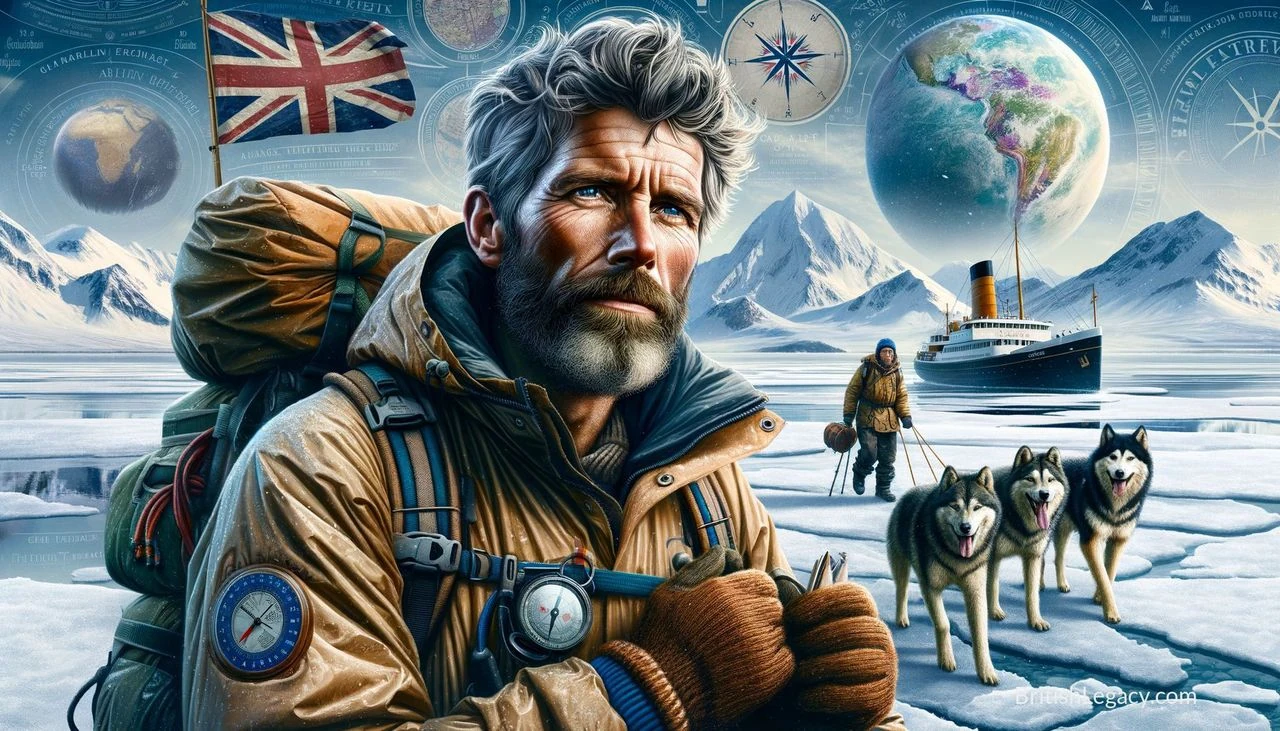
In 1979, Ranulph Fiennes set out with fellow expedition members to travel around the world on its polar axis using surface transport. The Transglobe Expedition took three years. It remains the defining undertaking of a career that also included crossing Antarctica on foot, reaching the summit of Everest at 65 and raising money for charitable causes through demanding endurance challenges.
A military career, and a plan that went wrong
Born in Windsor, Berkshire, on 7 March 1944, Fiennes was the son of an army officer who had died in Italy before his birth. He spent part of his childhood in South Africa before returning to England, where he attended Sandroyd School and Eton. After failing to gain entry to the Royal Military Academy Sandhurst, he trained at Mons Officer Cadet School and joined the Royal Scots Greys in 1963.
Fiennes served in the British Army for eight years. He was seconded to the Special Air Service, where he specialised in demolitions, and later served with the Sultan of Oman’s Armed Forces. In Oman he commanded a reconnaissance platoon and saw active service during the Dhofar War. He was decorated for bravery by the Sultanate and left the Army in 1971.
One episode from his time in the SAS brought a conviction rather than a military distinction. Fiennes and others planned to blow up a temporary sandbag dam built in Wiltshire for the film Doctor Dolittle. Police foiled the plan; Fiennes was fined for conspiring to cause public mischief and unlawfully possessing explosives. He and a co-conspirator were dismissed from the SAS. The episode gives a more complicated picture of his early career than a simple tale of adventure and achievement.
Across the world on its polar axis
Fiennes had begun leading expeditions in the 1960s, including a 1969 journey up the White Nile by hovercraft and a 1970 expedition on Norway’s Jostedalsbreen Glacier. The Transglobe Expedition, undertaken from 1979 to 1982, was more ambitious: Fiennes, Charles Burton and Oliver Shepard travelled around the world on its polar axis, using surface transport. Fiennes and Burton also completed the Northwest Passage in an open boat, travelling from Tuktoyaktuk to Tanquary Fiord in 1981.
The scale of the undertaking lay not simply in distance, but in its route through remote polar regions and the practical demands of travelling over ice and water. The expedition’s circumnavigation established a distinctive place for Fiennes in the history of British exploration. Its story also became the subject of his 1983 book, To the Ends of the Earth.
Later expeditions extended his record in polar travel. In 1993, with nutrition specialist Mike Stroud, he completed the first unsupported crossing of the Antarctic continent, a journey that took 93 days. An attempt to walk solo to the South Pole in 1996 ended when a kidney-stone attack forced his rescue. In 2000, he abandoned a solo, unsupported attempt to reach the North Pole after his sleds broke through weak ice and severe frostbite affected the fingertips of his left hand.
Mountains, marathons and fundraising
Fiennes’s later challenges included a difficult relationship with Everest. An attempt in 2005 ended when heart problems forced him to turn back. In 2008, bad weather stopped a second attempt within 400 metres of the summit. On 20 May 2009, aged 65, he reached the top, becoming the oldest British person to do so at the time. He also became the first person to have climbed Everest and crossed both polar ice caps.
His physical feats were often linked to fundraising. In 2003, only months after a heart attack and emergency bypass surgery, Fiennes and Stroud completed seven marathons in seven days on seven continents for the British Heart Foundation. The route and locations had to change after bad weather and aircraft trouble disrupted the planned Antarctic leg. In 2007, despite a lifelong fear of heights, Fiennes climbed the Eiger’s North Face, with sponsorship directed to Marie Curie Cancer Care’s Delivering Choice Programme.
He also led the first hovercraft expedition up the White Nile and took part in a 2013 attempt to cross Antarctica during the southern winter for Seeing is Believing, an initiative to prevent avoidable blindness. Frostbite forced him to withdraw from that expedition and be evacuated. These episodes show the limits as well as the reach of his chosen work: not every attempt ended in completion, but fundraising remained a recurring purpose.
Books, honours and public life
Fiennes has written books about his expeditions and military service, as well as works on earlier explorers. His titles include The Feather Men, Mad, Bad and Dangerous to Know, Cold and a biography of Captain Robert Falcon Scott. In writing about Scott, Fiennes argued for a robust account of his achievements and reputation. The books extend his exploration career into a record of how expeditions are remembered and interpreted.
His honours include the Officer of the Order of the British Empire, awarded in 1993 for human endeavour and charitable services, and the Polar Medal, awarded in 1986 for service to British polar exploration and research. A second clasp followed in 1994 after he had visited both poles. The Royal Geographical Society awarded him its Founder’s Medal. In 2015, his expeditions were reported to have raised £16 million for good causes; his work also brought substantial support to Marie Curie Cancer Care.
Fiennes married Virginia “Ginny” Pepper in 1970. She conceived, organised and participated in the Transglobe Expedition and was awarded the Polar Medal for her research into very low frequency radio propagation. After her death in 2004, Fiennes married Louise Millington in 2005; they have a daughter. He was diagnosed with Parkinson’s disease in 2019 and has spoken openly about living with the condition.
Why Sir Ranulph Fiennes deserves a place in British Legacy
Fiennes’s place in British Legacy rests on a body of work that made exploration a sustained undertaking rather than a single headline achievement. The Transglobe Expedition joined travel through both polar regions into a surface-transport circumnavigation; the Antarctic crossing with Mike Stroud tested what an unsupported journey across the continent required. His later Everest ascent added a striking conclusion to years of attempts, turn-backs and setbacks. These achievements connect him to Britain’s history of polar exploration while belonging unmistakably to the modern era, in which expeditions are documented, supported by teams and followed by audiences at home.
His legacy also has a public dimension. Fiennes repeatedly attached demanding challenges to charitable fundraising, including the seven marathons for the British Heart Foundation and the Eiger climb supporting Marie Curie Cancer Care. The amounts raised and the causes named in the record give this part of his career concrete significance beyond personal endurance. His books, meanwhile, bring both his own journeys and earlier explorers such as Scott to readers, contributing to public discussion of how exploration is undertaken and judged. Taken together, the expeditions, writing and fundraising explain the British connection: Fiennes is an English explorer whose work extended the country’s record of polar travel and directed public attention and resources towards charitable causes.
Sources
Ranulph Fiennes — Wikipedia revision 1379817970
Adapted in part from Ranulph Fiennes by Wikipedia contributors, under CC BY-SA 4.0. Text has been edited and combined with the existing article; this adapted text is shared under the same licence. Contributor history.