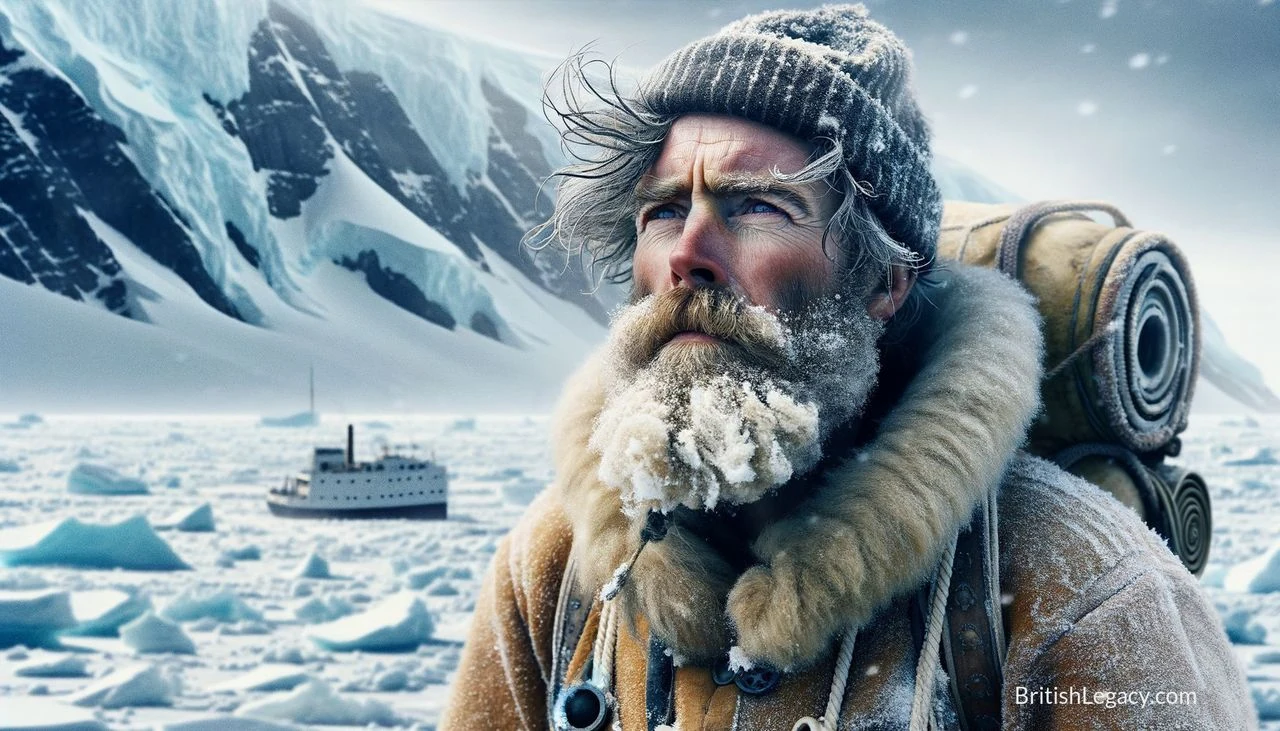
Sir Robert Falcon Scott became known for two British-led expeditions to Antarctica: the Discovery expedition of 1901–04 and the Terra Nova expedition of 1910–13. The second took him and four companions to the South Pole, where they found that the Norwegian Roald Amundsen had arrived before them. All five died on the return journey. Scott’s story is inseparable from that loss, but his expeditions also pursued scientific work and helped shape Britain’s public memory of polar exploration.
A naval career turns towards Antarctica
Born in Plymouth, Devon, on 6 June 1868, Scott entered the Royal Navy at 13, following a path described in the existing account as rooted in naval tradition. He later commanded HMS Bulldog, according to that account, before taking charge of the National Antarctic Expedition, better known as the Discovery expedition.
Organised jointly by the Royal Geographical Society and the Royal Society, the expedition sailed aboard RRS Discovery and lasted from 1901 to 1904. It explored Antarctic territory, undertook biological, geological and meteorological research, and reached a latitude of 82°17′ south, reported as a record at the time. The expedition’s geographical and scientific work formed a substantial part of its achievement, beyond the progress made towards the pole.
The Terra Nova expedition and the race south
Scott’s second Antarctic expedition, aboard the Terra Nova, ran from 1910 to 1913. Its central objective was to reach the geographic South Pole. The journey involved difficult weather and ice, and the expedition encountered a rival in Amundsen’s Norwegian party.
Scott and four companions reached the pole on 17 January 1912, 34 days after Amundsen. On the return journey, Scott, Henry Bowers, Edward Wilson and the other members of the polar party died. Scott’s final diary entry is dated 29 March 1912. Eight months later, a search party found the bodies of Scott, Bowers and Wilson, along with diaries and scientific collections. The expedition’s outcome was tragic, but its surviving records and collections also preserve evidence of its scientific purpose.
Exploration, science and commemoration
Scott’s reputation in Britain came to rest heavily on the fatal return from the pole. Accounts of his diary and the deaths of his party made the hazards of Antarctic travel vivid to a large public. That public memory has often emphasised courage and endurance; the expeditions’ scientific work and the records they left behind offer another way to understand their significance.
The Scott Polar Research Institute in Cambridge is among the commemorations associated with Scott and his team. The existing account also notes schools, ships and geographical features named in their honour, as well as books, documentaries and films about the expedition. These memorials place Scott’s story in British cultural life, while the research undertaken on the expeditions connects it to the development of knowledge about Antarctica.
Why Sir Robert Falcon Scott deserves a place in British Legacy
Scott’s place in British Legacy rests on more than the dramatic ending of the Terra Nova expedition. He led two major British Antarctic expeditions, and the earlier Discovery voyage combined exploration with biological, geological and meteorological research. The party’s journey south reached a record latitude at the time, while the expedition’s scientific work and the collections recovered after the later disaster preserved knowledge as well as a story of hardship. These details matter because they show polar exploration as organised work involving observation and record-keeping, not simply a contest to reach a destination.
The South Pole party’s deaths became central to Scott’s public reputation, and the memorials and cultural works associated with him show how enduring that reputation has been in Britain. Remembering him responsibly means holding together both parts of the record: the race Amundsen won, and the exploratory and scientific ambitions of Scott’s expeditions. His history offers a specific British connection to Antarctica through naval leadership, learned societies, expeditionary science and continuing commemoration. It also reminds readers that the pursuit of geographical achievement took place in conditions where failure could be fatal.