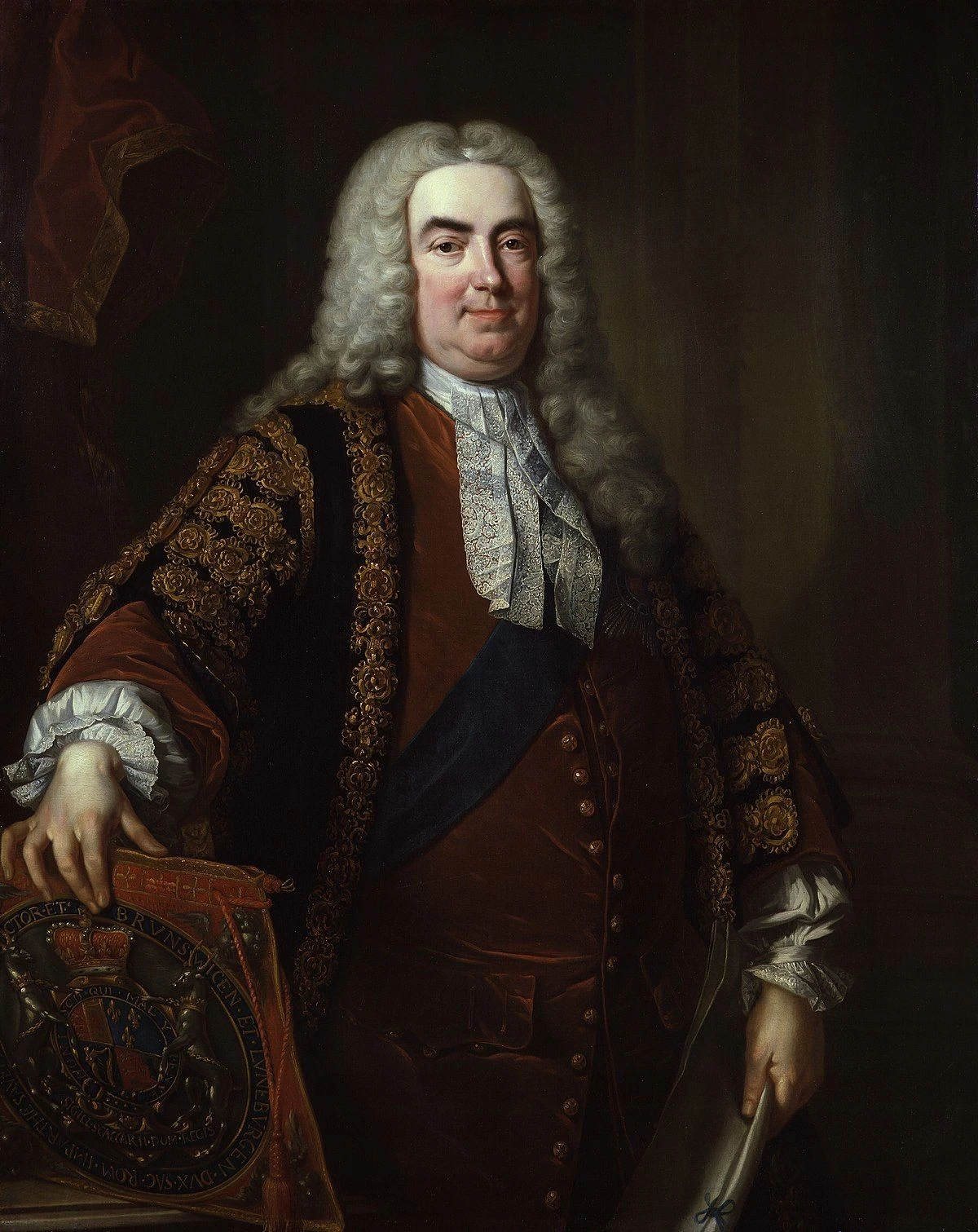
Robert Walpole’s authority rested less on a formal title than on the offices and parliamentary influence he held for more than two decades. From 1721 to 1742 he led the government as First Lord of the Treasury, Chancellor of the Exchequer and leader of the House of Commons. The title “Prime Minister” was not then an official designation, but Walpole is generally regarded as the first to perform the role in practice. His career shows how the office emerged through political management, royal favour and the day-to-day business of Parliament.
A Norfolk upbringing and an early political career
Walpole was born at Houghton in Norfolk on 26 August 1676, one of the children of Robert Walpole, a local landowner and Whig politician, and Mary Burwell. He attended Eton and entered King’s College, Cambridge, in 1696. His initial plan was to become a clergyman, but after the death of his elder brother he left Cambridge and took on responsibility for the family estate. His father died in 1700, and Robert inherited the estate the following year.
He entered Parliament for Castle Rising in 1701 and moved to represent King’s Lynn in 1702, a seat he held for most of his political career. A member of the Whig Party, he gained government experience under Queen Anne, becoming Secretary at War in 1708 and, briefly, Treasurer of the Navy. When the Whigs lost power, he remained a prominent opposition voice. In 1712 he was impeached and imprisoned in the Tower of London for six months after being found guilty of corruption in connection with contracts. He was expelled from Parliament, then returned to the Commons for King’s Lynn in 1713.
The accession of George I in 1714 brought the Whigs back to power. Walpole became Paymaster of the Forces, then First Lord of the Treasury and Chancellor of the Exchequer in 1715. Divisions within the Whig administration led him to resign in 1717 and join the opposition. He returned to office as Paymaster of the Forces in 1720. These changes mattered: Walpole’s later authority grew from years spent building alliances, debating policy and learning how to manage competing interests within his own party as well as across the Commons.
The South Sea crisis and the rise to power
In 1720, speculation in the South Sea Company’s shares collapsed. The scheme linked the company to the national debt, and the crash ruined investors and damaged confidence in the government. Walpole himself had invested. An investigation the following year implicated several leading ministers. The resignations and death of senior figures left him the administration’s most powerful politician.
On 3 April 1721, Walpole became First Lord of the Treasury, Chancellor of the Exchequer and leader of the House of Commons. Those posts, combined with his command of parliamentary business and influence with George I, made him prime minister in practice. He remained the dominant minister until February 1742, serving under George I and George II. His uninterrupted tenure of nearly 21 years remains the longest in British prime-ministerial history.
Walpole rejected the description “prime minister”, which could be used as a term of abuse. The office was not yet defined as it is today, and his power did not simply flow from the title. He shared government with other ministers, notably his brother-in-law Charles Townshend in the earlier years, and relied on the King’s confidence as well as support in the Commons. Walpole’s achievement was to make that combination work over an unusually long period, helping establish a practical precedent for a chief minister leading government through Parliament.
Finance, patronage and the limits of consensus
After the South Sea crisis, the government used the estates of company directors to compensate victims and divided the company’s stock between the Bank of England and the East India Company. Walpole helped defend the administration in Parliament and consolidate its position. In 1717, during an earlier period in office, he had introduced a sinking fund intended to reduce the national debt. Later, he pursued lower taxes and sought to keep Britain out of European wars, arguing that peace supported trade and prosperity.
His approach included reducing the land tax in stages. In 1733 he proposed collecting duties on wine and tobacco at warehouses rather than at ports, a measure intended to curb smuggling. Merchants strongly opposed the plan. Walpole withdrew the bill before Parliament voted on it, but the episode weakened his standing among some Whigs. His government also faced opposition over taxation, gin duties and the regulation of London theatres. These disputes make it difficult to describe his ministry simply as a period of uninterrupted prosperity or agreement.
Walpole maintained support through negotiation, party organisation and patronage: the distribution of offices and other benefits to secure political loyalty. His opponents condemned these methods as corrupt, while the protection he gave to political allies during the South Sea investigations added to suspicion. His capacity to manage the Commons was nevertheless central to his survival. The political system of the period was not a modern representative democracy; Walpole’s ministry is better understood as part of the gradual development of government accountable to Parliament, not as the completion of that process.
War, resignation and later influence
Walpole’s preference for peace became increasingly difficult to sustain amid disputes with Spain over trade and the searching of British ships. In 1739, Britain entered the War of Jenkins’ Ear. The conflict and the failed British attack on Cartagena de Indias in 1741 damaged his position. After the general election that year, his supporters still held a majority, but it was narrower and less dependable. Opposition came from rival Whigs, Tories and Jacobites, as well as from factions associated with Frederick, Prince of Wales.
In February 1742, Walpole resigned after losing a parliamentary vote arising from a disputed by-election. George II made him Earl of Orford, and he continued to advise the King and support the government in the House of Lords. He died in London on 18 March 1745, aged 68, and was buried at St Martin’s Church on the Houghton estate. His ministerial career had ended, but the conventions associated with a leading minister able to command the Commons and work closely with the Crown continued to develop after him.
Number 10 and the making of a ministerial office
One especially visible part of Walpole’s legacy is the official residence of the British prime minister. George II offered him the house at 10 Downing Street in 1732. Walpole accepted it not as a private gift but for use as the official residence of the First Lord of the Treasury. He moved in on 22 September 1735. Later office-holders did not all live there, but the house eventually became established as the prime minister’s official residence in that capacity. The distinction between a personal home and an office attached to government reflected the gradual formation of a public role beyond the individual minister.
Walpole also rebuilt Houghton Hall as his country seat and assembled a substantial collection of European paintings. His grandson sold much of the collection to Catherine II of Russia in 1779. These parts of his life sit alongside his political record: a Norfolk landowner who brought the resources and interests of a country gentleman to national office, and a minister whose standing depended on more than the formal powers of any one position.
Why Sir Robert Walpole deserves a place in British Legacy
Walpole deserves a place in British Legacy because his career helps explain how Britain’s premiership took shape. There was no settled constitutional job description for the prime minister in his time. Instead, Walpole combined the Treasury and Exchequer offices with leadership in the Commons and influence at court. He held those positions through changing monarchs and political pressures, establishing a working example for later ministers. The significance is not that he created modern democracy single-handedly, but that his long ministry formed part of the slow development of a government led by a minister who had to maintain parliamentary support.
His record also connects political leadership to practical decisions with lasting institutional consequences. Walpole’s response to the South Sea crisis, his use of a sinking fund and his preference for avoiding war show the financial and diplomatic concerns that shaped his administration. His acceptance of 10 Downing Street as an official residence rather than a personal reward helped give the emerging ministerial office a visible home. At the same time, his reliance on patronage and the criticism it attracted are essential to an honest account: political stability came with methods that contemporaries contested. Remembering both his influence and its limits offers British Legacy a more useful story than a simple celebration. It shows how conventions are built through practice, compromise and conflict, and why institutions should be understood in the conditions in which they first developed.
Sources
Robert Walpole (revision 1376845482)
Adapted in part from Robert Walpole by Wikipedia contributors, under CC BY-SA 4.0. Text has been edited and combined with the existing article; this adapted text is shared under the same licence. Contributor history.