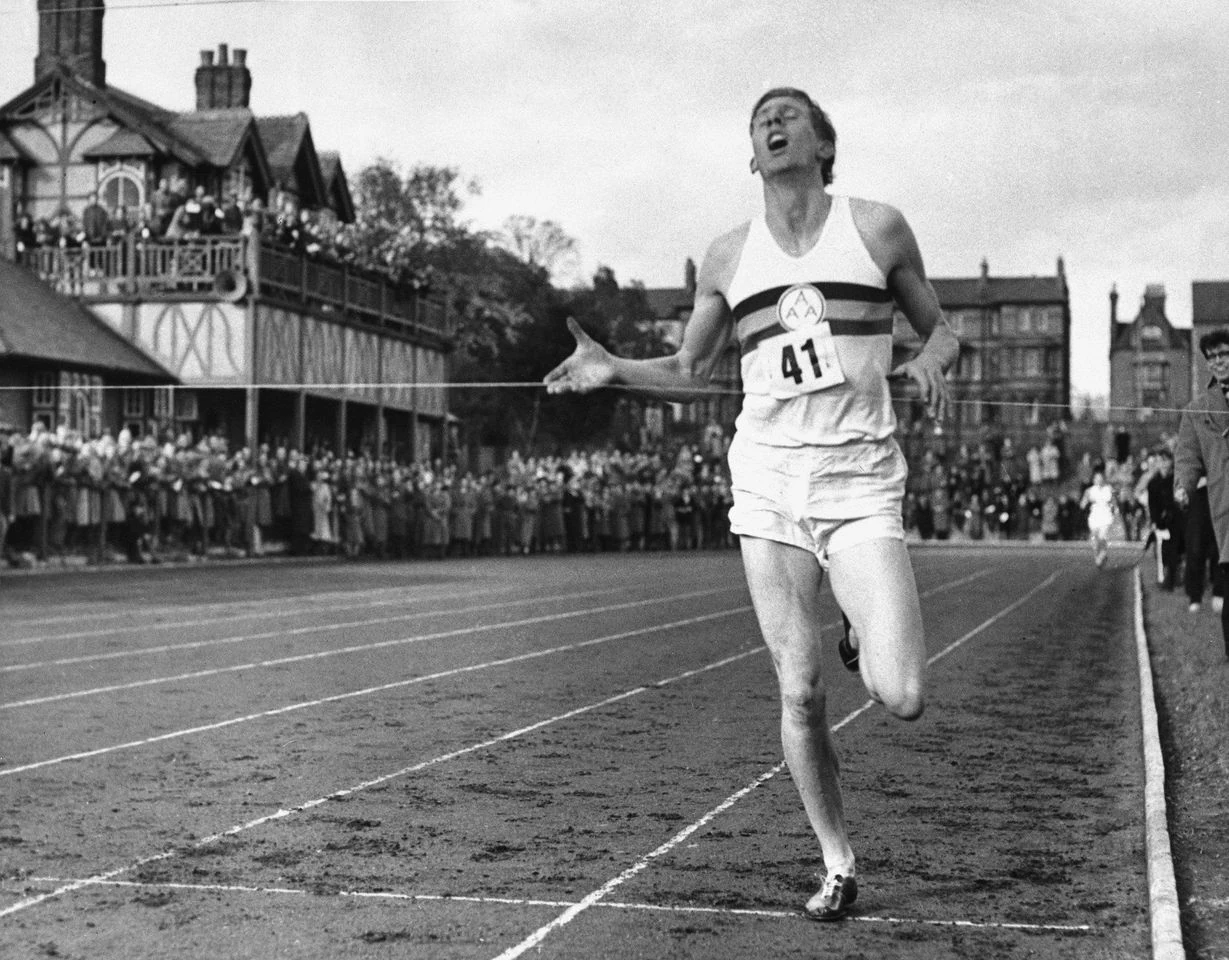
On 6 May 1954, at Oxford’s Iffley Road track, Roger Bannister became the first man to run a mile in less than four minutes. His time was 3 minutes 59.4 seconds. The achievement became one of British athletics’ defining moments, but it was not the whole of his life: Bannister was a medical student and junior doctor when he made the attempt, and later said he was prouder of his contribution to medicine than of his running.
A medical student finds his pace
Roger Gilbert Bannister was born in Harrow, London, on 23 March 1929. His parents, Ralph and Alice, came from working-class families in Lancashire. Ralph moved to London at 15 to work in the Civil Service; the family later relocated to Bath when he was transferred there during the Second World War. At City of Bath Boys’ School, Bannister discovered a talent for cross-country running, winning the junior cross-country cup three years in succession. After the family returned to London in 1944, he attended University College School.
Bannister began running at Oxford in 1946, aged 17. He had not previously worn running spikes or run on a track. His early training was light: in 1947 he ran a mile in 4 minutes 24.6 seconds on three half-hour sessions a week. He studied medicine at Exeter College, Oxford, and later at St Mary’s Hospital Medical School in London. From 1951 to 1954, while studying at St Mary’s, he trained at Paddington Recreation Ground, able to give running about an hour a day.
He declined selection as an Olympic “possible” in 1948, believing he was not ready, but watching the London Games strengthened his ambition. By 1950 he was competing internationally. At the European Championships in Brussels that year, he finished third in the 800 metres. He trained more seriously after that result and, in 1951, won the mile at the Amateur Athletic Association (AAA) Championships at White City, setting a meeting record before a crowd of 47,000.
From Olympic disappointment to a new goal
At the 1952 Olympics in Helsinki, Bannister finished fourth in the 1,500 metres, setting a British record of 3 minutes 46.30 seconds. The result fell short of a medal. After considering whether to give up running, he chose a more specific challenge: to become the first man to cover a mile in under four minutes.
His preparation combined interval training influenced by coach Franz Stampfl with other methods, including fell running. On 2 May 1953, paced by Chris Chataway, Bannister ran a British-record 4 minutes 3.6 seconds at Oxford. A later attempt, paced by Chataway and Chris Brasher, ended in 4 minutes 2 seconds. Officials did not accept that performance as a British record, and Bannister later said he was relieved it had not been achieved under what he considered artificial circumstances.
Other runners were closing in on the mark. American Wes Santee ran 4 minutes 2.4 seconds in June 1953, and Australia’s John Landy recorded 4 minutes 2 seconds that year. Landy made further attempts in early 1954. Bannister followed his rival’s progress and knew he would need to act before Landy’s season ended.
The four-minute mile at Iffley Road
The race took place during a meeting between the AAA and Oxford University on 6 May 1954. The weather made the decision uncertain: winds had reached up to 25 miles per hour before the event, and Bannister twice said he would rather wait for another meeting. The wind dropped shortly before the scheduled start, and he ran. About 3,000 spectators watched.
Brasher led the opening lap in 58 seconds, with Bannister close behind. Chataway took over the pace after the second lap, reaching the final-lap bell at 3 minutes 1 second. Bannister made his finishing move with about 275 yards remaining and completed the final lap in just under 59 seconds. His time, 3 minutes 59.4 seconds, was a world record.
The race was broadcast live on BBC Radio, with Harold Abrahams commentating. Announcer Norris McWhirter delayed the time announcement, listing the records it would set before beginning, “The time was three…” The crowd’s roar drowned out the rest. The performance was remarkable for its result and for the modest training volume Bannister maintained while working as a junior doctor. It was not, however, the end of the record story: Landy broke the mile record 46 days later.
In August 1954, Bannister and Landy met in the mile at the British Empire and Commonwealth Games in Vancouver, in a race billed as the “Miracle Mile”. Landy led for most of the contest, but Bannister passed him on the final bend and won in 3 minutes 58.8 seconds. Later that month, Bannister won the 1,500 metres at the European Championships in Bern in 3 minutes 43.8 seconds, a championship record. He retired from athletics late in 1954 to concentrate on medicine.
Neurology and service to sport
Bannister’s medical career lasted about 40 years. After National Service in the Royal Army Medical Corps, he worked in neurology, specialising in autonomic failure: disorders involving the loss of automatic nervous-system responses. He published more than 80 papers, chiefly on the autonomic nervous system, cardiovascular physiology and multiple system atrophy. He edited Autonomic Failure with his St Mary’s colleague C. J. Mathias and edited several editions of Brain and Bannister’s Clinical Neurology.
He also held academic and sporting responsibilities. Bannister became Master of Pembroke College, Oxford, serving from 1985 to 1993. He was the first chairman of the Sports Council, now Sport England. During his chairmanship, government funding for sports centres and other facilities increased, and he initiated the first testing for anabolic steroids in sport. He was appointed CBE in 1955 for services to amateur athletics and knighted in 1975 for his service to sport.
In 2011 Bannister was diagnosed with Parkinson’s disease. He died of pneumonia at the John Radcliffe Hospital in Oxford on 3 March 2018, aged 88. He had married Swedish artist Moyra Elver Jacobsson in 1955; they had four children. Bannister was also appointed a Companion of Honour in 2017 for services to sport.
How the achievement was remembered
Bannister’s run became a lasting reference point in British sporting life. In a 2002 Channel 4 poll, it ranked thirteenth among the 100 Greatest Sporting Moments. The 50th anniversary was marked by a commemorative British 50-pence coin bearing a stopwatch stopped at 3:59.4. In 2012, Bannister carried the Olympic flame at the Oxford track where he had made his record-breaking run.
His name also became part of the institutions around him. Pembroke College named a building in his honour, while St Mary’s Hospital Medical School named a lecture theatre after him in 2004. A memorial stone describing him as a “pioneering neurologist, world champion runner” was unveiled in Westminster Abbey in 2021. These tributes reflect a career remembered not only for a single race but also for its medical and sporting dimensions.
Why Sir Roger Bannister deserves a place in British Legacy
Bannister’s sub-four-minute mile deserves its place in British Legacy because it was a specific sporting first, achieved on an Oxford track by an athlete who was simultaneously training for a medical career. The achievement was not simply a dramatic time on a clock: it depended on a carefully paced race, with Brasher and Chataway helping Bannister reach the final lap in position to attack. Its place in British public memory is evident in the BBC broadcast, the 50-pence commemorative coin, the Olympic flame ceremony at Iffley Road and the result of the Channel 4 sporting-moments poll.
His wider legacy is equally important. For four decades, Bannister practised neurology and contributed research on the autonomic nervous system and related disorders. He served as Master of Pembroke College and led the Sports Council, helping expand public funding for sports facilities and initiating testing for anabolic steroids. These were practical contributions beyond his athletic fame. Bannister himself placed his medical work above the mile when asked which achievement mattered most. Remembering both careers gives a fuller account of a British life: one in which sporting distinction brought enduring recognition, while medical research and public service delivered benefits beyond the track.
Sources
Roger Bannister · Roger Bannister
Adapted in part from Roger Bannister by Wikipedia contributors, under CC BY-SA 4.0. Text has been edited and combined with the existing article; this adapted text is shared under the same licence. Contributor history.