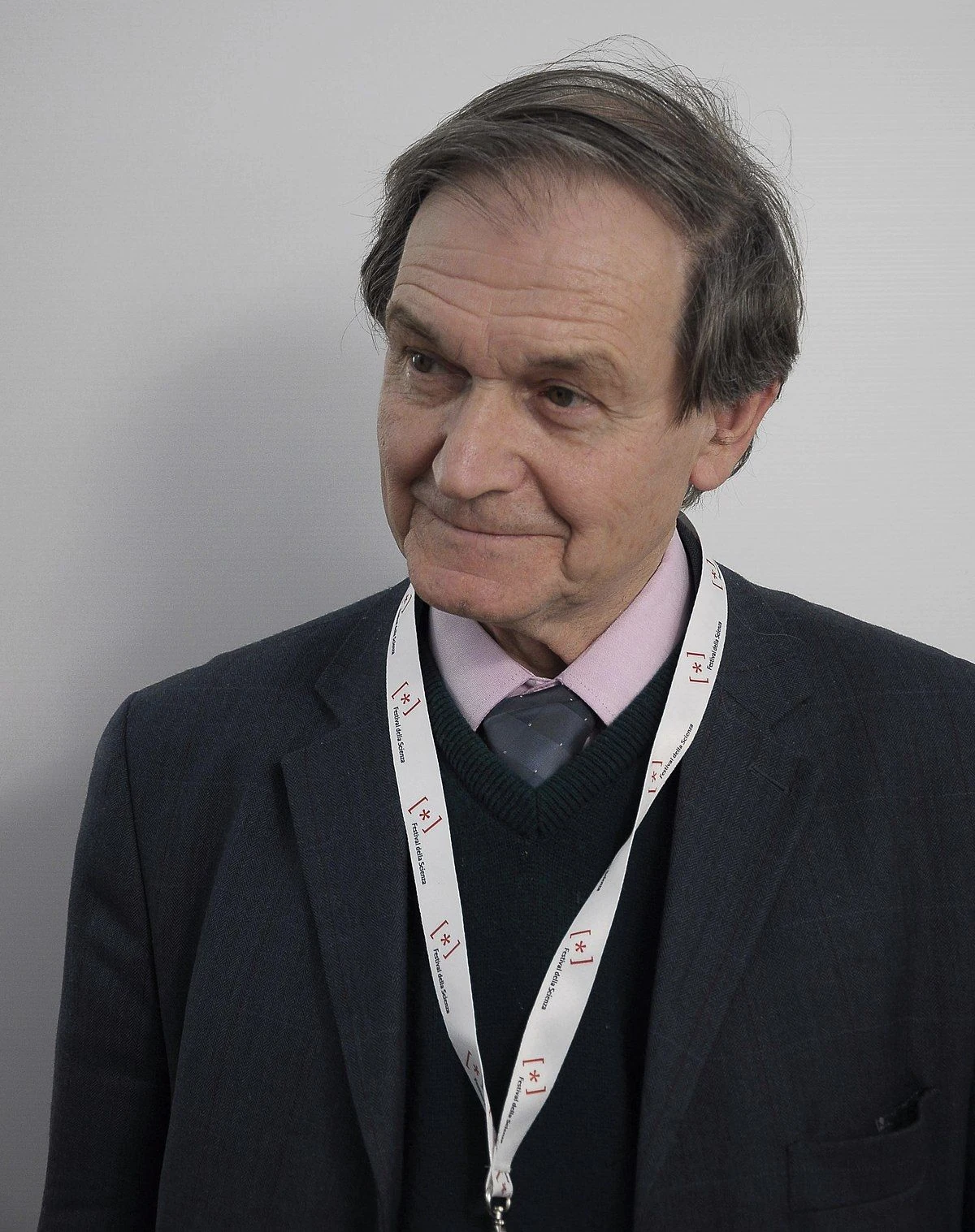
Sir Roger Penrose’s work changed how physicists reason about gravity. Rather than depend on highly symmetrical models that made Einstein’s equations easier to solve, he developed mathematical ways to draw conclusions about spacetime in more general circumstances. That approach underpinned his demonstration that black-hole formation is a robust prediction of general relativity, recognised with half of the 2020 Nobel Prize in Physics. His career also ranged across geometry, cosmology and the mathematical limits of explanations of consciousness.
From Colchester to Cambridge
Penrose was born in Colchester, Essex, on 8 August 1931. His mother, Margaret Leathes, was a physician, and his father, Lionel Penrose, was a psychiatrist and geneticist. During the Second World War, the family spent time in Canada, where Lionel worked in London, Ontario. Penrose later recalled the excitement he found in George Gamow’s Mr Tompkins stories, an early stimulus to his interest in fundamental physics.
He attended University College School in London and studied mathematics at University College London, graduating with first-class honours in 1952. After beginning research with the geometer and astronomer W. V. D. Hodge, Penrose completed a PhD in algebraic geometry at St John’s College, Cambridge, in 1957. His thesis, Tensor Methods in Algebraic Geometry, was supervised by John A. Todd. The distinction matters: Hodge was an academic adviser, but Todd supervised the doctorate.
Penrose’s early mathematical work already showed his appetite for ideas that crossed disciplinary boundaries. In 1955, he reintroduced the generalised matrix inverse now known as the Moore–Penrose inverse. He also worked with his father on the Penrose triangle, an impossible three-dimensional form. Penrose corresponded with the artist M. C. Escher; the exchange ran both ways, with Escher’s work prompting Penrose’s experiments and Penrose’s ideas inspiring Escher’s Waterfall and Ascending and Descending.
Changing the mathematics of gravity
After research and teaching posts in Britain and the United States, Penrose turned increasingly towards mathematical physics. He held positions at Bedford College and King’s College London, and visiting appointments in North America, before becoming a reader at Birkbeck College. There, in 1964, he helped transform the mathematical tools used to study spacetime. His method focused on topology and causal structure rather than requiring the detailed geometry of a system to be solved exactly.
That shift shaped his landmark 1965 paper, “Gravitational Collapse and Space-Time Singularities”. Penrose established a general result: under specified conditions, gravitational collapse leads to a singularity. The point was not simply that a particular idealised star might collapse, but that singularity formation was not an artefact of unusually neat mathematical assumptions. The argument helped make black holes a serious consequence of Einstein’s theory rather than a speculative curiosity.
Penrose’s work with Stephen Hawking extended this line of inquiry. Their singularity theorems addressed both gravitational collapse and the conditions associated with the Big Bang. In 1969, Penrose proposed the cosmic censorship conjecture: roughly, that singularities arising from collapse would be hidden behind an event horizon, leaving an exterior region in which physics remains well behaved. He also described a way that energy might be extracted from a rotating black hole, now called the Penrose process. These ideas remain part of a wider set of open problems in general relativity.
Patterns, diagrams and a wider scientific reach
Penrose’s contributions were not confined to black holes. He developed twistor theory, a mathematical approach to spacetime, and introduced spin networks, later used in work on loop quantum gravity. His causal diagrams—now widely known as Penrose diagrams—make the relationships between regions of spacetime easier to represent. In 1974, he discovered a set of two tiles that can cover a plane without repeating periodically. Such patterns became relevant to the understanding of quasicrystals, whose atomic arrangements do not follow ordinary periodic order.
He also explored cosmology through the Weyl curvature hypothesis, concerning the universe’s early conditions, and later proposed conformal cyclic cosmology. In 2010 he reported possible patterns in cosmic microwave background data that he interpreted as evidence consistent with an earlier universe. This was a proposal, not an established account of the universe’s history. Distinguishing Penrose’s conjectures from settled results is essential to understanding a career in which bold mathematical ideas often opened questions that remained contested.
His books brought difficult subjects to readers beyond specialist physics. The Emperor’s New Mind (1989) argued that known physics could not fully explain consciousness and challenged the idea that human thought could be wholly reproduced by algorithms. He developed those arguments in Shadows of the Mind and, in collaboration with Stuart Hameroff, advanced the Orch-OR hypothesis, which links consciousness to quantum processes in brain cells. The hypothesis has attracted substantial scientific criticism; it should be understood as a disputed proposal, not a scientific consensus. By contrast, The Road to Reality (2004) offers a broad account of mathematical physics, from foundational ideas to contemporary theories.
Recognition and a life in British mathematics
Penrose held academic appointments in Britain and abroad, including at Birkbeck and the University of Oxford. He became Rouse Ball Professor of Mathematics at Oxford and an emeritus fellow of Wadham College. His international career was matched by recognition from British scientific institutions: he was elected a Fellow of the Royal Society in 1972, received its Royal Medal in 1985 and its Copley Medal in 2008, and was knighted for services to science in 1994. In 2000 he was appointed to the Order of Merit.
He shared the 1988 Wolf Prize in Physics with Hawking for their work on singularity theorems. In 2020, he received one half of the Nobel Prize in Physics for the discovery that black-hole formation is a robust prediction of general relativity; the other half was shared by Reinhard Genzel and Andrea Ghez for their discovery of a supermassive compact object at the centre of the Milky Way. Penrose’s books also reached a wide readership: The Emperor’s New Mind received the Royal Society Science Book Prize, and his collected works, published by Oxford University Press in 2010, brought together five decades of research.
Why Sir Roger Penrose deserves a place in British Legacy
Penrose deserves a place in British Legacy because his work shows how mathematical reasoning can alter the questions physics is able to answer. His 1965 result made black-hole formation a robust implication of general relativity under defined conditions, helping move the subject beyond special cases and idealised calculations. The achievement was recognised internationally with the 2020 Nobel Prize, but its British context is equally clear: Penrose studied at University College London and Cambridge, held posts at institutions including Birkbeck and Oxford, and received honours from the Royal Society. His career connects British universities and scientific institutions to a transformation in modern gravitational physics.
That legacy is not limited to a single theorem or prize. Penrose’s tools and ideas—from spacetime diagrams and spin networks to aperiodic tilings—have contributed to fields ranging from relativity to the study of mathematical patterns. His popular books also invited general readers into debates about the laws of physics, mathematics and consciousness, while his more speculative proposals demonstrate the value of distinguishing established results from open questions. The benefit is a model of scientific inquiry that combines technical depth with intellectual reach: precise enough to prove important results, imaginative enough to pose new problems, and broad enough to make abstract mathematics part of public discussion. That is a substantial and specifically evidenced contribution to Britain’s scientific and intellectual history.
Sources
Roger Penrose — Wikipedia, revision 1379276079
Adapted in part from Roger Penrose by Wikipedia contributors, under CC BY-SA 4.0. Text has been edited and combined with the existing article; this adapted text is shared under the same licence. Contributor history.