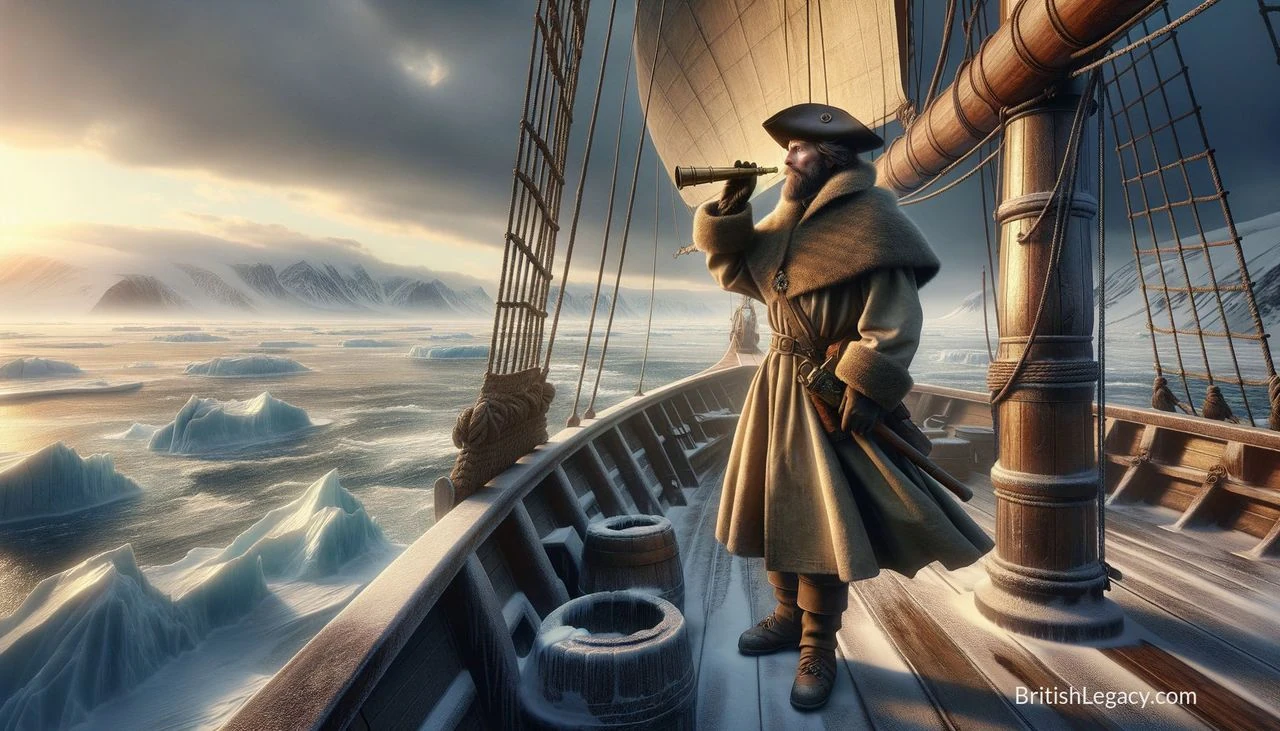
In 1612, Sir Thomas Button sailed from England with two navy ships and a difficult dual purpose: to search for the Northwest Passage and to look for the missing explorer Henry Hudson. The passage remained undiscovered, but Button’s expedition pushed into Hudson Bay, endured a winter at Port Nelson and charted coastlines that helped later explorers make sense of the region. His voyage was not a simple tale of triumph. The ships and men faced Arctic conditions, the Resolution was lost to sea ice, and Button’s later naval career ended in disputes and financial hardship.
A Welsh background and a naval career
Button was born in Wales around 1575, the fourth son of Miles Button of Worlton, Glamorgan, and Margaret, daughter of Edward Lewis. His family had been landowners, with roots in Gloucestershire, since the twelfth century. Around 1595 he married Elizabeth, daughter of Sir Walter Rice of Newton House in Llandeilo. Through that marriage he was connected to Sir Robert Mansell, a prominent naval officer whose patronage supported Button’s career.
The evidence of Button’s early life is limited, but his subsequent service placed him within England’s navy at a time when voyages into northern waters sought both geographical knowledge and access to trade routes. In April 1612, he was given command of the Resolution and the Discovery. The expedition was ordered to seek the Northwest Passage and to search for Henry Hudson, whose fate was unknown after his own voyage. Button sailed from England around the beginning of May.
Winter at Port Nelson
The expedition reached the mouth of a river that Button named Nelson, after the Discovery’s master, who had died. The ships wintered at the place now known as Port Nelson. That pause in the voyage was not incidental: it left the expedition to contend with the severe conditions of the bay before it could continue north the following year.
In 1613, Button resumed the search for a route through the Arctic. Sea ice took the Resolution, but the remaining ship continued north to 65 degrees. Button discovered and named Mansel Island before returning to England in September 1613. The expedition did not find the Northwest Passage or Hudson, yet it added landmarks and observations to European knowledge of the western shore of Hudson Bay.
Button called the region New Wales. The name connected his exploration with his Welsh origins, while the name Nelson commemorated a member of the expedition. Button is credited with exploring and securing the bay’s west coast for England. He and his men were among the first recorded Europeans to explore the area now known as Manitoba. Their landmarks, accounts and notes gave later visitors information on which to build.
What the voyage left behind
Button’s work became part of the geographical record used in subsequent exploration. The first maps of areas near Hudson Bay drew on his expeditions and those of Henry Hudson. Twelve years after Button’s return, Captains Thomas James and Luke Foxe visited the region. Foxe was said to have found a cross erected by Button at Port Nelson and to have named the shores to its north and south New North Wales and New South Wales. These later names demonstrate how Button’s marks on the landscape could outlast the expedition itself.
That legacy should be distinguished from claims that Button’s voyage directly established later commercial institutions or settled the Northwest Passage question. The evidence supports a more specific account: he explored the western coast of Hudson Bay, named places and left records that subsequent explorers could use. The search for the passage continued, while Button’s observations contributed to the growing body of geographical knowledge about the region.
Admiral, knight and a troubled end
After returning to England, Button was appointed Admiral of the Irish Coasts and commanded the Irish Squadron. The Lord Deputy of Ireland knighted him on 30 August 1616. His later duties included dealing with pirates and smugglers at Pwllheli in Cardigan Bay in 1631, a reminder that his service was not confined to distant exploration.
Despite his standing in the navy, Button’s later career was marked by prolonged quarrels with the Admiralty. The account of his life records wrongs on both sides. He became ill, lost his post as Admiral and was left effectively bankrupt. He died in London in April 1634 and was buried at St Margaret’s, Westminster, on 8 April. His wife and five of their seven children survived him. He left no will; his Welsh lands passed to his eldest son, Miles, who had to mortgage them to meet his father’s debts. The contrast between Button’s naval rank and the financial condition of his family gives his story an ending far removed from the uncomplicated triumph often attached to exploration.
Why Sir Thomas Button deserves a place in British Legacy
Sir Thomas Button deserves a place in British Legacy for a defined contribution to the history of exploration: his 1612–13 expedition carried English naval activity into Hudson Bay and left useful geographical records. The voyage did not achieve its central search for the Northwest Passage, nor did it find Henry Hudson. Its importance lies instead in the coastlines explored, the river and island named, and the landmarks that later travellers could recognise. Button’s account and observations became part of the information from which early maps of the area were made.
His story also connects a Welsh background with the maritime history of England. Button named the region New Wales, while his own career moved from command of an Arctic expedition to service as Admiral of the Irish Coasts and, later, work against piracy and smuggling in Cardigan Bay. Remembering him need not turn a difficult voyage into a legend of inevitable national success. The loss of the Resolution, the expedition’s failure to find the passage and the hardships that followed in Button’s career are part of the record. Together, they show how exploration depended on persistence, navigational knowledge and the accumulated work of people whose names remained on maps even when their wider lives were less celebrated.
Sources
Adapted in part from Thomas Button by Wikipedia contributors, under CC BY-SA 4.0. Text has been edited and combined with the existing article; this adapted text is shared under the same licence. Contributor history.