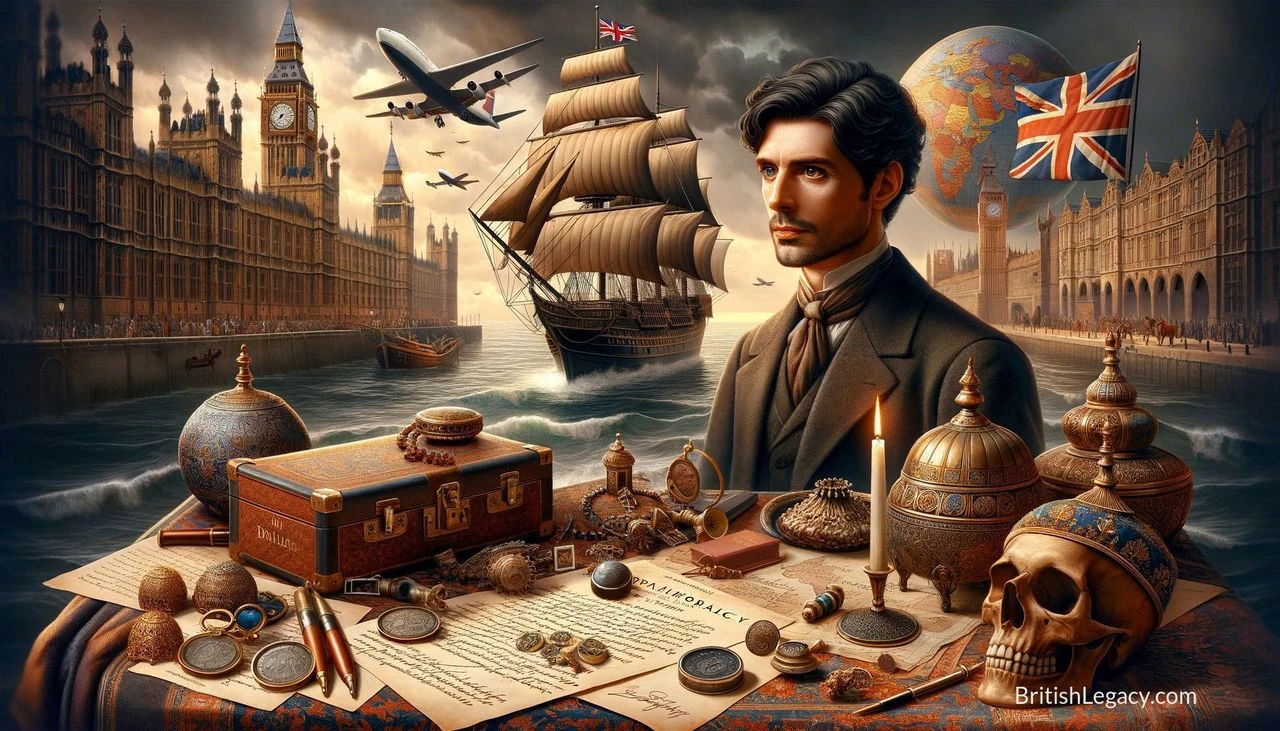
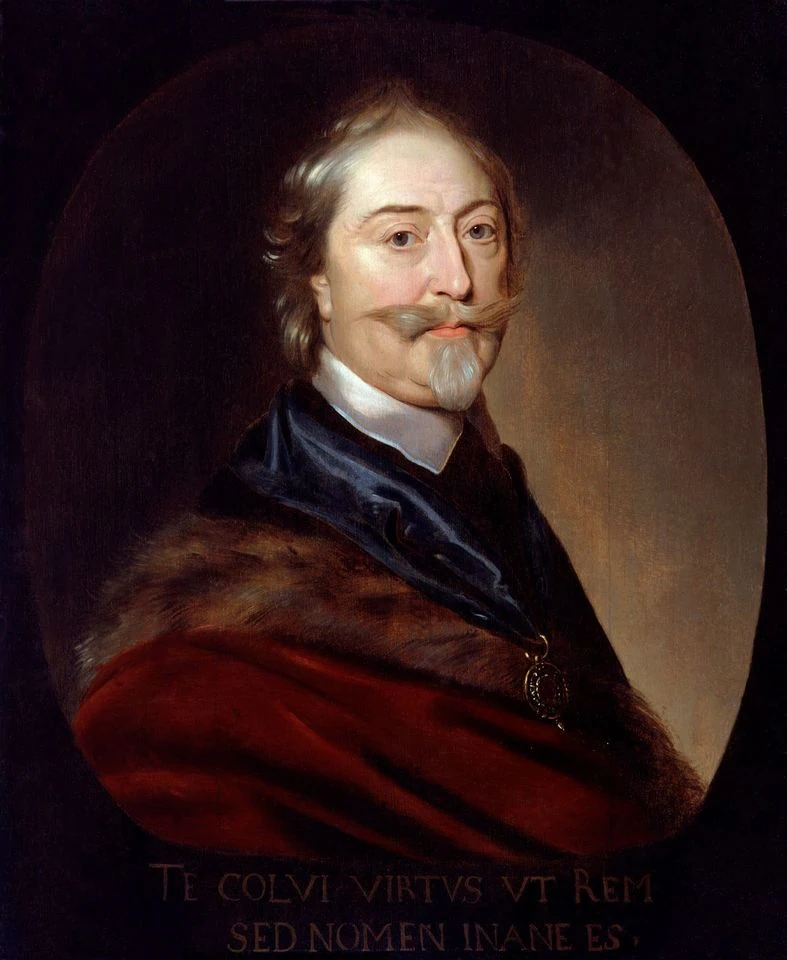
Sir Thomas Roe’s diplomatic career ranged from the court of the Mughal emperor Jahangir to the Ottoman Porte and the negotiations of the Thirty Years’ War. His work helped secure permission for an East India Company factory at Surat, extended privileges for English merchants and brought manuscripts to the Bodleian Library. He was not simply an emissary sent east: Roe also explored the Americas, represented constituencies in Parliament and served as England’s ambassador to the Holy Roman Empire.
An education in service
Roe was born around 1581 at Low Leyton, near Wanstead in Essex. His parents were Sir Robert Rowe and Elinor Jermy. He entered Magdalen College, Oxford, in 1593, aged twelve, and joined Middle Temple in 1597. That year he became an esquire of the body to Elizabeth I. James I knighted him in 1604, and Roe formed connections with the king’s son Henry, Prince of Wales, and Henry’s sister Elizabeth, later Queen of Bohemia. He maintained a correspondence with Elizabeth and championed her cause.
In 1610, Roe travelled to the West Indies on a mission for Prince Henry. He visited Guiana and the Amazon, seeking the fabled gold of El Dorado, but did not find it. The journey was an early stage in a career that would combine travel, intelligence-gathering and service to the English crown.
At Jahangir’s court
The East India Company persuaded James I to send Roe as a royal envoy to the court of the Mughal emperor Jahangir. Roe was elected MP for Tamworth in 1614 and went to India the following year. He resided at Agra for three years, until 1619. The mission’s clearest immediate outcome was permission and protection for an East India Company factory at Surat.
That achievement should not be mistaken for a sweeping grant of commercial privileges. The account of the mission describes no major trading concessions from Jahangir. Instead, Roe’s embassy opened a relationship between the Mughal court and the Company that would develop over time. His detailed journals preserve observations of Jahangir’s reign and the court in which he worked. They offer a record of Roe’s encounters and understanding, rather than proof that England had secured dominance in India.
Roe’s travels also took him along the East African coast and among the islands of the Indian Ocean. At the Comoros in 1615, he met the Somali navigator and pilot Maalim Ibrahim. Ibrahim showed him a map of the Indian Ocean, which Roe described as a high-quality graduated map and used to revise his own cartographic knowledge. Maalim invited him to Mogadishu, but Roe could not leave the fleet bound for the Mughal Empire.
The Ottoman embassy and its wider work
Roe received his diplomatic credentials for the Ottoman Empire in September 1621 and arrived at Constantinople in December. He secured an extension of privileges for English merchants. In 1624 he concluded a treaty with Algiers that secured the release of several hundred English captives. He also used an English subsidy to obtain the support of Transylvanian prince Gabriel Bethlen for a Protestant alliance in Europe and the cause of the Palatinate.
The embassy also brought Roe into contact with the Ecumenical Patriarch of Constantinople, Cyril Lucaris. The Codex Alexandrinus was presented to James I, and Roe gathered manuscripts for the Bodleian Library. In 1628, after his appointment had been revoked the previous year, he presented the library with 29 Greek and other manuscripts. His widow later gave the library a collection of 242 coins in accordance with his wishes. These gifts connected his diplomatic service with the work of preserving and studying texts and objects.
Negotiation, Parliament and scholarship
Roe’s career continued after his Ottoman embassy. In 1629, he undertook a mission to arrange peace between Sweden and Poland. The negotiations enabled Gustavus Adolphus of Sweden to intervene decisively in the Thirty Years’ War on the side of the Protestant German princes. Roe also negotiated treaties with Danzig and Denmark. A gold medal was struck in his honour when he returned to England in 1630 after attending the Diet of Regensburg.
In 1631, Roe sponsored Luke Fox’s Arctic expedition; Roes Welcome Sound was named in his honour. He was appointed Chancellor of the Order of the Garter in 1637 and became a privy councillor in 1640. That year he was elected MP for Oxford University. From 1641 to 1642, he served as England’s ambassador to the Holy Roman Empire, taking part in peace conferences at Hamburg, Regensburg and Vienna. He used his influence to seek the restoration of the Palatinate.
Roe died on 6 November 1644 and was buried at St Mary’s Church in Woodford. His surviving publications and papers reflect the range of his work: they include his journal and correspondence from India, records of negotiations at the Ottoman Porte, a published account concerning the death of Sultan Osman, and writings on European affairs. His journals from the Mughal court remain a valuable historical record of Jahangir’s reign.
Why Sir Thomas Roe deserves a place in British Legacy
Roe deserves a place in British Legacy for the concrete reach and variety of his public service. As an English envoy to Jahangir’s court, he helped obtain permission and protection for an East India Company factory at Surat. That was an important opening, but not a licence to claim that he secured broad trading privileges or single-handedly established British power in India. His Ottoman embassy produced practical results too: an extension of English merchants’ privileges and a treaty with Algiers that secured the release of several hundred captives. In Europe, he worked on treaties and peace negotiations at a time of conflict, including his mission between Sweden and Poland and his later embassy to the Holy Roman Empire.
His legacy also includes the records and collections that outlasted his missions. Roe’s journals preserve an English diplomat’s detailed observations of the Mughal court, while manuscripts he collected enriched the Bodleian Library. Those contributions link diplomacy with the preservation of historical evidence. His career shows the different forms that early modern public service could take: negotiation abroad, representation in Parliament, support for exploration and the gathering of knowledge. Remembering Roe in a British context is not a claim that his work alone made England a global power. It is a way to examine how an English diplomat pursued the interests of the crown and merchants, and how the records and objects he left behind continue to inform historical understanding.
Sources
Adapted in part from Thomas Roe by Wikipedia contributors, under CC BY-SA 4.0. Text has been edited and combined with the existing article; this adapted text is shared under the same licence. Contributor history.