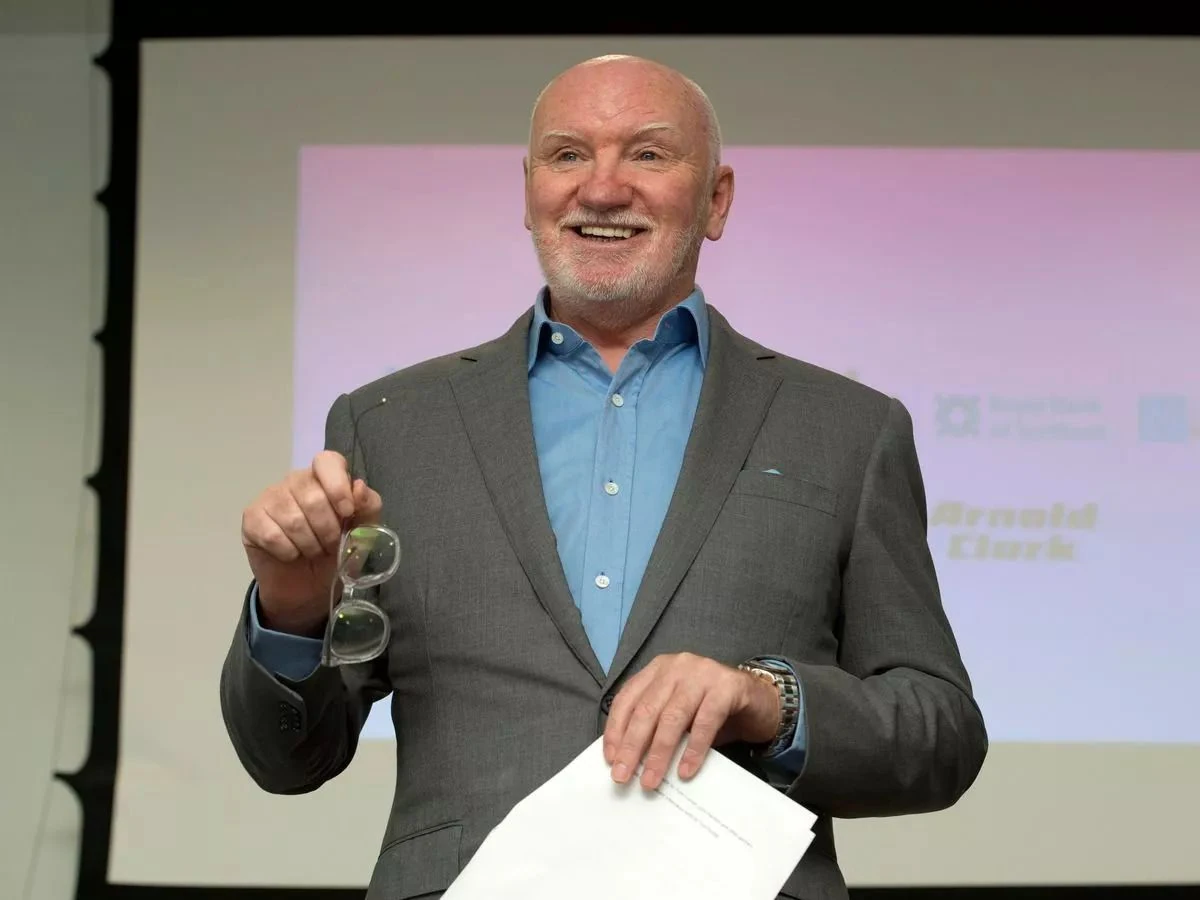
Sir Tom Hunter’s path from selling trainers from the back of a van to funding philanthropic projects began in New Cumnock, the Ayrshire mining village where he grew up. After building Sports Division into a major retailer and selling it in 1998, he turned a substantial part of his attention to how private wealth might support public causes. The Hunter Foundation, established with his wife Marion, has backed educational and entrepreneurial work in Scotland and sustainable development in sub-Saharan Africa.
From New Cumnock to Sports Division
Hunter was born on 6 May 1961 and grew up in New Cumnock. His father, Campbell, was the village grocer. Hunter went on to study at the University of Strathclyde and, after graduating, started his first business. He later said he felt “unemployable”. A £5,000 loan from his father, matched by bank funding, gave him the means to begin selling trainers from a van.
That modest start became Sports Division, which Hunter built into Europe’s largest independent retailer. The business grew with financing from the Royal Bank of Scotland. When Hunter sought finance for a proposed takeover of Olympus Sports, however, the bank declined. Through his friend Sir David Murray, he met Halifax Bank of Scotland governor Gavin Masterton; the relationship with HBoS subsequently helped shape his business activities.
In 1998, Dave Whelan’s JJB Sports made an unsolicited offer for the larger Sports Division. Hunter accepted the £290 million offer, receiving £252 million. The sale marked a change in the scale of the resources available to him, but it was not the end of his business career. It also preceded his work to organise philanthropy through a foundation and investment activity.
Business beyond the sports shops
Hunter’s commercial interests extended into property and private equity. HBoS lending manager Peter Cummings introduced him to property development, leading to stakes in housebuilder Crest Nicholson and retirement-home builder McCarthy & Stone. In 2001, Cummings introduced Hunter to fellow bank client Nick Leslau. Through Leslau’s Prestbury Investment Holdings, Hunter became involved in property portfolios that included Travelodge hotels, licensed premises and Merlin Entertainments attractions such as Alton Towers.
In March 2001, Hunter became a founding partner of West Coast Capital, the Hunter family’s private-equity arm. It invested in businesses across retail and other sectors, including USC, Office, D2, Qube and British Home Stores, as well as Wyevale Garden Centres. The firm invested in more than 50 companies at its height. Those investments did not all succeed: following the 2008 financial crisis, Hunter sold his stake in Dobbies Garden Centres to Tesco and lost his entire holding in Crest Nicholson, alongside much of his stakes in McCarthy & Stone and Wyevale.
These ventures form part of the context for Hunter’s later approach to giving. He was not simply separating philanthropy from business: his stated model, “venture philanthropy”, used investment pledges to attract additional money and involved him in the strategic delivery of projects. The aim, as he described it, was to make his own funding go further.
A foundation with Scottish and international reach
In 1998, Hunter and his wife Marion established The Hunter Foundation with a £10 million cheque. He had been advised to move to Monaco after the Sports Division sale, but wanted to raise his family in his homeland. His thinking about wealth was also influenced by Andrew Carnegie and The Gospel of Wealth. Hunter later described making money as only “half of the equation”.
After discussions with Vartan Gregorian, then head of the Carnegie Foundation in New York, Hunter set out a cause and a method for the foundation. It has donated more than £50 million to educational and entrepreneurial projects in Scotland and to sustainable development in sub-Saharan Africa. In Africa, the Clinton Hunter Development Initiative brought the foundation into partnership with former US president Bill Clinton. The international work sits alongside the foundation’s Scottish focus, rather than replacing it.
The Hunter Centre for Entrepreneurship at the University of Strathclyde is one practical expression of that interest in enterprise. Hunter donated £5 million to establish it. The foundation’s broader work has also included contributions to campaigns and charities: Hunter gave £6 million to the Band Aid appeal and £1 million towards Make Poverty History. In 2013, he received the Carnegie Medal of Philanthropy, which he dedicated to his father, whom he described as his hero and inspiration.
Giving, recognition and public life
Hunter’s charitable giving has included large donations to UK appeals. He gave £4 million to Children in Need, including £3 million for the 2019 Rickshaw Challenge, and donated more than £1 million to the charity in 2018. He also gave £1 million to Comic Relief and matched £1 million raised during Comic Relief Does The Apprentice. In November 2020, he distributed £1 million between the Alzheimer’s Society and Music for Dementia. That gift was inspired by Paul Harvey, a retired teacher with dementia whose piano tune had attracted wide attention and was arranged as a charity single performed by the BBC Philharmonic.
In 2005, Hunter was knighted for services to philanthropy and entrepreneurship in Scotland. He was named Alumnus of the Year by the University of Strathclyde in 1997. His public activity has also touched politics: he donated £100,000 to the Labour Party in 2001 and, in 2014, launched a website intended to provide impartial information on questions surrounding the Scottish independence referendum.
His approach has been described as catalytic: using private funds to encourage other contributions and to influence how projects are delivered, rather than treating philanthropy simply as a general giveaway. That description is consistent with the foundation’s partnerships and with Hunter’s stated emphasis on leverage. It also helps explain why his giving has been associated with both local institutions and international development.
Why Sir Tom Hunter deserves a place in British Legacy
Hunter’s place in British Legacy rests on a specific combination of Scottish enterprise and organised giving. He built Sports Division from a van-based start-up into Europe’s largest independent retailer, then accepted a £290 million offer for the business. The subsequent foundation was not an afterthought in his public story: established in 1998 with his wife, it gave him a structure for directing resources towards causes he considered important. Its work has supported educational and entrepreneurial projects in Scotland, including the Hunter Centre for Entrepreneurship at Strathclyde, as well as sustainable development in sub-Saharan Africa.
The method matters as much as the donations. Hunter’s account of “venture philanthropy” describes an effort to use pledges to bring in further money and to take a strategic role in delivering initiatives. That model connects his commercial experience with a public purpose, while the range of named gifts—from education and development to major charity appeals—shows how the foundation’s priorities have operated alongside individual giving. His career also offers a grounded Scottish story: a business begun in his home village, a decision to raise his family there rather than move abroad, and a lasting commitment to funding work at home and beyond. Those achievements make his contribution relevant to British Legacy without relying on claims of universal impact or unmeasured praise.
Sources
Adapted in part from Tom Hunter by Wikipedia contributors, under CC BY-SA 4.0. Text has been edited and combined with the existing article; this adapted text is shared under the same licence. Contributor history.