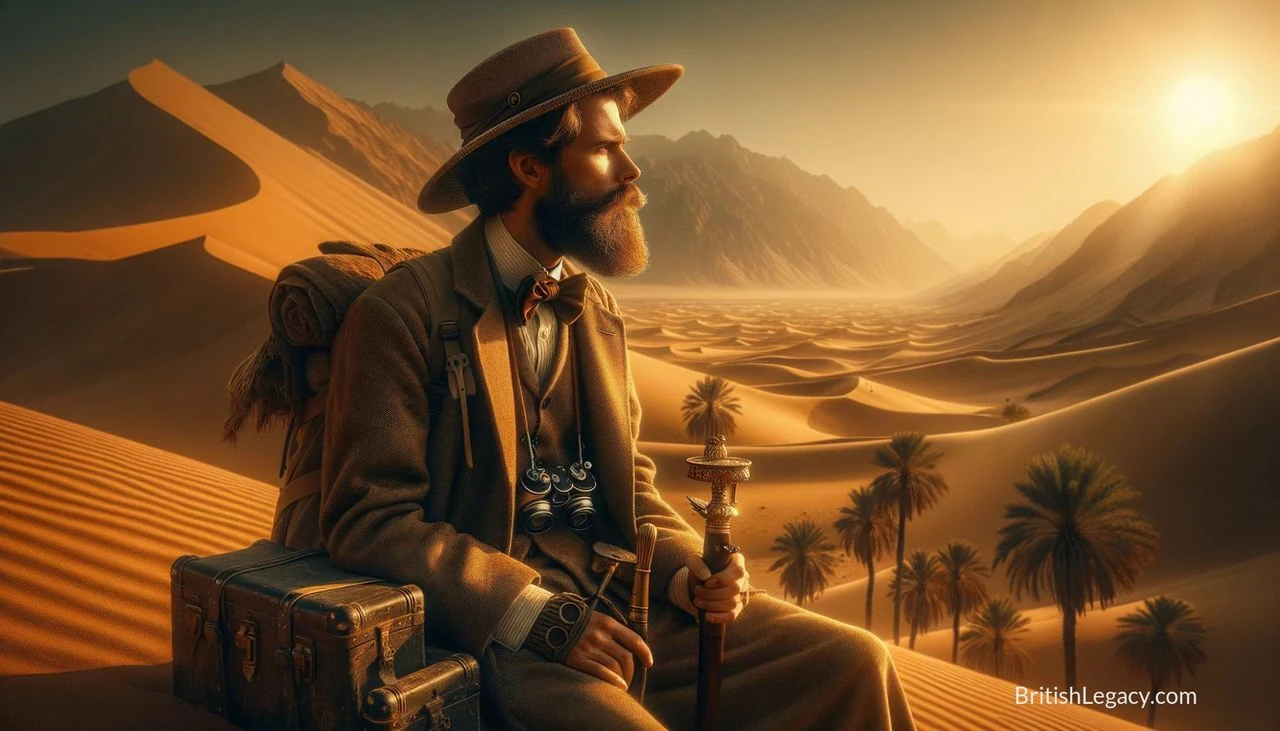
Wilfred Thesiger’s travels took him from Ethiopia, where he was born, to the Arabian Empty Quarter, the marshlands of Iraq and the mountains of Asia. He became best known for journeys across the Rub' al Khali with Bedu companions, and for books that set those travels down in detail. His life also included service in the British Army during the Second World War, work in the Sudan Political Service and a substantial photographic record of the people and places he encountered.
An early life between Ethiopia and Oxford
Thesiger was born in Addis Ababa on 3 June 1910. His father, Wilfred Gilbert Thesiger, was the British consul-general in Ethiopia from 1909 to 1919; his mother was Kathleen Mary Vigors. Thesiger and his younger brother were, for much of their early lives, the only European children in the city. He later recalled the striking scenes around the British Legation during the upheaval of 1916, an experience he connected in his own account with a lasting interest in tradition and established customs.
He attended St Aubyn’s School in Rottingdean, Eton College and Magdalen College, Oxford, where he read history and took a Third. At Oxford he boxed for the university, won a boxing Blue in each of his four years and captained the team in 1933. He was also treasurer of the Oxford University Exploration Club in 1931–32.
In 1930, Emperor Haile Selassie invited him to attend his coronation. Thesiger joined the Order of the Star of Ethiopia. Three years later he led an expedition, partly funded by the Royal Geographical Society, to explore the Awash River. The party travelled into the Aussa Sultanate and visited Lake Abbe. These early expeditions preceded his later fame as a desert traveller, but already joined exploration to extended time in unfamiliar places.
Service in Sudan and the war
From 1935 to 1940, Thesiger served in the Sudan Political Service, working in Darfur and the Upper Nile. At the outbreak of the Second World War, he joined the Sudan Defence Force and helped organise resistance to the Italian occupation of Ethiopia. He received the Distinguished Service Order for capturing Agibar and its garrison of 2,500 Italian soldiers.
He subsequently served with the Special Operations Executive in Syria and the Special Air Service during the North African Campaign, reaching the rank of major. From 1943 to 1945 he was political adviser to Crown Prince Asfa Wossen of Ethiopia. His military and administrative work forms an important part of the chronology: the explorer remembered for travelling by camel in Arabia had also served in several different roles during wartime.
Crossings of the Empty Quarter
In 1945, entomologist O. B. Lean hired Thesiger on behalf of the Middle East Anti Locust Unit to search for locust breeding grounds in southern Arabia. The assignment led to two crossings of the Rub' al Khali, or Empty Quarter, as well as travel in inner Oman. He travelled by camel with Bedu guides through remote country where tribal tensions and local opposition to foreigners could make journeys dangerous.
His first camel expedition began at Salala, Oman, in October 1945 and ended at Tarim, Yemen, in February 1946. The following October, he set out from Salalah in Dhofar with a larger party. After disagreement among the travellers, Thesiger continued with four companions: two members of the Rashid tribe and two of the Bait Kathir. They crossed the sands to the Liwa Oasis in what is now the Emirate of Abu Dhabi, visited Abu Dhabi town, then travelled through Oman and Dhofar, returning to Salalah in February 1947.
A second major crossing began at Manwakh well in Yemen in December 1947. The party was imprisoned briefly at Sulayil after entering territory whose ruler had not agreed to Thesiger’s presence. After their release, they travelled to the Liwa Oasis and Abu Dhabi town, arriving in March 1948. In April, Thesiger visited Buraimi Oasis, where the Iraq Petroleum Company held an oil concession through an associate company. He opposed oil exploration because he believed it would damage Bedu life. Yet financing his expeditions led him to accept money from the oil company in exchange for information gathered on his travels—a tension that complicates any simple account of his position.
Books, photographs and later journeys
Arabian Sands, published in 1959, recounts Thesiger’s travels in the Empty Quarter between 1945 and 1950 and describes a way of life he saw as vanishing. The Marsh Arabs (1964) records his time among the Madan, the indigenous people of the marshlands of southern Iraq. His writing made these journeys accessible to readers beyond the people who had travelled with him, while preserving his observations in books rather than leaving them only in personal memory.
Thesiger’s travels continued beyond Arabia and Iraq. He went to Iran, Kurdistan, French West Africa and Pakistan, and lived for many years in northern Kenya. His 1998 memoir, Among the Mountains, draws on journeys through Afghanistan and northern Pakistan. He also took photographs throughout his travels and donated a collection of 38,000 negatives to the Pitt Rivers Museum in Oxford.
He returned to England in the 1990s. His honours included the Royal Geographical Society’s Founder’s Medal in 1948, a CBE in 1968 and a knighthood in the 1995 Birthday Honours. He died in Croydon, London, on 24 August 2003, aged 93.
Why Sir Wilfred Thesiger deserves a place in British Legacy
Thesiger’s British legacy rests on a career that connected exploration, public service, writing and photography. His journeys across the Empty Quarter were not solitary feats: they depended on Bedu guides and companions, including members of the Rashid and Bait Kathir tribes. His books record those travels and the people who made them possible. In Arabian Sands, he documented a way of life he believed was changing; in The Marsh Arabs, he described the Madan communities of southern Iraq. These accounts give readers a record of places and experiences that he encountered at close quarters, rather than a story of geographical achievement alone.
His work also invites a clear-eyed view of exploration. Thesiger objected to oil development because he feared its effects on Bedu life, yet accepted oil-company funding to pay for expeditions. That contradiction helps make his story more instructive than a straightforward celebration of adventure. His photographs, including the 38,000 negatives donated to the Pitt Rivers Museum, extend the record beyond his books. For British Legacy, Thesiger represents a particular strand of the country’s history: a British-born traveller whose work depended on local knowledge, whose observations reached a wide readership, and whose record can be read alongside the complicated circumstances in which it was made.
Sources
Wilfred Thesiger — Wikipedia, revision 1379813182
Adapted in part from Wilfred Thesiger by Wikipedia contributors, under CC BY-SA 4.0. Text has been edited and combined with the existing article; this adapted text is shared under the same licence. Contributor history.