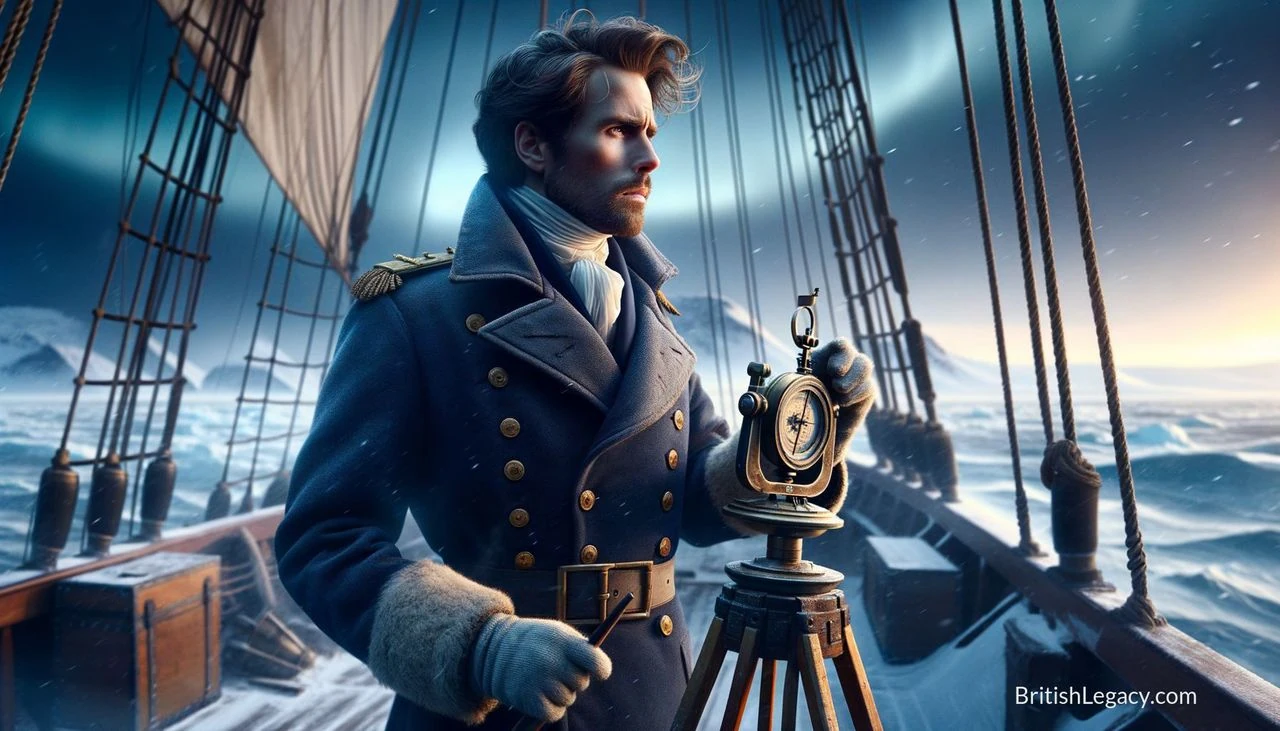
William Edward Parry’s Arctic voyages did not find the Northwest Passage, but they carried British ships deep into an unfamiliar region and brought back detailed observations of its geography, climate and conditions. His 1819 expedition travelled three-quarters of the way across the Canadian Arctic Archipelago. Eight years later, leading an attempt to reach the North Pole, Parry and his men attained a latitude record that stood for 49 years.
A young officer with an interest in observation
Parry was born in Bath on 19 December 1790, the son of Caleb Hillier Parry and Sarah Rigby. He attended King Edward’s School and joined the Royal Navy at 13 as a first-class volunteer. He became a midshipman in 1806 and was promoted to lieutenant in 1810, while serving aboard the frigate Alexander.
For three years, the Alexander helped protect the Spitsbergen whale fishery. Parry used the opportunity to practise astronomical observations at northern latitudes, work that he later presented in a short book, Nautical Astronomy by Night. From 1813 to 1817 he served on the North American Station. In 1814, during the War of 1812, he took part in an operation against American privateering vessels on the Connecticut River.
In 1818 Parry commanded the brig Alexander on an Arctic expedition led by Captain John Ross. The voyage followed the coast of Baffin Bay without making new discoveries. Parry and others disagreed with Ross’s decision to turn back after entering Lancaster Sound. The following year, Parry was given command of a new expedition to continue west.
Through Lancaster Sound
Parry sailed in Hecla, accompanied by the slower Griper, commanded by Matthew Liddon. The ships had been strengthened against ice, and the expedition included the scientist Edward Sabine and the officer Frederick William Beechey. Rather than follow Ross’s route around Baffin Bay, Parry crossed the bay to Lancaster Sound. On 28 July 1819, the ships entered the sound and passed the western limit reached by Ross.
Heavy ice blocked their way south into Prince Regent Inlet. The ships then continued west, passing 110 degrees west longitude—a distance that qualified the expedition for a £5,000 award offered by Parliament. Ice eventually forced them to winter at a place Parry named Winter Harbour, on Melville Island. The ships were trapped there for ten months, through three months of darkness and temperatures that fell to minus 54 degrees Fahrenheit.
The crew kept to a routine of exercise, while the officers staged plays and produced a newspaper. Scurvy appeared during the winter; Parry had brought mustard and cress seeds, which he grew in his cabin. In the summer, he led a party hauling a wooden cart across the island to its northern shore. The ships were finally able to leave the harbour on 1 August 1820, and travelled as far west as 113 degrees 46 minutes west before turning back. They returned to England in October, having lost one man.
The expedition had crossed much of the Canadian Arctic Archipelago, but not the whole distance to the Pacific. Its achievement was nonetheless considerable: no ship travelled so far west again until Edward Belcher’s expedition in 1850. Parry was promoted to commander on his return and elected a Fellow of the Royal Society in 1821. His account, Journal of a Voyage to discover a North-west Passage, appeared the same year.
Further voyages and a northern record
Parry returned to the Arctic in 1821, commanding Fury alongside Hecla. This expedition sought a passage near the north-west end of Hudson Bay. The ships charted coastlines, wintered at Igloolik and investigated the ice-filled Fury and Hecla Strait, but did not find a route through. They returned to Britain in October 1823. Parry had been promoted to post rank during the voyage and, after his return, became acting Hydrographer of the Navy. His account of the expedition was published in 1824.
In 1824 he led a third expedition, again with Hecla and Fury, aiming to make progress through Prince Regent Inlet. Difficult ice delayed the ships, and they wintered at Port Bowen. The following summer, pressure from wind and ice damaged Fury. Attempts to repair the ship failed; its crew transferred to Hecla, which returned to England in October 1825. Parry’s account of the voyage was published the following year.
Parry’s next Arctic undertaking was different: an attempt to reach the North Pole by travelling from the northern coast of Spitsbergen. He married Isabella Louisa Stanley in October 1826, before the expedition. In 1827, he reached 82 degrees 45 minutes north. The record for the farthest north attained by human exploration remained unbeaten until 1876, when it was surpassed by Albert Hastings Markham.
From exploration to naval administration
Parry was knighted in April 1829. From that year until 1834, he served as a commissioner of the Australian Agricultural Company at Tahlee, New South Wales. He then returned to naval work in Britain, becoming comptroller of the Navy’s newly created department of steam machinery. In 1837, he reorganised the packet service after its transfer from the Post Office to the Admiralty: private steamship companies, rather than naval vessels, were contracted to carry mail on regular schedules.
After retiring from active service in 1846, Parry became captain-superintendent of Haslar Hospital. He reached the rank of rear-admiral in 1852 and the following year became a governor of Greenwich Hospital, a post he held until his death. He died after a long illness at Bad Ems, in what was then the Kingdom of Prussia, on 8 July 1855. His body was returned to London for burial.
Maps, records and namesakes
Parry’s expedition journals recorded journeys through Arctic waters and observations made along the way. The 1819–20 voyage also documented an optical phenomenon now known as a Parry arc. The broad legacy of his work is reflected in the places and features named after him, including Parry Sound in Ontario and Parry County in New South Wales. A crater on the Moon also bears his name.
His 1819 wintering place at Winter Harbour is marked by a large sandstone rock on Melville Island. Designated a National Historic Site of Canada in 1930, the rock connects the record of the expedition with the landscape where the ships spent ten months icebound. The surviving traces of Parry’s work are therefore not confined to published journals or geographical names: they include a specific site associated with one of the most demanding periods of his first major voyage.
Why Sir William Edward Parry deserves a place in British Legacy
Parry’s place in British history rests on more than the ambition to find a northern sea route. His expeditions extended geographical knowledge of the Canadian Arctic at a time when navigation there was constrained by ice, darkness and severe cold. In 1819, he led Hecla and Griper beyond the farthest west reached by Ross, crossing much of the Arctic Archipelago and qualifying for Parliament’s £5,000 award. His 1827 attempt towards the North Pole set a farthest-north record that lasted 49 years. Those achievements give his story a clear connection to Britain’s naval and exploratory history, while the charts and observations made during the voyages show the practical value of exploration beyond the search for a passage.
His career also carried those experiences back into British institutions. Elected to the Royal Society, later appointed Hydrographer of the Navy, and eventually responsible for work on steam machinery and the mail-packet service, Parry served in roles that linked naval knowledge with the administration and technology of a changing fleet. His journals, the named Arctic features and the preserved Winter Harbour marker keep the expeditions legible as both achievements and difficult journeys. Remembering Parry in British Legacy recognises a specific contribution: a British officer whose voyages expanded the geographical record, whose northern record endured for decades, and whose later service brought him from exploration into the organisation of naval and public services.
Sources
Edward Parry (Royal Navy officer, born 1790), revision 1373166171 · Edward Parry (Royal Navy officer, born 1790)
Adapted in part from Edward Parry (Royal Navy officer, born 1790) by Wikipedia contributors, under CC BY-SA 4.0. Text has been edited and combined with the existing article; this adapted text is shared under the same licence. Contributor history.