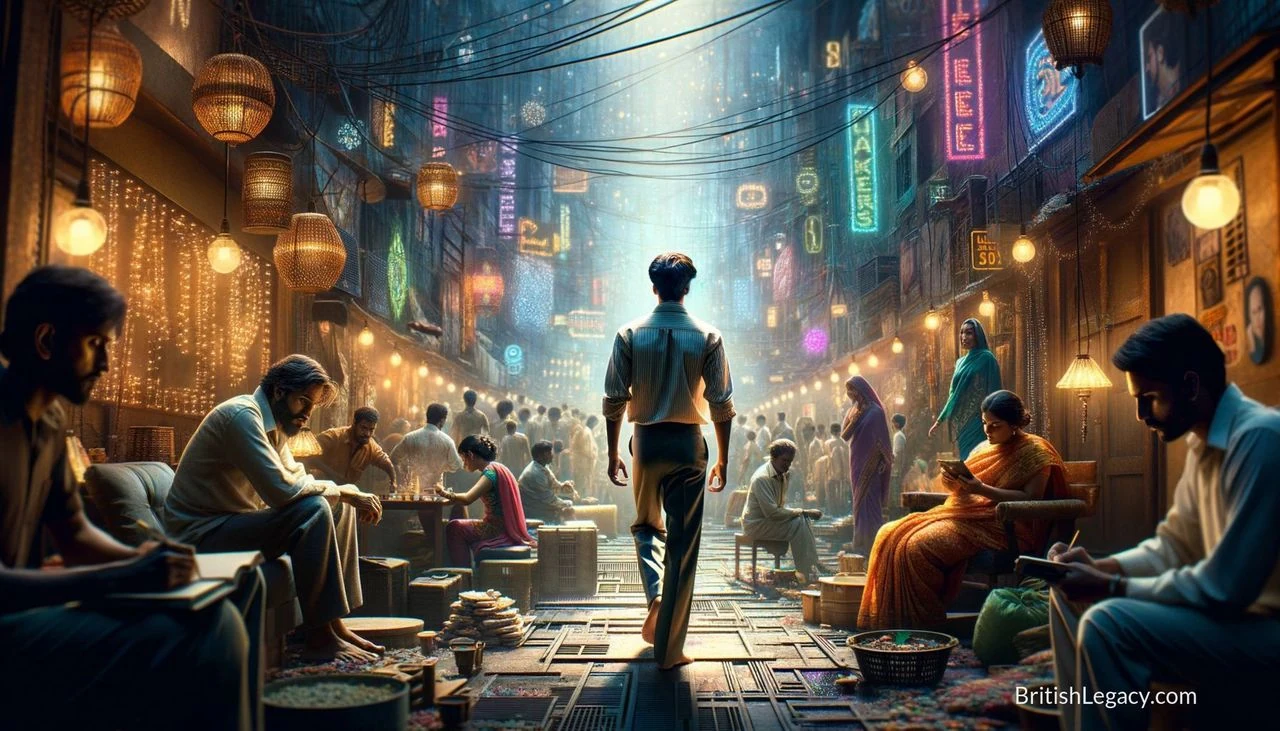
A quiz-show contestant from Mumbai’s Juhu slums is accused of cheating after answering question after question correctly. To explain himself, Jamal Malik recounts the events of his life that gave him each answer. That premise drives Slumdog Millionaire, Danny Boyle’s 2008 British drama: a story built around a television contest, but moving through childhood, separation and the changing city beyond the studio.
Adapted by Simon Beaufoy from Vikas Swarup’s novel Q & A, the film brought together a British production with Indian performers, locations and cinematic influences. Its awards success made it a conspicuous British film of its year. Its depiction of poverty and urban life also drew criticism, particularly from Indian commentators and scholars. Both its achievement and that argument belong to its history.
A life told through the quiz
Jamal Malik, played by Dev Patel in his film debut, is a chaiwala working in a call centre when he appears on Kaun Banega Crorepati, the Hindi-language Indian version of Who Wants to Be a Millionaire?. He answers correctly, wins public attention and becomes a suspect in the eyes of the police. Under questioning, he explains how episodes from his life supplied the answers. The quiz provides the film’s frame; the recollections carry its main story.
As a boy, Jamal grows up alongside his elder brother, Salim, and Latika, a girl they meet after escaping the violence of the Bombay riots. Their paths diverge as they encounter adults who exploit street children and the criminal underworld. Jamal’s memories return to Latika and to the brothers’ different choices. As an adult, he tries to find her again, and enters the quiz show in the hope that she will see him.
The film’s central device connects personal memory to popular entertainment: answers that seem inexplicable to the show’s producers and audience become legible through Jamal’s past. The story moves between the contest, police interrogation and flashbacks, making the game’s escalating questions a structure for a much longer account of childhood and survival.
Making a British production in India
Celador Films and Film4 Productions invited Boyle to read Beaufoy’s screenplay in 2006. He was initially hesitant about making a film centred on Who Wants to Be a Millionaire?, but returned to the project after learning that Beaufoy had written it. Boyle admired the way the screenplay brought together the different storylines in Swarup’s novel. The production was projected to cost $15 million, and Warner Independent Pictures contributed $5 million in exchange for the film’s US rights.
Filming began in November 2007 after the filmmakers travelled to Mumbai and hired local cast and crew. Locations included the city’s slum and shantytown areas. Loveleen Tandan, initially one of the film’s Indian casting directors, proposed using Hindi dialogue and later became co-director. Boyle translated nearly a third of the English dialogue into Hindi. The film therefore drew on an international production process, while its setting and much of its cast were rooted in India.
Anthony Dod Mantle shot the film mainly with a digital camera, the Silicon Imaging SI-2K, using 2K digital video. Its visual approach was part of the film’s fast-moving style, which combines crowded streets, the quiz-show set and the different periods of Jamal’s life. The cast included Patel as Jamal, Freida Pinto as Latika, Madhur Mittal as Salim and Anil Kapoor as host Prem Kumar. Irrfan Khan played the police inspector questioning Jamal.
The film’s influences also reached beyond Swarup’s novel. Boyle described the Hindi crime film Deewaar as important to Indian cinema, and the filmmakers drew on the visual and narrative traditions of Hindi films. Boyle also cited the Mumbai-set films Satya and Company, as well as the police chase in Black Friday, as reference points. The result was not simply a British story transported to India: its production and style engaged with Indian cinema, even as its perspective became a subject of dispute.
Music, release and recognition
A. R. Rahman composed the score, which brings together Indian classical music and influences including R&B, hip hop and house. Rahman won the Academy Award for Best Original Score, and shared the award for Best Original Song for “Jai Ho” with lyricist Gulzar. The soundtrack and its international reach formed a significant part of the film’s reception.
Slumdog Millionaire premiered at the Telluride Film Festival in August 2008, screened at Toronto the following month and later appeared at the London Film Festival. It opened in UK cinemas on 9 January 2009. Its release in India followed on 23 January, with a dubbed Hindi version, Slumdog Crorepati, as well as the original version. These different releases reflected the film’s movement between British, Indian and international audiences.
At the 81st Academy Awards in 2009, the film won eight of its ten nominations, including Best Picture, Best Director for Boyle and Best Adapted Screenplay for Beaufoy. Dod Mantle won for cinematography; Chris Dickens for editing; Rahman for score; and “Jai Ho” won Best Original Song. The film also received seven BAFTA Awards, including Best Film, and four Golden Globes, including Best Drama Film.
Its commercial performance in Britain was strong. The film reached number one at the UK box office in its second weekend, and its earnings rose after the Golden Globes and BAFTA nominations. Following the Academy Awards, it returned to the top of the UK chart. It became the highest-grossing British independent film at the UK box office, according to the film’s reported box-office record. Its recognition was not limited to awards: in 2010, the Independent Film & Television Alliance included it among its 30 most significant independent films of the preceding 30 years.
The argument over its portrayal of India
The film’s acclaim was not universal. Some Indian filmmakers and critics objected to its depiction of poverty, its dramatic violence and the way it presented Mumbai. Adoor Gopalakrishnan called it anti-Indian, while Salman Rushdie criticised its central conceit. Other objections concerned its use of English for characters from the slums and the international attention it received compared with films made by Indian filmmakers.
Academic criticism raised questions about whether the film’s stylised representation of urban poverty could reinforce reductive images of slum life. Other readings placed the story in the context of changing urban aspirations and the service economy. These disagreements matter because the film’s international success did not make its representation of India uncontested. Its British production identity and its Indian subject are both essential to understanding the discussions it provoked.
Why Slumdog Millionaire deserves a place in British Legacy
Slumdog Millionaire deserves a place in British Legacy as a major achievement of British film production with an unmistakably international creative and cultural reach. Boyle directed Beaufoy’s adaptation for Celador Films and Film4 Productions; the film brought British filmmakers and production companies together with Indian cast and crew, Mumbai locations, Hindi dialogue and the work of composer A. R. Rahman. That combination is more specific than a general claim that the film “bridged cultures”: it shows how a British-led production was made through collaboration with artists and institutions in the country where its story is set.
The film’s eight Academy Awards, including Best Picture, and its seven BAFTA wins marked an exceptional level of recognition for a British independent production. Its UK box-office success and international distribution carried that achievement well beyond the awards ceremony. Its legacy is also more complicated than a list of prizes. The questions raised about its representation of poverty, Mumbai and Indian life invite audiences to consider who tells stories, how those stories travel and what is lost when a complex place is seen through a single dramatic lens. Remembering both the film’s craft and the argument around it gives British Legacy a fuller account of its contribution to cinema.
Sources
Slumdog Millionaire (Wikipedia revision 1379601586)
Adapted in part from Slumdog Millionaire by Wikipedia contributors, under CC BY-SA 4.0. Text has been edited and combined with the existing article; this adapted text is shared under the same licence. Contributor history.