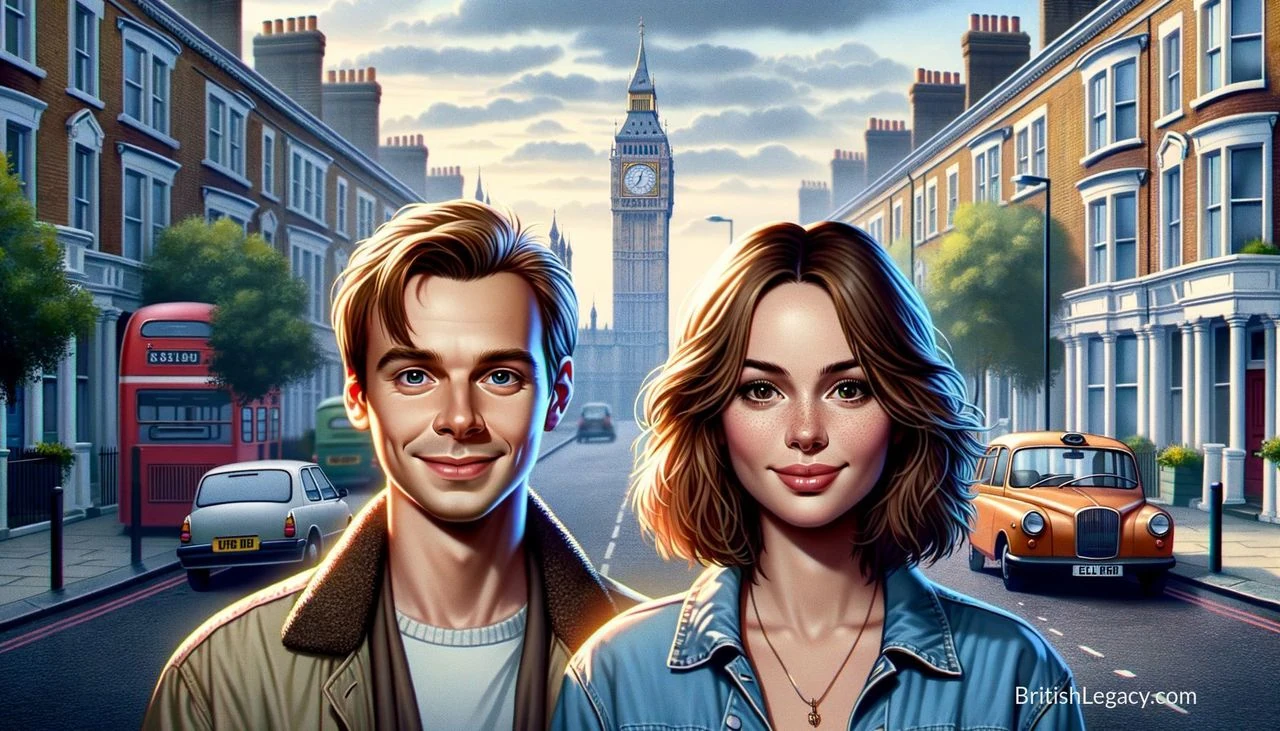
When Daisy Steiner and Tim Bisley meet while looking for somewhere to live, neither is in a position to be choosy. A flat is available, but only to a professional couple. They have barely met; together, they decide to pretend otherwise. That practical deception is the starting point for Spaced, a Channel 4 sitcom about two Londoners in their twenties whose everyday uncertainties are repeatedly refracted through films, comics, television and games.
Created and written by Jessica Stevenson and Simon Pegg, who also play Daisy and Tim, the series ran for two seven-episode series between 1999 and 2001. Edgar Wright directed every episode. Its combination of an ensemble of oddball neighbours, close attention to popular culture and visually inventive comedy made it distinctive without losing sight of the less spectacular business of trying to find work, make friends and work out what to do next.
A flat shared under false pretences
Daisy, an aspiring journalist, and Tim, who wants to draw comics, meet while flat-hunting. Daisy has been living in a squat; Tim has lost his home after splitting up with his girlfriend. The relatively cheap flat is in a building owned by Marsha, who is looking for a professional couple. The new acquaintances pass themselves off as one, although they repeatedly have to explain to other people that they are not actually together.
The pretence gives the sitcom its durable tension: Daisy and Tim share a home and a growing friendship, while Marsha believes their relationship is real. Affection, embarrassment and romantic possibility accumulate alongside the more immediate problems of finding work and occupying their time. The building also brings them into contact with Brian Topp, an eccentric conceptual artist living downstairs, Daisy’s friend Twist Morgan and Tim’s friend Mike Watt. After Marsha’s daughter Amber leaves home, Mike becomes a lodger too.
The supporting cast helps turn the flat into a small social world rather than a simple backdrop. Katy Carmichael plays Twist, Nick Frost plays Mike, Mark Heap is Brian and Julia Deakin is Marsha. Bill Bailey, Peter Serafinowicz and Michael Smiley also appear, as Bilbo, Duane Benzie and Tyres O’Flaherty respectively. The characters’ competing enthusiasms and grievances repeatedly pull Daisy and Tim’s private arrangement into the wider group’s life.
Comedy with a cinematic point of view
Wright’s direction gives the programme a visual rhythm distinct from a conventional studio sitcom. Spaced was shot with a single camera and borrows from the language of cinema: quick cuts, visual jokes and transitions in which one scene changes during a camera pan. Fantasy sequences let characters experience ordinary frustrations as if they were inside the stories and genres they love. The result makes the gap between everyday life and imaginative escape part of the comedy.
Wright cited The Simpsons and The Young Ones among his influences, as well as the dream sequences in The Fall and Rise of Reginald Perrin. The creators pitched the series to London Weekend Television as a mix of The Simpsons, The X-Files and Northern Exposure; the fantasy sequences in Northern Exposure were another influence. These references help explain the programme’s range: a scene can be rooted in an awkward conversation and then shift into a parody of science fiction, horror or action-film conventions.
Popular culture is not simply decoration. Tim’s interest in comics and science fiction, and the characters’ enthusiasm for films, television and games, shape how they interpret the world around them. Spaced draws on horror and science-fiction films, comic books and video games, among other forms. The second-series DVD included an alternative subtitle track called the “Homage-o-meter”, listing references; a later collectors’ box offered a similar track for the first series. That release gives viewers a practical way to follow the show’s dense web of allusions.
The music adds another strand to its atmosphere. Individual episodes featured tracks including Louis Jordan’s “Is You Is or Is You Ain’t My Baby?”, Fuzz Townshend’s “Smash It” and Lemon Jelly’s “The Staunton Lick”. A Guy Pratt remix of the A-Team theme closed “Epiphanies” and became a fan favourite, although it was not commercially released. A soundtrack for the first series accompanied its DVD and videotape release in 2001; a second soundtrack did not follow.
Two series, and the choices that fill them
The first series began on Channel 4 on 24 September 1999 and ran for seven episodes, concluding on 5 November. It introduces the flat-sharing arrangement and develops the characters’ different ambitions and distractions. Tim tries to pursue comic-book work; Daisy’s efforts to write are repeatedly interrupted or deferred. Their friends’ escapades provide a parallel source of disorder, from Mike’s Territorial Army troubles to Brian’s attempts to balance his work and relationship with Twist.
The second series began on 23 February 2001 and finished on 13 April, also after seven episodes. Daisy returns from a trip to Asia and struggles to settle back into daily life; Tim’s frustration with Star Wars: Episode I – The Phantom Menace becomes a running point of comic contention. Both face setbacks at work, while Mike moves into the building and relationships among the group become more strained. In the final episode, Marsha discovers the lie that has sustained Daisy and Tim’s tenancy. Daisy receives an offer of a job in Colwyn Bay, and Marsha decides to sell the house.
The series ends with the consequences of the original bargain, rather than expanding its premise indefinitely. Wright later said there would not be a third series, and Pegg explained in a 2013 interview that the creators could no longer write the characters with the same sense of truth because they were no longer at the same stage of life. The conclusion leaves the two-series story intact: its characters have to face change, even when they would prefer to keep improvising.
Recognition, releases and a proposed remake
Both series were nominated for the BAFTA Television Award for Best Situation Comedy, in 2000 and 2002. Stevenson won the British Comedy Award for Best TV Comedy Actress in 1999 and 2001. Pegg was nominated for Best Male Comedy Newcomer in 1999, and the programme was nominated for Best TV Sitcom that year. The second series received a nomination for the International Emmy Award for Popular Arts in 2001.
The two series were released separately on DVD in the UK and later collected in a box set with a bonus disc. Its additional material included the feature-length behind-the-scenes documentary Skip to the End and a music video by Osymyso. Music rights delayed a North American DVD release. A Region 1 edition was eventually announced in 2008, with commentaries featuring Wright, Pegg and Stevenson, as well as invited guests, alongside outtakes and other supplementary material.
A US remake was announced by Fox in 2007, but the proposed pilot was abandoned the following year after negative reactions from the original’s creators and fans. Wright objected that he, Pegg and Stevenson had not been consulted, despite their names being used in announcements. He also argued that the original’s appeal depended on London characters acting out ideas from American films in a less glamorous setting. The proposed version did not proceed.
Why Spaced deserves a place in British Legacy
Spaced deserves a place in British Legacy for the way it made a recognisable British setting and the habits of its characters inseparable from its comedy. Daisy and Tim are not presented as heroic professionals with their lives already organised: they are flat-hunters who pretend to be a couple because the rent and the rules leave them few options. Their uncertain work, friendships and domestic arrangements supply the substance of the story. The series’ London flat and its eccentric occupants give those concerns a specific social setting, while its comic transformations show how popular culture can become a language for navigating an ordinary day.
Its achievement also rests on a clear creative partnership. Stevenson and Pegg created and wrote the programme as well as playing its central characters; Wright’s single-camera direction gave their scripts a visual energy that made film references part of the storytelling rather than an ornamental list of jokes. The show’s recognisable technique, documented influences and careful accumulation of references give viewers reasons to return and notice more. Its two series also remain a complete story: the false couple’s arrangement eventually comes to light, and the characters must face what comes next. Together, the writing, performance and direction make Spaced a particular contribution to British television comedy, not simply a launch point for later careers or a nostalgic portrait of youth.
Sources
Spaced — Wikipedia revision 1371158737
Adapted in part from Spaced by Wikipedia contributors, under CC BY-SA 4.0. Text has been edited and combined with the existing article; this adapted text is shared under the same licence. Contributor history.