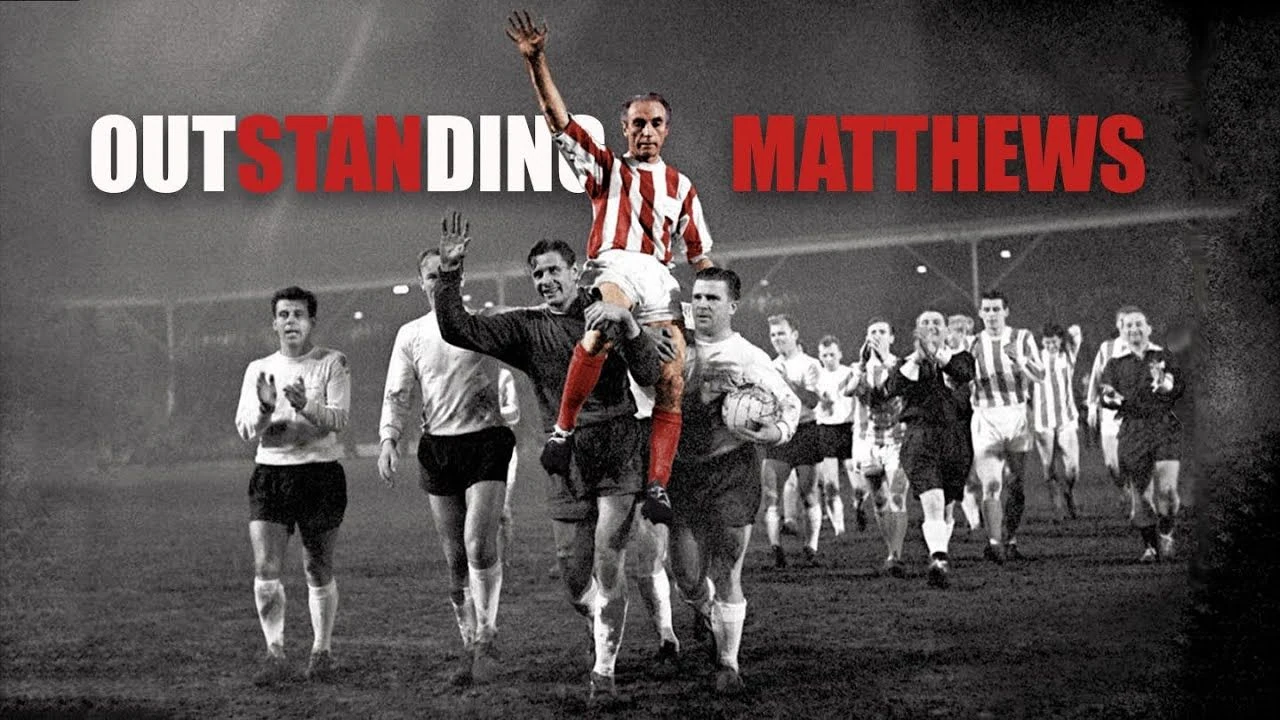
Stanley Matthews made a career of confronting defenders with a simple problem: how to stop a winger who could change direction at speed and keep the ball close. His dribbling made him one of English football’s defining players, but his story is larger than a collection of dazzling runs. Across spells at Stoke City and Blackpool, he played through war, won the FA Cup at 38 and remained in the Football League until he was 50. He was still an active professional when he was knighted in 1965.
A boy from Hanley finds his position
Matthews was born in Hanley, Stoke-on-Trent, on 1 February 1915, the third of four sons of Jack Matthews, a local boxer. His father took him to Stoke City’s Victoria Ground for a boys’ race when Stanley was six; he won it. Matthews later recalled practising his dribbling around chairs in the backyard. He attended Wellington Road School and, after deciding at 13 that he wanted to be a footballer, played for England Schoolboys against Wales in 1929.
Stoke took him on as an office boy on his 15th birthday in 1930. He played in the reserves before signing professionally on his 17th birthday. His first-team debut came against Bury on 19 March 1932. The next season, Stoke won the Second Division title, and Matthews began to establish himself as an outside right: a position from which his changes of pace and close control could unsettle full-backs.
He developed his technique through trial and adjustment. Rather than wait for a defender to commit, he learnt to draw the player in and swerve past. Later, as opponents marked him more closely, he dropped deeper to collect the ball and deliver crosses. That change made him less dependent on scoring himself and more useful to the team. Stoke reached fourth place in the First Division in 1935–36 and again in 1946–47, the club’s best league finish in the account of his career.
War, Blackpool and the Wembley final
The Second World War interrupted Matthews’s professional career. He served in the Royal Air Force, based near Blackpool, and played wartime matches for Stoke, Blackpool and other sides. Regular Football League football resumed in 1946. Following a difficult relationship with Stoke’s management, Matthews requested a transfer; the club eventually accepted, and in May 1947 he moved to Blackpool for £11,500.
Under manager Joe Smith, Blackpool gave its forward line licence to play with expression. Matthews joined Stan Mortensen and other attacking players in a side known for its entertaining football. Blackpool reached the FA Cup final in 1948 and 1951, losing both. In 1948, Matthews received the first Football Writers’ Association Footballer of the Year award. His first major club trophy came five years later.
The 1953 final against Bolton Wanderers became known as the “Matthews final”. Blackpool were 3–1 behind with 35 minutes remaining, then came back to win 4–3. Mortensen scored a hat-trick, and Matthews played a leading part in the recovery. He later resisted the idea that the victory belonged to him alone, giving credit to his teammates, particularly Mortensen. At 38, he had finally won the FA Cup promised to him by his father, who had died in 1945.
Matthews remained with Blackpool until 1961. He was named the inaugural European Footballer of the Year in 1956, narrowly beating Alfredo Di Stéfano in the vote. His international career also extended across decades: he won 54 caps for England between 1934 and 1957, played at the 1950 and 1954 World Cups, and was part of nine British Home Championship-winning sides. At 42 years and 104 days, he became England’s oldest player when he appeared against Denmark in 1957.
Back to Stoke, still playing at 50
Matthews returned to Stoke in 1961. The club were then in the Second Division, and his arrival drew a crowd of 35,974 for his first home appearance. Stoke won the Second Division title in 1962–63, with Matthews contributing during the promotion campaign. That year, 15 years after first receiving it, he became the oldest winner of the Football Writers’ Association award.
His final Football League appearance came for Stoke against Fulham on 6 February 1965, five days after his 50th birthday. It ended a professional career of 35 years. He was knighted on 1 January 1965, becoming the only footballer to receive a knighthood while still playing. The combination of longevity and top-level performance is remarkable, but it should not obscure the skill that made him famous: he adapted his game as age and opposition changed the demands on him.
Matthews had already taken on work beyond playing. He became general manager at Port Vale in 1965, initially working with his friend Jackie Mudie to find young players. The club’s financial difficulties and his unsuccessful period in charge left him disillusioned with management in English football. He later spent summers coaching abroad, including in Africa. In 1975, in apartheid South Africa, he formed a team of black schoolboys in Soweto, known as Stan’s Men, and helped arrange a tour of Brazil.
Recognition, home and remembrance
Matthews’s influence can be traced in football honours and in the places that remember him. He was an inaugural inductee of the English Football Hall of Fame in 2002. Blackpool named its West Stand after him; Stoke-on-Trent has a statue in Hanley, and another stands outside Stoke City’s stadium. The National Football Museum holds the Stanley Matthews Collection. These are not simply markers of a famous name: they link his career to the clubs and city whose supporters watched him play.
He returned to Stoke-on-Trent with his wife Mila in 1989 and later served as president of Stoke City and honorary vice-president of Blackpool. Matthews died on 23 February 2000, aged 85, after a fall at his holiday home in Tenerife. His funeral took place in Stoke, and his ashes were buried beneath the centre circle of Stoke City’s stadium. More than 100,000 people lined the streets of Stoke-on-Trent to pay tribute.
Why Stanley Matthews deserves a place in British Legacy
Matthews deserves a place in British Legacy because his career captures both the artistry and the changing conditions of professional football in Britain. At Stoke, Blackpool and again at Stoke, he made the outside-right position a platform for invention: draw in the defender, beat him with a swerve or a change of pace, then cross for a teammate. When opponents adapted, he changed his own approach, dropping deeper and creating chances rather than chasing goals. The 1953 FA Cup final is the best-known example of his influence, but it belongs within a much longer record that includes two Second Division titles, two Football Writers’ Association awards and the inaugural Ballon d’Or.
His achievement was not confined to the English game. Matthews represented England for 23 years, played in two World Cups and later used his reputation to coach abroad. His work with young players in Africa, and the Soweto team he formed during apartheid, connected football with opportunity across racial barriers. Back home, his story remains physically present in Stoke-on-Trent and at the clubs he served, from the statues and museum collection to the ashes beneath Stoke City’s centre circle. Together, his technical influence, sustained playing career and practical contribution to young footballers give his legacy substance beyond the familiar nickname of “Wizard of the Dribble”.
Sources
Adapted in part from Stanley Matthews by Wikipedia contributors, under CC BY-SA 4.0. Text has been edited and combined with the existing article; this adapted text is shared under the same licence. Contributor history.